
Writer as Oracle
Who is the author of the story we are all living? My impressions of Lavinia by Ursula Le Guin
Lavinia, is Ursula K. Le Guin’s last novel, written in 2008 when she was 79.
If one is a writer, as they read this novel, they can consider themselves to be sitting at the feet of this literary giant, listening to her musings on writing as an art and practice, the creation of character and stories, and how, in some cases, the characters writers create come alive and begin to have minds and even lives, of their own.
The many lives of a writer’s characters
Lavinia is but an inconsequential character in Italian poet Vergil’s*, the Aeneid. However in Le Guin’s novel, Lavinia is the main character.
The novel is set in the time period before Rome, when it was only beginning to have its first settlements. Lavinia’s father, Latinus, is King of Latium, the region of Italy that eventually became Rome.
In the novel, Lavinia meets the poet (Vergil) who created her. She meets him in Albunea, her family’s personal place of the oracle complete with sulfur springs whose scented vapor many attribute to the powers of oracles in ancient times.
“I was twelve when I first went with my father to Albunea, the sacred forest under the hill, where sulfur springs running out from a high cave fill the shadowy air with an endless, troubled noise and a mist that smells of rotten eggs. There the spirits of the dead are within hearing if you call. In the old days people came to Albunea from all the western lands to consult with the spirits and powers of the place; now many go to the oracle near Tibur, which bears the same name. This lesser Albunea was sacred to my family. When my father was disturbed in his mind, he went there”(26).
Vergil appears to Lavinia at the Sulfur Springs in Albunea as a “wraith” (that is what he calls himself) or shadow — what is currently called a spirit or phantom. This etheric part of him travels to her as his physical body lay dying on a boat trip between Greece and Italy. He tells Lavinia she is but a character he has created and reveals to Lavinia her fate, future and her story.
Lavinia is witty and smart. After Vergil tells her about her future, the poet comments, “you should not be concerned about it. I made it up. I imagined it. A dream within a dream. . . within a dream that has been my life . . . “
To which Lavinia replies, “I am not a dream, and I don’t think I’m dreaming”(39).
“Perhaps I did not do you justice, Lavinia,”(40) Vergil later remarks.
It’s OK Vergil, Le Guin fixed that for you.
At the end of the novel Lavinia laments:
“I was fated, it seems, to live among people who suffered beyond measure from grief, who were driven mad by it. Though I suffered grief, I was doomed to sanity. This was no doing of the poet’s. I know that he gave me nothing but modest blushes, and no character at all…In truth he gave me nothing but a name, and I have filled it with myself. Yet without him would I even have name? I have never blamed him. Even a poet cannot get everything right.
It is strange though, that he gave me no voice. I never spoke to him till we met that night by the altar under the oaks. Where is my voice from, I wonder?”(262).
Where indeed? And what a sly and sneaky little trick Le Guin plays as she plants this line near the end of the novel.
Writer as Oracle
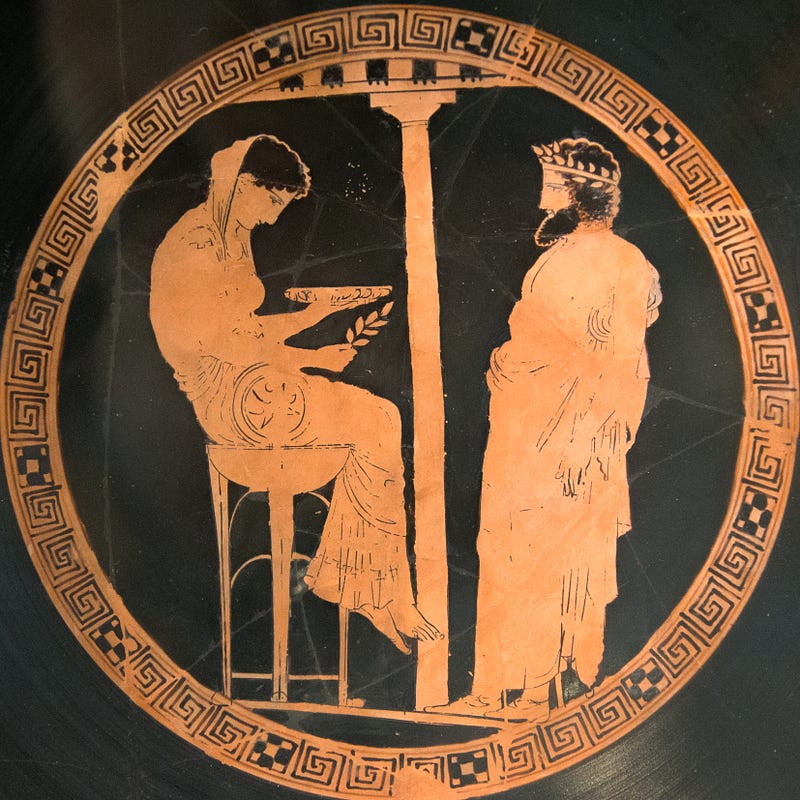
Throughout the novel Lavinia, Le Guin pulls on the oracular tradition that is woven through the Greek and European classics as well as history. In the ancient world, oracles (seers, foretellers, prophetesses) were consulted and their predictions often changed the course of history. In epic poems, oracles and oracular predictions drive the plot and trajectory of the poem. In Lavinia, Le Guin focuses on the decisions made by local and tribal kings based on oracular consultation as a plot device as well.
In Lavinia, no one questions a king if they say that the decision they are making and therefore decreeing for their people came from the oracle because to go against the oracle puts your people in danger. Bad things happen when one disobeys the oracle.
Lavinia is told by the Vergil not to worry, she will not have to marry, Turnus — the man she is dreading — because her father will receive oracle from his ancestors in Albunea that she must marry the foreigner (Aeneas).
Indeed in the novel Lavinia, such an event occurs and Lavinia is released from marrying the man she detests.
When the father, who is king, tells the people his decision about who his daughter shall marry, a war breaks out because Turnus, the man who wanted to marry Lavinia will not accept it. Of course, Lavinia marries Aeneas after Turnus dies in battle because it is written.
In Lavinia, Le Guin plays a clever trick in that she has the poet serve as the oracle and in this twist, tosses out this question to the reader: inside whose story are we living? Who is writing our story?
Is the creator of the universe a writer, a poet? If so, when we hear from the oracle, is it the voice of that poet we are hearing and following — the one who has written our story?
This is a musing and playful twist that Le Guin throws in for the literary types to catch and muse on as well. And for a woman who created so many worlds and characters, a sly and sweet nod to herself.
When Lavinia first meets Vergil in the place of the oracle and asks him who or what he is, he replies:
“I am a poet, Lavinia,” I liked the sound of the word, but he saw I did not know it. “A vates,” he said. I knew that word of course: foreteller, soothsayer. It went with his being part Etruscan, and with the knowledge he seemed to have of what had not happened yet”(43).
At the end of the novel (which is the rewritten end of Vergil’s epic poem), after Aeneas dies, Lavinia retreats to the forest, to Albunea, to save her son from a fate she does not wish for him.
Lavinia is no fool. While there she asks for help from the oracle and receives an answer.
She is told to bring her son up in the forest, or that she did. She returns to her village to alert them that she has received oracle telling her to retreat to the forest with her son. She tells her people it is the father of Aeneas, Anchises, who gave her this oracle. Later, she admits to us, the readers, it was really the poet.
“But as I said it I knew that it was not true. Aeneas had not been there with me as a man in the flesh, nor, had Anchises spoken. It was the poet who spoke. It was all the words of the poet, the words of the maker, the foreteller, the truth teller: nothing more, nothing less. But was I myself any more, or less, than that?
And this was nothing I could say to any living soul, or ever did, till now”(256).
None of us really know the origins of this universe and the stories we are playing out, but we do know that it often feels as though it was and is pre-written. Two things we can be sure of according to Le Guin:
- The creator of the universe loves stories
- He/She/ They are intensely interested in the webbed and connected tapestry of all stories through time.
©Theresa C. Dintino
*Le Guin uses this form of spelling for Vergil so I follow suit. Alternative spelling is Virgil.
Works Cited Le Guin, Ursula K. Lavinia. Houghton Mifflin Harcourt , Boston 2008.


