
Ursula K. Le Guin’s Advice To Me On Writing
“Write your truth”
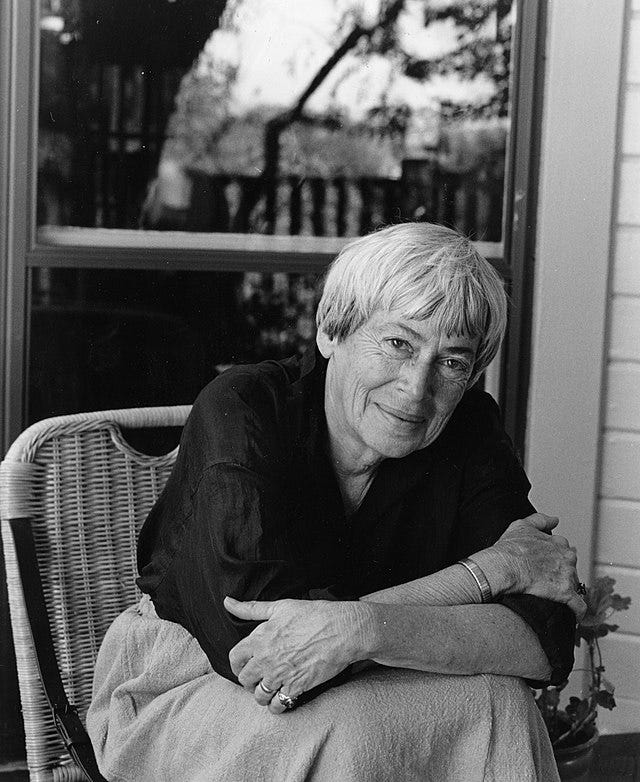
When I was in my late twenties, there was one essay I read in the New York Times Book Review that moved me so deeply that I immediately signed up for a summer writing workshop where the writer of the essay was teaching. It was not like me to go to writing workshops anymore at that age. I was in complete burnout with the workshop culture from my college writing program and the many writing workshops I had gone to after.
I was what I would call a “beginning writer” at that point, trying to find my authentic voice, in the middle of writing my first book.
But this essay, it rumbled my insides as I read it and made my cry out “Yes,” and “please.” I wanted to learn more from the woman who had written it. That woman was Ursula K. Le Guin. The essay was, The Fisherwoman’s Daughter. It begins like this:
“’So, of course,’ wrote Betty Flanders, pressing her heels, rather deeper in the sand, there was nothing for it but to leave.’
That is the first sentence of Virginia Woolf’s Jacob’s Room. It is a woman writing. Sitting on the sand by the sea, writing. It’s only Betty Flanders, and she’s only writing a letter. But first sentences are doors to worlds. This world of Jacob’s room, so strangely empty at the end of the book when the mother stands in it holding out a pair of her son’s old shoes and saying, “What am I to do with these?” — this is a world in which the first thing one sees is a woman, a mother of children, writing.
On the shore, by the sea, outdoors, is that where women write? Not at a desk, in a writing room? Where does a woman write, what does she look like writing, what is my image, your image, of a woman writing?”(213).
Written in 1988, Le Guin tackles the questions of women and writing, the lack of women represented as writers in fiction, how women have written through history with all the other responsibilities constantly tugging at them, women writers and motherhood, the books vs. babies myth, women allowing themselves the full breadth and depth of their imaginations and women’s realities as represented in art — all topics still relevant today.
Women have written at kitchen tables, between making dinner and lunch, with their children running about (Harriet Beecher Stowe), hidden their works on writing tables under other, more acceptable, “ladies papers” such as letters and invitations (Jane Austen), had their work trivialized by their family even though they have become famous for it (Louisa May Alcott), and written potboilers in the corner in the evening with other women who are chatting while doing their needlework (Oliphant).
Women have felt they needed to choose between writing books or having babies as (they have been told) one would surely kill the other. Women’s realities in literature have been portrayed through the lens of other: husband, lover, son, rather than the woman herself. In 1988 there were very few portrayals of motherhood from the perspective of the mother in literature, especially not writers who were mothers.
When I went to the writing workshop, I was so happy to be in the presence of an elder, a role model. I was so excited to hear more, to talk to her about all these subjects, but, frustratingly, Le Guin did not speak about this in the workshop sessions.
We were a large group who had mostly — except for me, (hungry to hear more from her about women writers, women and writing and get advice how to navigate being a woman and a writer) — come to learn more about the craft of writing and have their writing read and reviewed in a group facilitated by her. Another dull writing workshop is what it, in fact, was.
In our private session, however, I did get to address the issues of the essay with her. She told me that she was so happy for me that I was already identified as a feminist and a writer at such a young age and that I was already, without question, putting those two identities together as a feminist writer.
She said it had taken her a long time to get to that point as a woman and writer and she regretted it. She encouraged me to keep my feminist voice, and pleaded with me to not let anyone talk me out of it. “You will regret it,” she said. “Write the truth. Write your truth.”
This was great encouragement for me at the time. I had often been told the opposite. Why do you have to be so feminist? People don’t like that. Could you write about things that appeal more to people, not this angry feminist stuff?
I always remembered her advice, especially as I moved forward in my writing and took larger and larger risks. For, though I was never going to let go of my feminist voice — the whole reason I wanted to write was to address women’s issues and causes through this vehicle — I trusted her that if I didn’t, I would regret it.
I have to say now, at this point in my life — in my late fifties and having written eight books — though it has not been easy, she was right — I have no regrets. And regret, it seems to me, is the stuff that corrodes away at happiness in later years.
Ursula K. Le Guin (1929–2018) is one of the most prolific writers of our time. She is the author of over twenty-two novels, including EarthSea series of books, The Dispossessed, The Left Hand of Darkness, Lavinia, seven books of poetry, over a hundred short stories, four collections of essays, twelve books for children, and four volumes of translation.
She is also the mother of three children.
© Theresa C. Dintino
Works Cited:
Le Guin, Ursula K. “The Fisherwoman’s Daughter,” Dancing at the Edge of the World: Thoughts on Words, Women, Places, (Grove Press: N.Y., 1989)


