
Little Epiphanies or Virginia Woolf’s “Moments of Being”
Transcending the Self
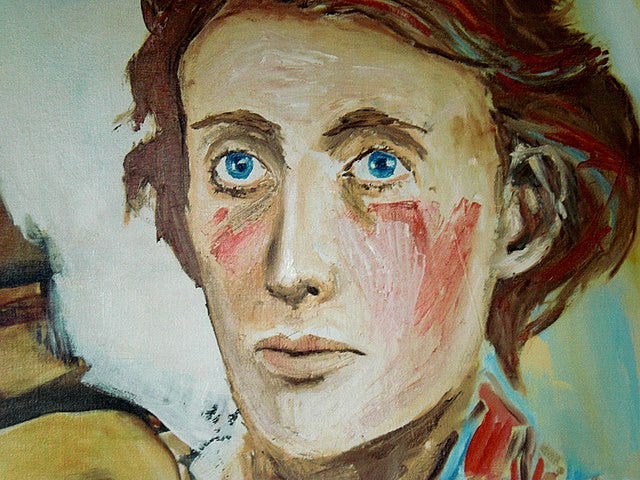
In her autobiographical memoir, “A Sketch of the Past,” Virginia Woolf (1882–1941) writes of what she calls moments of being: moments in our lives that separate themselves out from all the other moments of “non-being.” These moments of being are poignant, powerful and transcendent.
Moments of being can be so strong and meaningful that they remain with us all our lives in the form of memory. Over time they are called up again and again into our consciousness, building complexity and strong association with other moments of being, further ripening with potential for experiences of transcendence as we age.
Moments of being possess a euphoric quality that make us stop and feel or see the unseen part of life, which according to Woolf is actually the main component of life. For Woolf, reality is the hidden substrata or interconnected web below the surface of ordinary daily life. That layer is timeless or time free, holding all past and future at once while simultaneously giving rise to the surface layer or present, which is often locked into linear time. Yet the potent present possesses the potentiality for moments of being which reveal the infinite and remind us of the interconnectedness of all.
Memoir writing pulls at the threads of these remembered and often treasured moments of being and in so doing reveals the contours of life and all its complexity. A memory is often a writer’s best prompt.
In the same essay, Woolf ponders whether these moments of being and the memory associated with them have a life of their own and continue on in the universe once they have occurred. She wonders if one day we will have a way to deliberately access them.
“Is it not possible — I often wonder — that things we have felt with great intensity have an existence independent of our minds; are in fact still in existence? And if so, will it not be possible, in time, that some device will be invented by which we can tap them? I see it — the past — as an avenue lying behind; a long ribbon of scenes, emotions. . . . Instead of remembering here a scene and there a sound, I shall fit a plug into the wall; and listen into the past. I shall turn up August 1890. I feel that strong emotion must leave its trace; and it is only a question of discovering how we can get ourselves again attached to it, so that we shall be able to live our lives through from the start”(67).
What a fabulous visionary she was.
In the introduction of the book, Moments of Being, a collection of Woolf’s essays and autobiographical writing which contains “A Sketch of the Past”, editor Jeanne Shulkind writes:
“Virginia Woolf’s shorthand for the idea of character in the novel — cannot be purposefully separated from the search for reality . . . The questions repeatedly posed by the characters of her novels — What is life? What is love? What is reality? Who are you? Who am I? — lead to this one end, the spiritual continuum which embraces all of life, the vision of reality as a timeless unity which lies beneath the appearance of change, separation and disorder that marks daily life”(18).
As stated earlier, according to Woolf the “timeless unity which lies beneath the appearance of change, separation and disorder” is reality whereas the personal identity is the false reality made up and contributed to by things like social class, daily obligations and other’s expectations of us. These are all rooted in the finite world. Death puts an end to these but not to reality.
Since true reality is timeless, we never really die. But we can and we do exit this false and finite zone, dissolving back into the aliveness just below the surface.
Moments of being remind us of this essential reality. When we experience them, we feel a oneness with all and become excruciatingly aware of the interconnectedness of all, the beauty and perfection held there, and the fragility of life in the physical dimension. Moments of being are achieved spontaneously often through a small or seemingly inconsequential event that suddenly stands out and holds all meaning within it.
Shulkind continues: “This emphasis on the change and continuity of personal identity discussed above applies only to the self that inhabits the finite world of physical and social existence. During moments of being, this self is transcended and the individual consciousness becomes an undifferentiated part of a greater whole. Thus, just as the outer limits of personality are blurred and unstable because of the responsiveness of the self to the forces of the present moment, so the boundaries of the inner self are vague and, at moments, non-existent. For Virginia Woolf, when the self merges with reality, all limits associated with the physical world cease to exist”(18).
Some days are full of moments of being. According to Woolf, these are the good days. Days full of only non-being are less so.
“A great part of every day is not lived consciously. One walks, eats, sees things, deals with what has to be done; the broken vacuum cleaner; ordering dinner; writing orders to Mabel; washing; cooking dinner; bookbinding. When it is a bad day the proportion of non-being is much larger”(70).
As I was working on this piece I experienced what I realize is a consistent and repeated moment of being for me: the sound of a window fan on a summer morning.
I don’t know why but when I hear it I am filled with a moment of being where I am aware of past, present and future intersecting. The moment is unlike others. It is tangibly alive with all time, memory, sensation and a quality of tenderness.
These moments of being with the fan do not happen early in the morning, rather when the sun has already risen quite high in the sky; a 10 or even 11 o’clock sun. There is no rain or cloud or fog, but bright sun outside.
Inside is still cool from the night. The soft hum of the fan yet blows air into the somewhat dark, or dim house. There are no lights on because outside is summer and sunny. There are flowers blooming along with green grass and birds singing and there is the sound of the fan in the window which it is time to shut off.
That moment is the very moment for me.
Palpable.
I stand there and feel it. I feel the summer mornings of my childhood, the summer mornings when I am a young woman, or a new mom, or an older mom and now, 59, Virginia Woolf’s age when she dies. I think of my mother at 59, and her mother, and all the women who think, “Oh, it is time to shut that fan off.”
We shut the fan off and feel the warm air outside the window and the summer day ahead — the summer, another summer, meaning another year has gone by — and become painfully aware of the passage of time.
In “A Sketch of the Past,” Woolf writes: “If life has a base that it stands upon, if it is a bowl that one fills and fills and fills — then my bowl without a doubt stands upon this memory. It is of lying half asleep, half awake, in bed in the nursery at St Ives. It is of hearing the waves breaking, one, two, one, two, behind a yellow blind. It is of hearing the blind draw its little acorn across the floor as the wind blew the blind out. It is of laying and hearing this splash and seeing this light, and feeling, it is almost impossible that I should be here; of feeling the purest ecstasy I can conceive”(64).
I too can count the experience of a window blind moving back and forth from the morning breeze as another one of my moments of being. It’s compelling that both Woolf’s and my moment of being described here include wind (fan) and blinds and morning. There must be something fundamental about the morning light in the summer and the breeze moving through the window curtain/blinds that brings forward a moment of being.
There is plenty of non-being to be lived in this life. Like Woolf, we can lean into the spontaneous and unexpected moments of being, some days possessing more of them than others, and call those good days.
©Theresa C. Dintino 2022
Works cited:
Woolf, Virginia, Jeanne Shulkind, ed. Moments of Being. Harcourt Brace and Co. 1985.