What My Male Characters Have Taught Me
Fiction writing and its lessons
First of all, I never wanted to write a male character. I wanted to write about women. I wanted to tell the lost, forgotten and erased stories of women throughout history. I wanted to give women their voices and allow them to finally be heard.
This was my mission and quest at age 28 as I set out to write my first novel. Enough with stories about men. Hadn’t we all had enough of those? Hadn’t men had the podium for long enough?
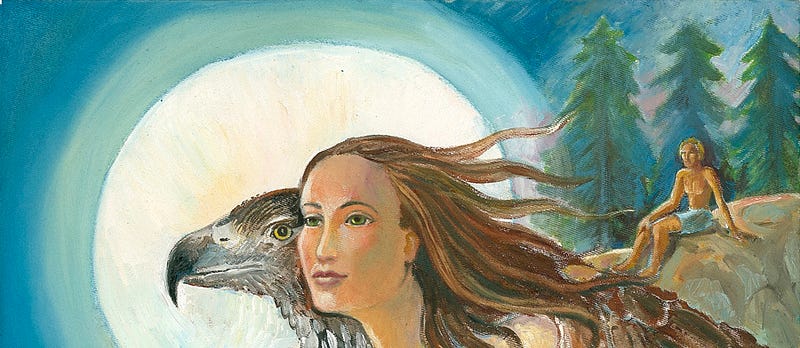
My first novel was to be about a Snake Priestess in Bronze Age Crete growing up in a woman centered, Goddess worshipping culture. I wanted to write about the life of a priestess who worshipped a Goddess and grew up with other women who did the same; a woman who was mentored and guided by strong, independent and powerful Goddess worshipping women. That is the voice, the reality, the story I intended to imagine, amplify and expose.
After years of research, and with the main story line in mind, I sat and began to let the story flow through my pen onto the paper. Almost immediately, a male character showed up. Even worse, he presented himself as a love interest to my strong and powerful priestess.
“Oh no,” I said to this character, “No. No. No. You are not allowed. You are banished. shoo.”
I shook my head, clicked my tongue and swatted him away with my pen. “I am not interested in you. Be gone. I am focusing on Aureillia, my main female character. This is not your story.”
And yet, he kept showing up, inserting himself into scenes and dialogue, until my attempt to ignore and squelch him began to interfere with my creativity.
Finally he asked me, so gently, “Please, won’t you give a listen?”
I compromised, “You can be in my book but you will have no voice. And you will have only a minor role. You are the supporting character in her life. How about that?”
He agreed.
As I let him in, I began to feel his interior, to hear his voice, to recognize something I had never known but perhaps faintly remembered. My interest piqued, I opened my listening further. He revealed himself to be a man worthy of my novel, worthy of Aureillia. He began to teach me what it meant to be a man in such a culture. I was able to see how different that was for him, different than the reality men are living in current western cultures. He showed me his world, his point of view, what the loss of the Goddess had meant for men. I fell in love with him, the main male character of Ode To Minoa and its sequel, Stories They Told Me: Danelle.
Then I set out to write the story of my great-grandmother, a Strega (midwife, healer and wise woman) in Italy who immigrated to New Hampshire at the turn of the last century. I wanted to understand who she was, what a Strega was. I carried out massive amounts of research, sat down to write her story and, just like before, my great-grandfather showed up, wanting half of the story. I rolled my eyes, Not this again. “No. Go away. I want to tell her story.”
He kept coming, asking for me to please listen to his story, tell his story as well, once again wearing me down.
And so I listened to his story of immigrating to the U.S. before my great-grandmother and working to build the railroads and the long days chipping away at rock in the granite quarries. I came to understand how difficult the work had been on his body, the humiliation and shame of being treated poorly and insulted constantly because he didn’t speak English well, his skin was dark and he smelled like garlic and other aromatic herbs that he cooked with.
He was poor. He had nothing. He had come to the U.S. with nothing because they were starving back home. I never really knew what hunger or poverty was until I listened to him. I didn’t understand the amount of shame immigrants carry. He wanted so badly to bring his wife and children, whom he loved, over from Italy. It took him eight long years. It tore him up inside. He showed me that he was a good man, good enough for my great-grandmother. He broke my heart and he broke it open. And I fell in love with the main male character of The Strega and The Dreamer: Marcello.
To listen means to quiet one’s self. To cultivate compassion for someone else’s story, one must open their heart, and so I did that with both of these characters. What was revealed to me in their stories were their own wounds. In Marcello’s case, the ones experienced from living in the patriarchy, in Danelle’s case the ones caused from seeing that future hurtling towards him. They showed me their beauty as well. I am thankful I listened for they both taught me so much.
©Theresa C. Dintino 2022