
Wow. I Just Tested A “Ghost” AI That Can Write Like Famous Dead Authors
He calls it the only “ghostwriting” service to use real ghosts. lol. Here’s how to use this tool to hone your writing chops.
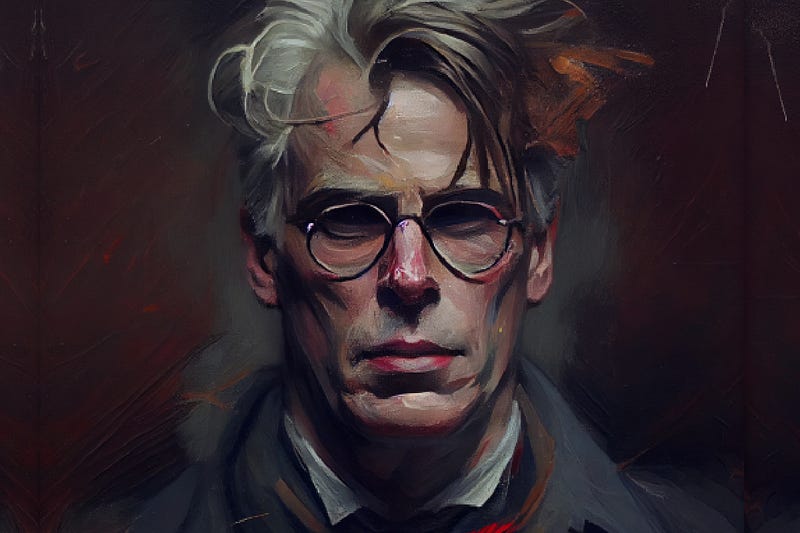
See that pic above? It’s not zombie Stephen King.
It’s William Butler Yeats.
He’s undead, thanks to AI and the wild creativity chops of one guy who has more imagination than most ten people put together.
Yes, I’ll explain.
He’s used GPT tech in a super interesting way.
He’s created a ghost writer. Literally. You can put in a prompt and have the program write in the voice of famous dead writers.
Before you lose your mind about “omg, cheating” let me tell you something you might not know…
Did you know there are 30,000 copies of “Little Women” on Amazon?
Not even kidding. See?
Plus, 6000 copies of Dracula, 5000 copies of Frankenstein, 3000 copies of Jane Eyre, and 2000 copies of Romeo and Juliet. To name a few.
When an author has been dead sufficiently long, their work goes into the public domain. The time frame varies from 70–120 years after death.
Then people can do what they want, even download their entire books from Gutenberg and upload to Amazon. Wham bam, thank you ma’am, book for sale and didn’t have to write a word.
You can bet ChatGPT had a hearty dinner on public domain. But unlike Ghost Writer, most AI doesn’t credit those famous dead writers.
This site does.
So first, it’s not “cheating” to use public domain works.
And second? I’m going to show you something really, really cool that you can do to hone your own writing chops. And I don’t mean copy/paste.
They’re all undead now. See?
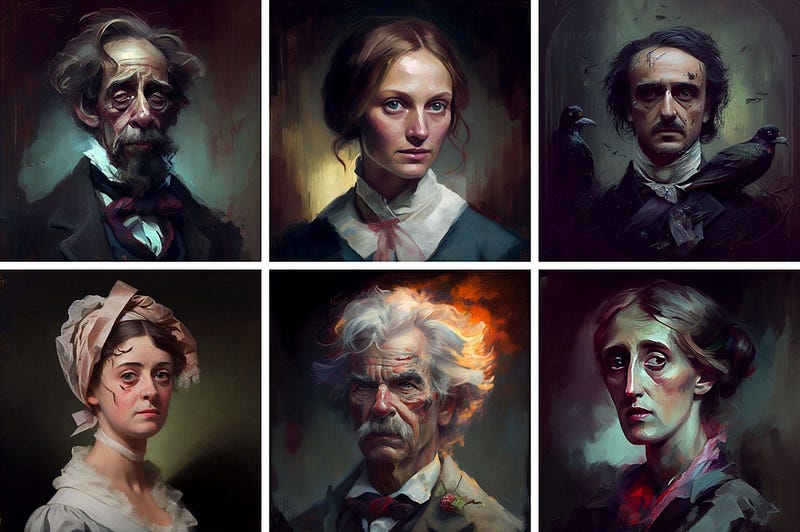
On the site, you get to choose from 44 famous dead writers. Talk about killer artwork, too. This tool is just jam packed with brilliant execution from the artwork to the novel use of AI.
Here’s the list of dead authors that can “write” for you:
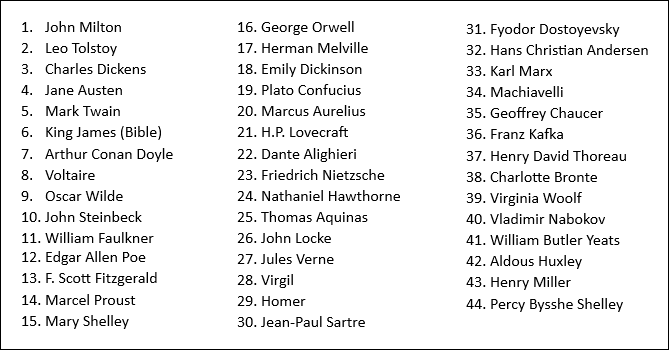
Pretty safe to say all those writers don’t write the same way, yes?
Like — Hans Christian Andersen and Fyodor Dostoyevsky are not the same and neither of them wrote like Virginia Woolf or Jane Austen.
So I did a little test!
I asked the “ghosts” to write a short opening paragraph about a little girl lost in the forest…
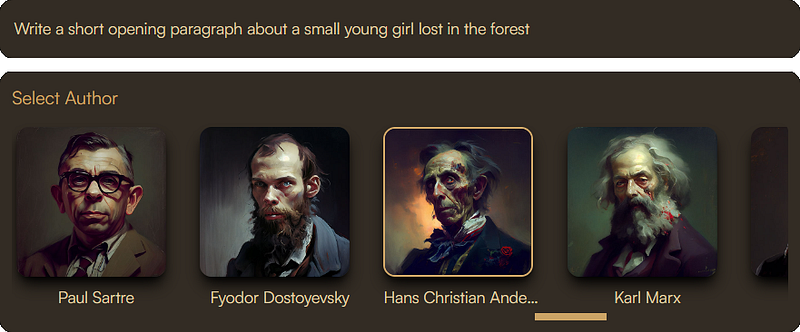
I was curious to compare the different writing styles. I won’t share as many as I tried because hoo boy, I had some fun in there. But here’s a half dozen to show you something really cool...
Then we’re going to talk about your writing chops. Because the point here isn’t to go copy and paste, even though you totally could.
But this is ME, and I’m all about developing your writing chops.
1. I started with Hans Christian Andersen..
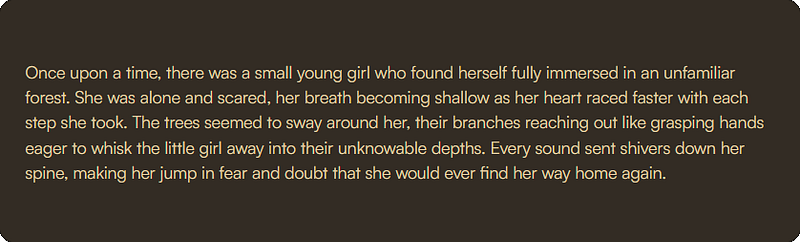
Of couse Hans Christian Andersen would start with Once upon a time. lol. When you read the swaying trees and branches grasping, can’t you almost hear the voice that created the Ugly Ducking, running, afraid?
2. Erm, Dostoyevsky? I said SHORT.
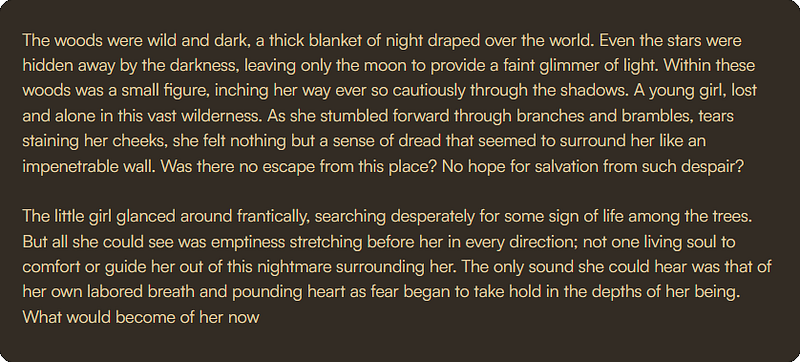
Much easier reading that Crime and Punishment, but still. He’s no Hans Christian Andersen if you hear what I’m saying.
3. Mary Shelley, creator of Frankenstein
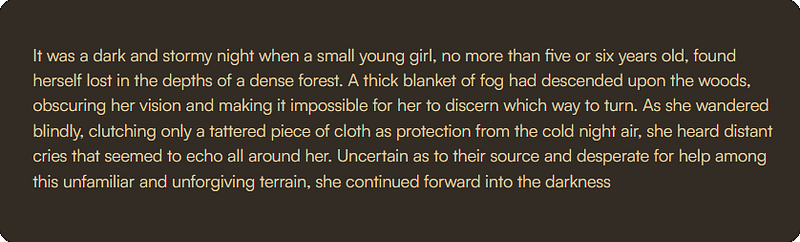
Of course it starts with a dark and stormy night — this is the version written by the ghost of Mary Shelley. The teenager who created both Frankenstein and his monster. You can feel the slightly dark overtones, can’t you?
4. Zombie Jane Austen next…
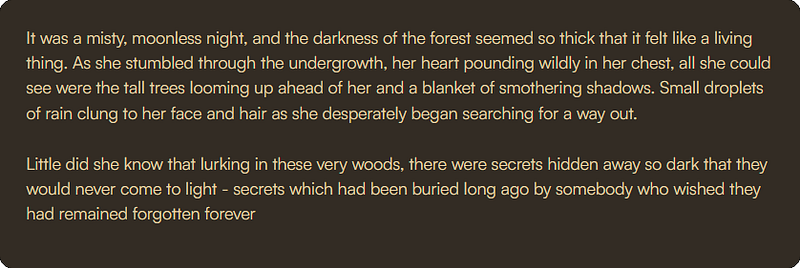
Can you hear her voice, here, just a little bit? The same voice that painted Mr. Darcy or Emma, who was entirely blind to the dangers of meddling as Austen put it.
5. Here’s how Mark Twain wrote it…
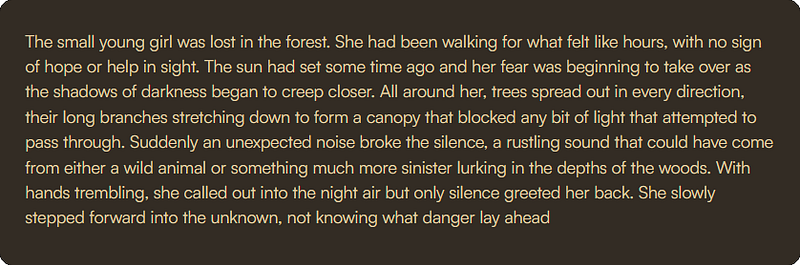
Falkner once called Twain “the father of American literature." If you’ve read Tom Sawyer, Huckleberry Finn or any of his classics, I think you’ll hear his voice here. Funny how we can recognize a voice and yet lack the words to describe that recognition.
6. Last but not least, zombie Virginia Woolf
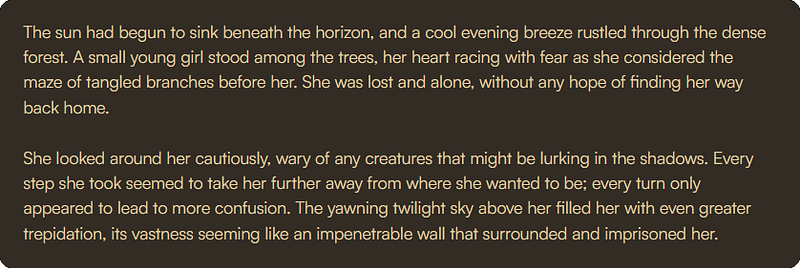
Funny how Virginia Woolf sounds nothing like Dostoyevsky or Twain or any of the others. Do you see how they are all describing the same thing, the same scene, but in different writing styles?
That’s what comes of allowing an AI to feed heartily on the words of famous writers whose names we know so many years later.
Now, the caveat…
Mary Shelley didn’t write hers. Hans Christian Andersen didn’t either, nor did Mark Twain or any of them. I do know that in case you felt compelled to let me know. lol.
They are AI. Plain and simple. The way all GPT programs work is that they don’t “write” like you and me do. They are probability generators that do math so fast it would make you blind to try follow along. They figure out how to string words together based on the probability of one word appearing next to another in the text they are “trained” on.
With AI, they are what they eat.
In this case, what they’re fed is the words of famous dead writers.
Which means the odds of finding it full of purple pose and redundant adverbs is pretty low. With me so far?
One more dead man, but he’s not in the public domain yet, and thank heavens for that…
William Zinsser was a journalist and writer who became so well known for his killer writing chops that Yale reached out and asked him to please, please come teach a course on writing.
Nine years later, they pleaded with him to turn his course into a book.
It’s sold over 1.5 million copies. If you only ever read one book on writing in your life, make it this one.
One of the things Zinsser always said is that most people honestly do not know how bad their writing is.
He believed clutter is the disease of American writing.
We are a society strangling in unnecessary words, circular constructions, pompous frills and meaningless jargon. — William Zinsser (source)
Too many of us fill our writing with fluff and descriptions that too easily become purple prose. You’ll notice there are no big blue eyes blinking back large glistening tears that trail down their face, blah, blah. No long, flowing golden locks waving in the gentle breeze.
Zinsser told his students good writing should express, not impress.
So now let’s talk about your writing…
How you can use “Ghost Writer” to hone your own writing chops and have fun doing it...
I know lots of people hate AI in general, including ChatGPT.
Here’s the thing. Lots of people hated motor vehicles when they came along, too. No, thank you very much, they’d take the horse. Or walk. Not having any part of new fangled technology.
And that’s fine if that’s you.
There are also people who will use AI to copy and paste.
I think there’s something in the middle. AI is here to stay.
I think we can use new technology to make us better at what we do. That’s why I wrote how to use ChatGPT to write better titles, and how to use ChatGPT to generate ideas that make you a more compelling writer.
This one, you can’t do with ChatGPT. But you can with ghost writer
Take the opening paragraph of a story you’ve written. Doesn’t matter if it’s for a book or an essay you wrote. Read it to yourself and create a one sentence synopsis.
It forces you to stop and ask what you’re really trying to say. That’s the only way to write a one-sentence synopsis.
Then type that single sentence synopsis into Ghost Writer.
Basically, give it a prompt based on a paragraph you wrote. Play around with a half dozen writers. Look how they write a paragraph based on the synopsis of your own. And then take a look how you wrote it.
Why?
Because we develop writing chops through emulation.
That’s why Stephen King says if you don’t have the time to read, you don’t have the tools to write. Because we learn how to string words together from those who came before us. Those who influenced us.
When it comes to writing — we are what we eat, too. You know?
So, who better to learn from than people whose names we still know hundreds of years since they shuffled off their mortal coil?
Not to copy and paste. No. But to learn. Absolutely.
Because that IS how we learn. So if you can ask the greats to write your idea in their words, what a great way to strengthen your own writing chops.
Not to copy, but to learn.
If you try it , I’d love to know what you think!
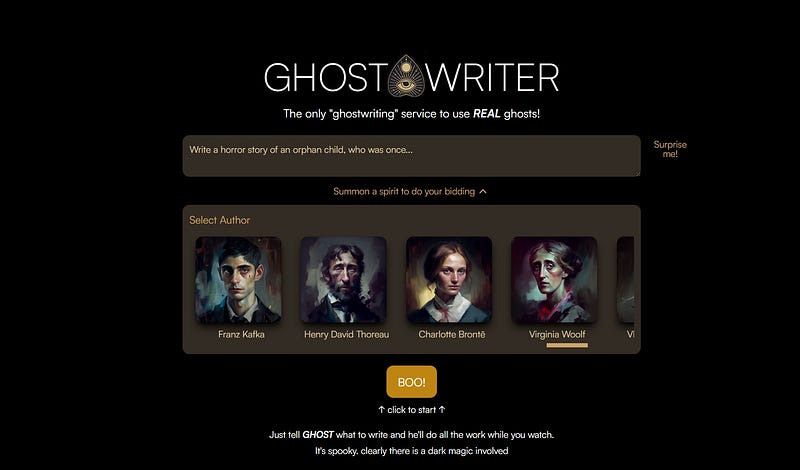
You can find it at…
https://www.ghostthewriter.com/.
P.S. Great job Derek and thanks for permission to screencap like mad.
P.S. Enjoyed this? Don't count on the feed, get my posts by email.“The people you love become ghosts inside of you, and like this you keep them alive.” ― Rob Montgomery