
10 ChatGPT Prompts That Can Make You A More Compelling Writer
It sucks to write for crickets. Here’s how to use ChatGPT to write better stories that people actually want to read.

You know what really sucks?
It really sucks to spend hours writing and editing a post and then when you publish it? Pffft. Nothing. Crickets.
David Ogilvy once said people read what they want. Duh.
Sometimes, it feels like what they want isn’t me. lol.
Ogilvy was a marketing guy in the mad men era, and he was talking about writing powerful long form sales letters that people actually want to read. Hah. Good luck. Most writers can’t even get people to read a story.
The first issue is the title, of course. No one clicks boring titles. That’s why I wrote about using ChatGPT to help write better titles.
But it’s not just titles.
It’s also topic.
If I can be blunt, a lot of writers are a bit myopic.
You know what I mean, right? This happened to me, and this happened to me and did I tell you this other thing that happened to me? Me, me, me.
Kim Kardashian talks about herself all the time and people eat that up. But you and me? We’re not exactly Kim Kardashian. #thankGod #gratitude
When William Zinsser taught writing at Yale, he once told a writer, “You’ll notice I stopped marking this halfway through. What you’ve written is interesting only to you.”
Ouch.
But there’s the rub, of course. How in the name of good writing are we supposed to know what the heck is interesting to the reader?
ChatGPT to the rescue.
Incidentally, I’m using ChatGPT as a tool, not a cheat.
Like — dear ChatGPT, I don’t need your help with writing, but can you help my poor weary brain with ideas? I’ll take it from there, okay?
So here’s some prompts you can try.
1. What are 5 common mistakes [audience] make?
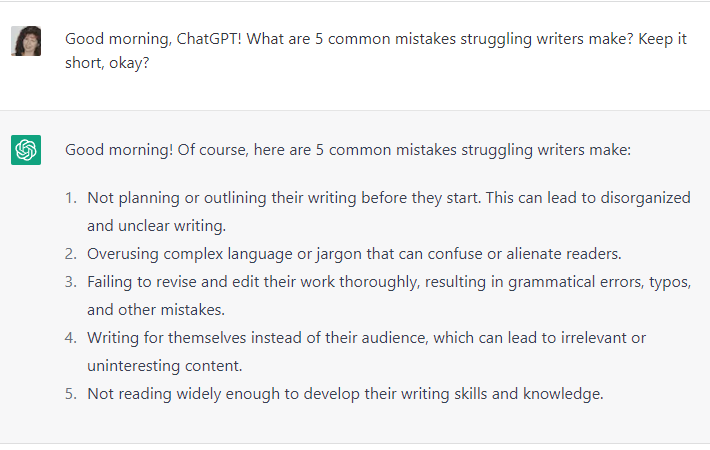
Don’t we just love mistake posts? We do. I promise.
Because it’s one thing to be told what TO do. Helpful posts are lovely. But they pale in comparison to posts about what not to do at risk of looking like a freaking idiot. See #4 above? Bwahahaha.
You can use that prompt for any topic. What are the mistakes cat owners make? What are the mistakes weight lifters make? Etc. Because we all make mistakes, and we all want to make sure we’re not making mistakes.
So then, find a prompt related to the story you want to tell and work your story in as an anecdote. See? It makes you think more. But it works better.
ChatGPT tip:
You’ll notice I added “keep it short.” That’s because ChatGPT tends to be super verbose and overly wordy. I just want ideas. I don’t want it to write for me.
2. What are 5 of the biggest mistakes [audience] make?
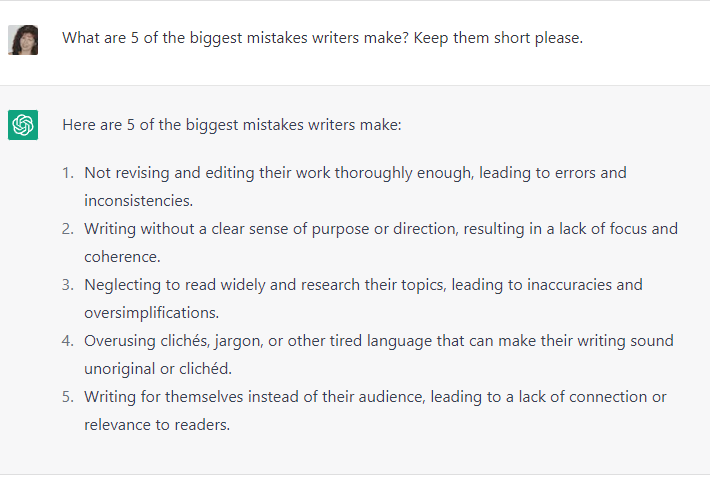
You’ll notice I changed the first prompt a little and got different results.
In the first, I asked for “common mistakes” and in this one I asked for the “biggest” mistakes. Different answers. Cool how that works. 😊
Incidentally, I wrote about #5 in a post called Dumb Writing Mistake #1. Should You Write For Readers Or Yourself? It got over 3500 claps so it’s safe to say people like to read about dumb mistakes so they don’t make them.
ChatGPT tip:
Change your questions just slightly because you’ll get different answers. One of them might be the perfect idea for a story.
3. Make a list of 5 questions [audience] might ask to find information about [topic]
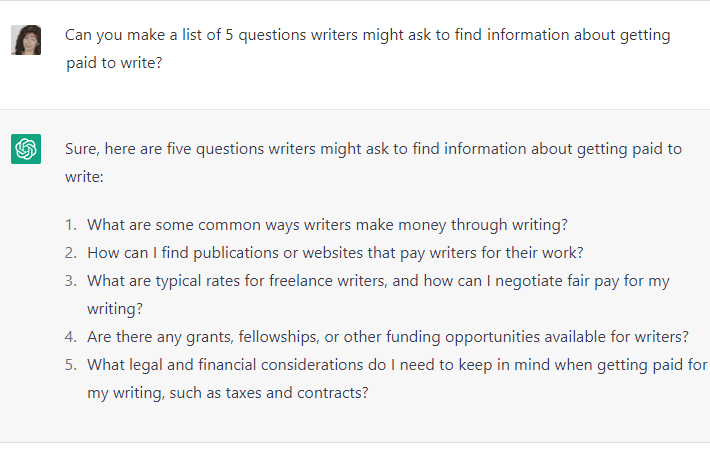
Again — I focused on writers because (duh) I am writing for writers. But every topic is full of questions. What questions do people have starting a business, or using Canva, or selling on Etsy, or caring for a puppy?
You know? You have a story idea in your head. Something you want to write about. That’s great. Find the questions in the related topic and voila — a story people want to read, and it fits the anecdote you want to tell.
4. Make a list of 5 little known facts about [topic]
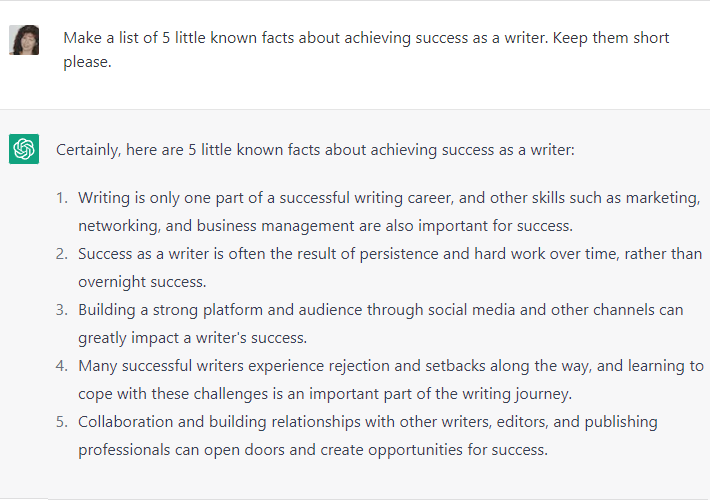
Those look a little boring. But if you stop and read them, there are a ton of ideas there. Take the first one — writing is only part of a successful career. Hmm. Idea. What jobs did famous writers do? Stephen King was a teacher. Liz Gilbert was a bartender.
Second one… can you tell me which writer was an overnight success that only took 20 years to get there? The idea of prompts isn’t for ChatGPT to do the work for you. It’s to help you find ideas. See?
5. Make a list of 5 interesting blog topics that would appeal to [audience]
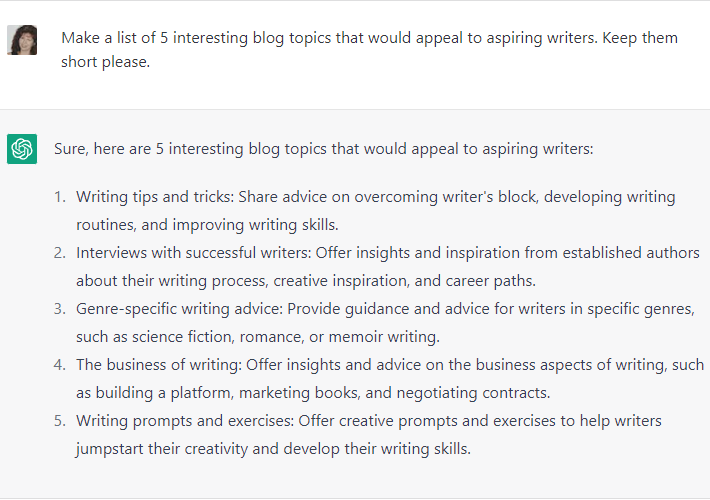
If you write to aspiring writers, there’s a ton of ideas for you right there. There’s 3 of them right in #3. Tips for romance writers. Tips for science fiction writers. Tips for memoir writers.
Every one of those bullet points has more than one idea in it. You could cobble together a month of writing just with one ChatGPT prompt.
Just change “aspiring writers” to your audience and find a ton of ideas!
6. What are 5 big misconceptions about [topic]?
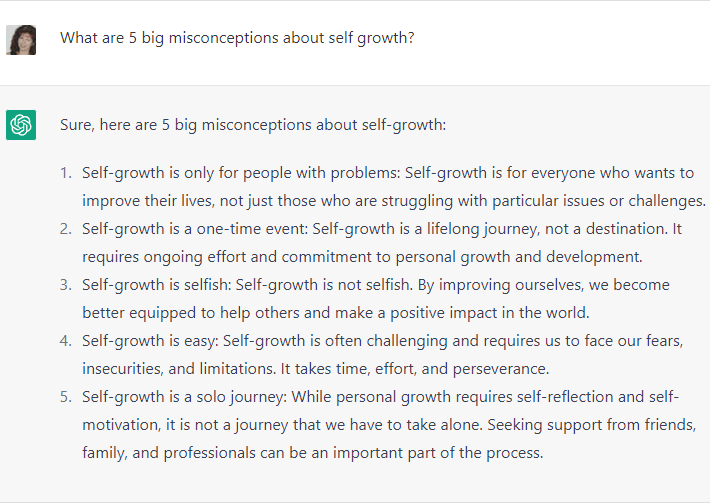
You want to write a personal anecdote that doesn’t read like you left your diary on the bed and went to the bathroom? There you go.
Call it “Self growth isn’t easy — here’s what I learned from a family feud.”
That’s how you write personal stuff and still have people want to read it. You include your story, but make it bigger than you. Add a takeaway for the reader and you’re good as gold.
7. Make a list of 5 [fun/funny/strange/bizarre/odd] facts about [topic]. Keep them short.
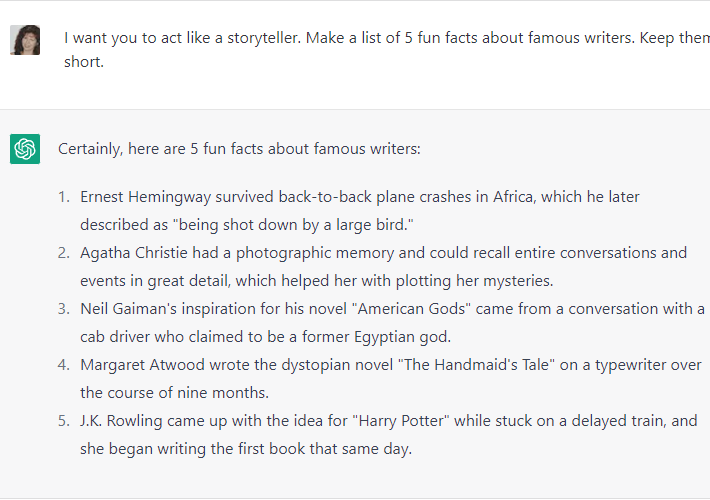
Fun facts are a great way to find story ideas. Change the question up, too. Try fun facts, funny facts, strange facts, bizarre, odd, unknown, etc.
You can find them on any topic. Doesn’t matter if you write about writing, writers, parents, kids, etc. There’s funny facts on every topic. Trust me, you’ll find a ton of story ideas your readers will love.
ChatGPT tip:
You’ll notice I added “I want you to act like a storyteller.” That seems to change the way it phrases things. Try both with and without that.
8. Make a list of 5 things [your readers] need to stop [doing/saying/thinking].
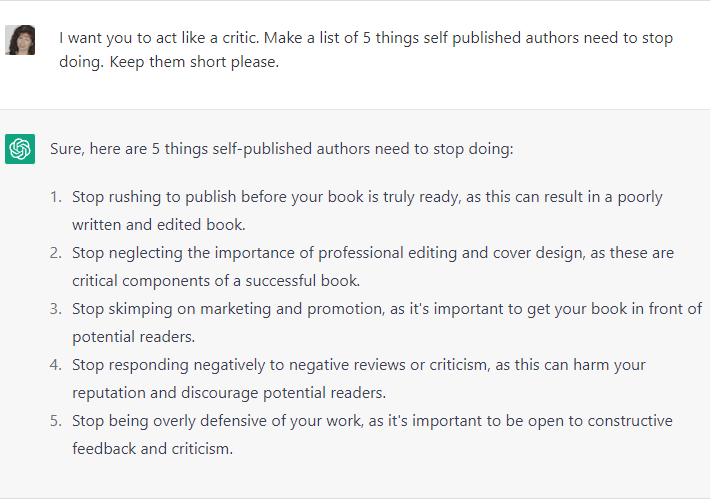
“Stop” posts tend to get good response. It’s right up there with mistakes to avoid. Seriously, 5 things writers need to stop doing, dog owners need to stop doing, bosses need to stop doing. See what I mean? It works.
Interesting little note — in testing this prompt, I asked ChatGPT to tell me 5 things self growth coaches need to stop saying. It said self growth writers need to stop positioning themselves as the authority because it devalues the reader’s agency and intuition. I was gobsmacked.
9. List the top 5 reasons [blank] fail to [blank].
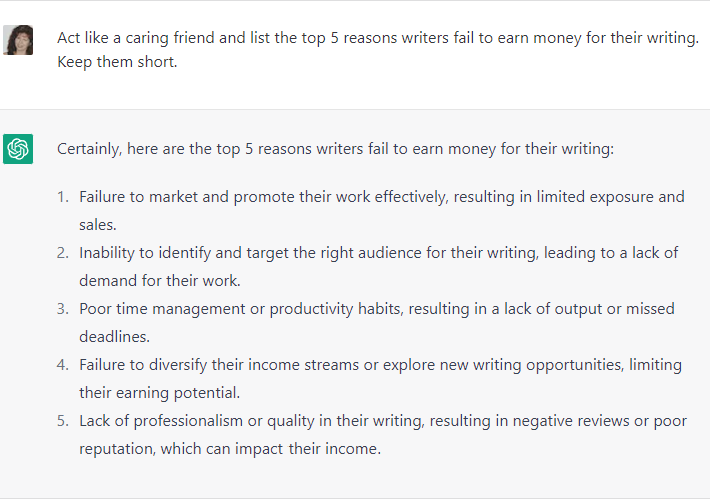
You’re sensing a trend, I’m sure. No one likes to be embarrassed. No one wants to intentionally do dumb stuff. This one just gets a little more specific about “who” is failing at “what”
You can use it in any topic area. 5 reasons dog owners fail to train their dogs. 5 reasons dieters fail to lose weight. 5 reasons designers fail to get clients. Pick anything people are trying to do, and someone is failing and not sure why. Ton of ideas to write about.
10. Can you tell me the 5 [least/little] known but very successful people in the [topic] industry? Keep them short.
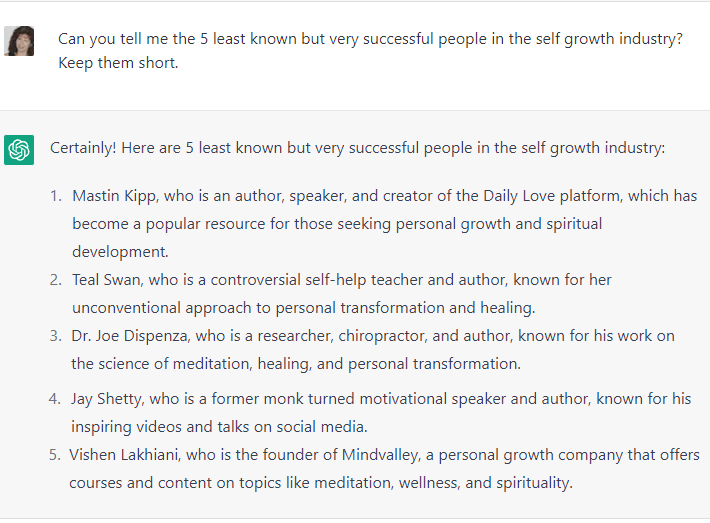
Last, but not least — amazing people to write about. You can play with that prompt, too. Instead of “very successful” try “most accomplished” or most financially successful, etc.
You’ll find interesting stories on a topic that interests you, without writing about the same old names everyone writes about. We don’t need more posts about Elon Musk or Jeff Bezos, but the world is full of fascinating people most of us never heard of. So go find some.
Here’s the list of ChatGPT prompts I used…
Thought I’d pull them out separately so you can grab them and give them a try for topics you write about.
- What are 5 common mistakes [audience] make?
- Make a list of 5 questions [audience] might ask to find information about [topic]
- What are 5 of the biggest mistakes [audience] make?
- Make a list of 5 little known facts about [topic]
- Make a list of 5 interesting blog topics that would appeal to [audience]
- What are 5 big misconceptions about [topic]?
- Make a list of 5 fun facts about [topic]. Keep them short.
- Make a list of 5 things [your readers] need to stop [doing/saying/thinking].
- List the top 5 reasons [blank] fail to [blank] for[blank].
- List the 5 least known but very successful people in the [topic] industry?
Summary: Writing is easy. Writing things people actually want to read is much harder.
I’m not saying you shouldn’t write from the heart. You should. We need to if we want to connect with people. You know?
You are all you have that differentiates you from every other writer on the planet. But also? We need to remember that most readers aren’t here to voyeuristically peer into our diaries, flung open to the world.
If your life is racy enough, sure. If you could post on Reddit’s “Am I The Asshole” every day of the week and the stories would be fresh and real because you are surrounded by that many a-holes, maybe.
But the rest of us? We have to weave our experiences into stories that interest the reader. But that doesn’t mean we can’t get a little help with ideas. Ideas aren’t the art.
I can tell a room full of artists to paint me a moon and a tree at night and they’re all going to look different. Same with writers.
In the long run, as more and more writers get lazy and use AI tools to do their writing for them, it’s your voice and your personality and the way you connect that will make you stand out.
There’s no harm in getting help to inspire idea.
Then go write your butt off.
“After nourishment, shelter and companionship, stories are the thing we need most in the world.” ― Philip Pullman