
World’s Oldest Shark Victim Discovered in Japan
It dates back 3,000 years…

An international group of researchers reports the oldest shark attack victim ever discovered after examining a 3,000-year-old skeleton excavated from a burial ground at the Tsukumo archaeological site in Japan.
According to the study, the skeleton, identified as Tsukumo №24, belonged to a young to middle-aged man who met a horrendous death when a large shark attacked him near the Seto Inland Sea.
Tsukumo №24
The Tsukumo site was discovered by construction workers in 1860 with the first excavations taking place in 1915. Since then, scientists have found more than 170 human remains buried in the particular archaeological site but one skeleton, an adult male known as Tsukumo №24, stands out.
The man showed traumatic lesions scarring the majority of his skeleton, with most of the damage on his pelvis, left leg, shoulders, and arms. Nearly all his ribs had been bitten and fractured, and the chest cavity and abdomen may have been eviscerated. He was also missing his left hand and right leg, and his left leg had been arranged upside-down in the grave, according to the study. In total, we suffered almost 800 injuries in his body.
“We were initially flummoxed by what could have caused at least 790 deep, serrated injuries to this man,” said researchers J. Alyssa White and Rick Schulting in a joint statement. “There were so many injuries and yet he was buried in the community burial ground, the Tsukumo Shell-mound cemetery site.”
Scientists were initially puzzled at the injuries Tsukumo №24 suffered and began a quest to identify the culprit behind these terrible wounds.
Identifying the culprit
Through the process of elimination, the researchers began to narrow down the potential culprits. The injuries resembled those made with metal weapons, but scientists used radiocarbon dating to determine that the attack occurred at a time when people in Japan didn’t have them. The team considered other possible assailants — like crabs, bears, and boars — but the types of lesions on the remains didn’t fit the bill, so researchers ruled those out too.
After considering and dismissing terrestrial carnivores and taphonomic damage, they researched further afield and were left with the dawning realization that the culprit who left so many distinctive and consistent lesions on the man’s bones was none other than a shark.
Since archaeological cases of shark reports are scarce, scientists turned to modern forensic cases of shark attacks for clues and found that nearly all the diagnostic characteristics of a shark attack were present on Individual №24’s skeleton. The distribution of wounds was also consistent with these attacks.
What type of shark was responsible for the attack?
Tiger sharks and great white sharks are the most likely candidates, as both are commonly found in Japan’s Inland Seto Sea; both species have also been known to attack humans, according to the study. However, such attacks are rare, and most sharks don’t attack people without provocation, the researchers added.
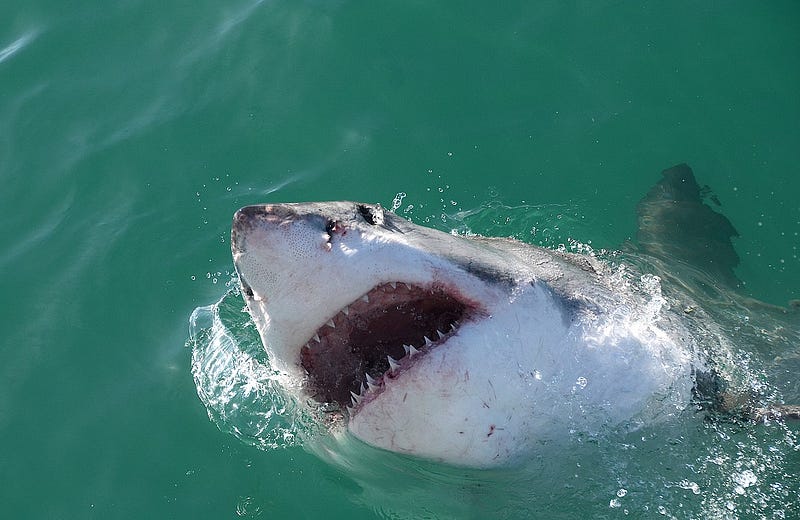
A deadly encounter
While most civilizations in early human history were hunter-gathers, archaeologists know the people of the Jōmon era (c. 14,000 to 300 BCE) were fisher-hunter-gatherers. It is not clear if the victim was a fisherman but the theory is plausible.
Scientists suspect the man was probably out fishing from a boat, or diving for shellfish with some companions in the Inland Seto Sea. Perhaps they were even hunting sharks since shark teeth are sometimes found in Jōmon archaeological sites.
“One or more sharks — we suspect one but can’t be certain about that — attacked the man either while he was already in the water, or perhaps he lost his balance and fell, or was pulled overboard if the shark was on a fishing line — this would not have been a small shark,” Schulting said.
Since the majority of the wounds were concentrated around the left hip and leg, the man may have lost his left hand while trying to defend that part of his body. Long bones in the arms and legs showed bites from numerous directions, suggesting that the shark continued circling and tearing at the corpse after the man was dead.
The man’s injuries were so numerous that he probably didn’t survive, and he would have died from blood loss and shock. He likely was alive when attacked, as the distribution of skeletal damage differed from damage patterns left by sharks on scavenged corpses. The widespread trauma to the skeleton also suggests that the victim remained in the sea for some time sufficient to allow the shark to feed on the body after death. The man’s body was finally retrieved by his companions at a later stage and was buried during a special ceremony.
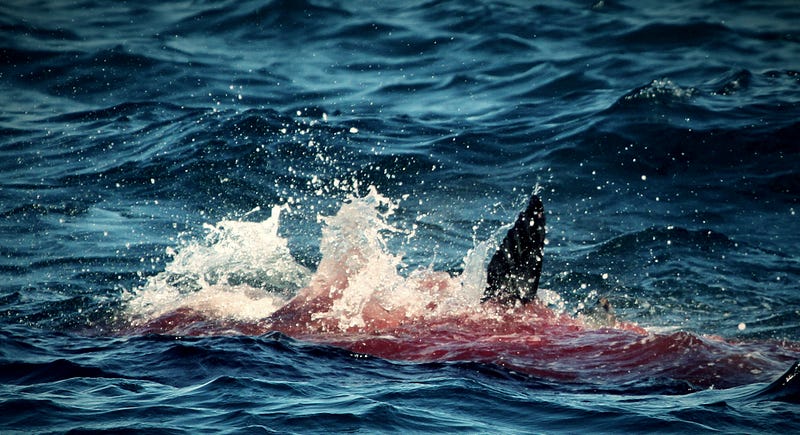
Epilogue
About 3,000 years ago, a shark fatally mauled a man in waters near western Japan. The encounter left a map of horrific scars spread across the man’s skeleton, and parts of his body were never recovered.
“This find not only provides a new perspective on ancient Japan but is also a rare example of archaeologists being able to reconstruct a dramatic episode in the life of a prehistoric community,” said study co-author Mark Hudson, an archaeologist with the Max Planck Institute for the Science of Human History in Jena, Germany.
Shark attacks were and still are extremely rare. On average, there are about ten fatalities recorded a year in recent times, with a human population much larger than that of 3000 years ago. Accounting for the probabilities of a shark attack in ancient times, the Tsukumo individual must have been extremely unlucky to meet such a gruesome death.
This remarkable study was conducted by researchers from the University of Oxford, University of Florida, Kyoto University, Max Planck Institute for the Science of Human History, Tokai University’s School of Marine Science and Technology, University of Tokyo, and Tokyo Metropolitan University.
Relevant Reads:
Sharks Were Nearly Wiped Out from the Planet 19 Million Years Ago
And no one is sure why…
medium.com
References
J. Alyssa White, George H. Burgess, Masato Nakatsukasa, Mark J. Hudson, John Pouncett, Soichiro Kusaka, Minoru Yoneda, Yasuhiro Yamada, Rick J. Schulting, 3000-year-old shark attack victim from Tsukumo shell-mound, Okayama, Japan, Journal of Archaeological Science: Reports, Volume 38, 2021, 103065, ISSN 2352–409X, https://doi.org/10.1016/j.jasrep.2021.103065.


