
World’s Most Profitable company goes Public with one of the lowest floats
Saudi Oil giant Aramco becomes the World’s biggest listed company amid a record-breaking IPO
The financial markets were abuzz last week with the highly anticipated IPO launch of the World’s most profitable and the third-largest company by revenue overall — Saudi Oil giant Aramco. The delayed public offering hit another snag earlier in September when a drone attack took out one of the biggest oil refineries in the heart of the Saudi Kingdom run by the company. The Saudi authorities were quick to restore the refinery to its full capacity mitigating the disruption & keeping investors' confidence intact.
The public offering of the Kingdom’s biggest asset is seen as the new ruler’s 2030 vision of diversifying the economy away from its over-dependence on oil & investing in megaprojects and industries like tourism and entertainment. Apart from Aramco going public, opening doors to western tourism and a planned futuristic city are all part of this endeavor.
After an agonizing wait of almost four years, Saudi Aramco’s IPO debuted on Riyadh’s stock market on December 11, 2019. The IPO that was priced at 32 Saudi riyals ($8.53) proved really popular among investors as it jumped 10% (the daily limit) to 35.2 riyals in Riyadh, raising the company’s valuation to a staggering $1.88T. The company in turn also set the record for the biggest IPO ever.

This has not only made Aramco the biggest listed company in the World overtaking American tech giants like Apple & Microsoft but also propelled the Saudi Tadawul exchange into the top ten financial markets of the World. Should the demand prove higher than expected in the first 30 days of trading, Aramco’s underwriters can exercise an option to sell up to 15% more shares — which would increase the money raised to nearly $30 billion and could value the company at close to $2 trillion*.
All of this sounds exciting & promising from the investors’ point of view. But there’s a catch. The Gulf Oil giant has only sold a meager 1.5% stake in the IPO with the remaining to stay under the control of the Saudi state. This means that the ‘free float’ or the portion of the stock that can be held by public investors is among the lowest in the world — third lowest to be exact.
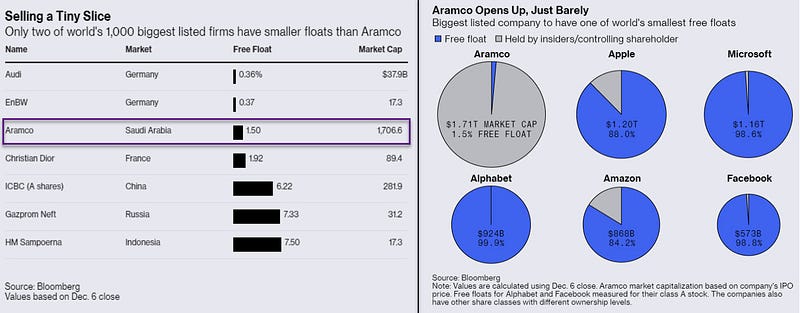
Only two companies among the top 1,000 listed companies by market value have lower floats than Aramco(left chart above). The carmaker Audi AG has the lowest float of 0.36% (rest owned by Volkswagen AG) followed by state-controlled German utility EnBW Energie Baden-Wuerttemberg AG having 0.37% of its stock in public hands.
Now compare this to publicly listed tech giants like Apple, Microsoft, Alphabet (Google), Amazon & Facebook — all having at least 80% of their equity owned by independent shareholders (right chart above). In fact, Google, Microsoft & Facebook are truly public companies with almost 99% of the shares held by public investors.
Having said that, even companies who float most of their shares like the Big techs find ways to keep decision-making powers — Facebook, for example, has special stock classes giving founders outsized control over the company matters.
Unfortunately for Aramco investors, the company is all that the kingdom has and does not want to relinquish even a minority share to the public… at least not yet. Controlling more than 98% of the company means that the government can implement decisions which might be good for the kingdom but not necessarily for the shareholders. Nevertheless, a good first step towards opening up the economy for investors.
Keeping in mind the staggering size of the company, it would likely be included in global benchmarks like the MSCI Emerging Markets Index a with a weight of about 0.7%, which according to an estimate, would trigger $2.4 billion of automatic buying from funds that follow the Index. So even if you are not directly exposed to trading in the company, your investment account might still be affected by how the stock performs.
*That didn’t take too long… shares of Saudi Aramco (ARMCO) surged to 38.7 riyals ($10.32) on their second day of public trading (12/12/2019) pushing the company to the long-sought $2 trillion valuation.