
Mass Madness on Sesame Street Spreading?
World Health Organization Investigates Spreading Hallucinations Which Appear to Have Started on Sesame Street
WHO Highly Concerned Over Spread of Mass Hysteria from Big Bird to other residents of Sesame Street to viewers
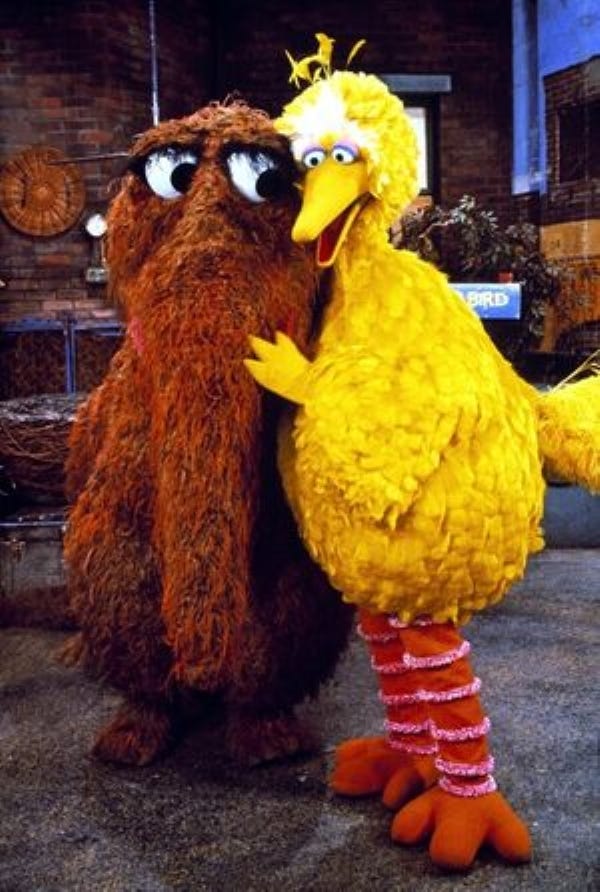
The World Health Organization (WHO) has begun an investigation into what appears to be some kind of widespread potential health threat involving hallucinations. The threat was previously identified in Manhattan, where it was determined to be limited to those who lived on Sesame Street. The problem was first defined in a single individual, Big Bird, a long time resident of Sesame Street, whose friends reported concerns related to him talking about a new friend that only he could see or hear. The “friend” was described as some sort of large brown being, something like a earless, tuskless, wooly mammoth.
Big Bird had claimed that the beings name was Aloysius Snuffleupagus or Snuffy for short and he began attempting to introduce the rest of the street’s residents to this “friend”. The large avian evidently experienced some distress when other residents on Sesame Street claimed to be unable to perceive Snuffy and became annoyed with Big Bird’s insistence that he existed..
Over time, however, other residents began to perceive Snuffy until everyone on Sesame Street could see and hear him. At this point, the street was blocked off and quarantined in case there was an infectious agent causing the hallucinations. Since that time, anyone intending to visit the street, has been informed that they will not be permitted to leave should they decide to go there.
Because of the quarantine, residents of Sesame Street began communicating with the outside world through the medium of television. After this, there was a brief scare in 1985 when children who tuned in to learn about what was happening on Sesame Street were found to also be able to see the wooly mammoth.
This fear was later dismissed when it was learned from producers of the daily telecommunication program that as a joke, one of the residents who worked on the show had created a sort of animation of Snuffy that was added to that days episode. It was explained that so many children had written in saying how much they loved Snuffy, that the producers had decided to include him in the show, continuing to add him after the live taping.
It has now been discovered, that the Producers of the show lied about the nature of Snuffy, admitting that they had never done anything to add the character to the show. This led to an immediate mobilization of WHO investigators who have since been traveling to wherever Sesame Street can be viewed to determine how widespread this manifestation is. Once this is determined, a detailed plan will be formulated to address the condition. One of the WHO researchers on the project said:
“It’s hoped we will find that it is only a small subset of those who have seen any of the Sesame Street daily communication episodes that are able to see this Snuffy creature. We don’t want to think about what it might mean if everyone who has viewed one or more of these episodes appears to be suffering from this hallucination. Sesame Street is seen in 120 countries. Though even if the worse case scenario is realized, from the children and parents interviewed, it doesn’t appear that Snuffy is seen as frightening, threatening or otherwise problematic. In fact, both children and parents seem to view Snuffy as a sweet, compassionate being who they really like and who makes them feel happy.”
Initial concerns regarding Big Bird, led some to hypothesize that he suffered from Schizophrenia due to the hallucination. However, as he had no other symptoms, experts believed that whatever was causing his symptoms it wasn’t schizophrenia. Until his symptoms seemed to be spreading to others nearby, professionals found nothing amiss with him seeing Suffy.
“Big Bird remains at a six year old level. It is not unusual for six year olds to have imaginary friends or to later report that they did actually see and hear them, with many saying could also touch them,” said famed child psychologist, Dr. Soyun Nakatamo.
Later, when the full extent of the problem was determined, the street had already been quarantined and so no one had been able to assess the situation. Hypotheses for these occurrences were generated in the absence of actual data based on Big Bird’s initial perception of Snuffy and how subsequent residents came to perceive the woolly mammoth creature.These hypothesized causes included:
- Residents were just pretending to perceive Snuffy to prevent Big Bird from feeling like something was wrong with him, or thinking that they were angry at him for what they believed to be lies on his part
- A virus with a variable incubation period that the residents had all been exposed to at the same time was responsible
- Some kind of pathogen found only on Sesame Street was responsible
- The hallucinations were the result of Shared Psychotic Disorder or folie à deux, a rare disorder shared by two or occasionally, more people with close emotional ties.
As more children and parents have been identified as experiencing the hallucination, world wide concern has developed over possible biological agents or other types of causes perpetrated by terrorists. WHO spokespersons have attempted to reassure the public, pointing out that this situation has been going on since 1971, and have said that an intentional effort by anyone to harm people is highly unlikely.
“In all the years since it first began, no one has attempted to take credit for the occurrences. There doesn’t seem to be any possible gain for terrorists and too many countries have been affected. It’s much more likely in my opinion that we are looking at Shared Psychotic Disorder although, admittedly there has never been a case with so many people affected,” said WHO researcher Peter Varmuus.
Experts have concluded that it’s more likely that these instances of shared hallucinations are the result of mass hysteria. This is a condition that affects members of a close knit group. There are some differences, however, between what has been termed mass hysteria and the current situation experienced by the Sesame Street community. In particular, in the traditional manifestation of mass hysteria, the symptoms result from a commonly perceived but unrealistic or delusional threat.
In the current case, the afflicted are experiencing a hallucination of a well-liked creature who makes others feel happy and more lighthearted. Because of this difference, the WHO has decided to create a different category of the disorder. They have named this new version of the disorder “Big Bird Syndrome,” in recognition of the first known individual to experience it.
The only remaining question that may still be of some concern is the discovery that there is another hallucination that seems to have developed. Several children have let it slip that they have seen another being similar to Snuffy, who is evidently his baby sister, Alice. Some have expressed concern over the number of children and parents who have been affected and by what is perceived to be the worsening of symptoms with the addition of the new hallucination. Yet WHO investigators have advised the public to remain calm.
“This condition has evidently been present in those in the Sesame Street Community for almost 50 years without there being any adverse effects on those who experience it. To the contrary, those who perceive Snuffy and his baby sister, Alice seem to be positively affected in mood and to experience an increased sense of social support and closeness with other members of the community. So even if it’s impossible to alleviate this condition or prevent it from spreading to new members of the Sesame Street community, this isn’t necessarily a problem. In fact, given the possible effects of the syndrome, it might be quite the opposite,” said Dr.Nakatamo.

If you enjoyed reading this story, you might also like these:
You can find links to my other work on Medium and follow me here. Thanks for reading and for supporting Mental Gecko!


