avatarAngus Peterson

Free AI web copilot to create summaries, insights and extended knowledge, download it at here

4792

Abstract

D-19 pandemic has compelled companies to shut down their branches and physical stores. Hence, they are relying more on digital solutions to automate front-end and back-end processes.</p></blockquote><blockquote id="7940"><p>The demand for advanced software is surging rapidly as more firms are looking for transforming their engagements with stakeholders, customers, suppliers, and employees.</p></blockquote><p id="c19b">The shutdowns forced companies to work without or with many fewer employees than they had ever expected. This made them realize a few things.</p><ul><li>There was little need for the number of employees they currently had.</li><li>They could get by with a lower level of service that could be handled by a robot.</li><li>The cost savings of automation was huge.</li><li>Automation was the only way to increase production when no humans were available.</li></ul><p id="6548">Just take a look at what is happening with pharmacists.</p><p id="0274">Decades ago, pharmacists used to be a primary source of medical information, with many customers consulting them before going to their primary doctor.</p><p id="3e26">However, the emphasis on streamlining processes and cost reduction during the 70s and 80s led to the entire industry being merely highly-educated assembly line workers, counting pills and manning the drive-through.</p><p id="766c">A lot of the changed with COVID.</p><blockquote id="cd6b"><p>Pharmacists have made monumental progress recently in coming out from behind the counter.</p></blockquote><blockquote id="d39c"><p>In the wake of COVID-19, <a href="https://www.pharmacytimes.com/view/pharmacy-automation-is-critical-to-win-the-fight-against-covid-19">many pharmacies are turning to automation technologies</a> to help pharmacists work at the top of their licenses, support operations, and take over redundant tasks. This means reallocating time for immunizations, with a goal of getting patients in and out of pharmacies most effectively.</p></blockquote><blockquote id="9f72"><p>In a post-COVID-19 world, allowing automation to take the place of filling and supporting verification can get the pharmacy team to focus its attention on patients, which most agree is far more impactful than just filling prescriptions.</p></blockquote><p id="e314">And that’s just the tip of the iceberg. Most companies are rolling out automation, with COVID being the main driver.</p><blockquote id="7724"><p>A <a href="https://new.abb.com/news/detail/74784/abb-launches-next-generation-cobots-to-unlock-automation-for-new-sectors-and-first-time-users">survey</a> by Swiss engineering giant ABB Ltd. of more than 1,600 businesses globally found that 8 out of 10 workplaces will introduce or increase the use of robotics and automation in the next decade, with 85% saying Covid had been a game changer for their business.</p></blockquote><h1 id="7f60">The Skills Gap</h1><p id="e122">Another major factor that will only accelerate the adoption of automation is the skills gap in the manufacturing sector.</p><p id="ed7d">Anyone who has followed Mike Rowe over the years, either on Dirty Jobs or through his foundation mikeroweWORKS, has heard about this skills gap, but here’s a primer.</p><p id="16c1">It is estimated that as many as <a href="https://www2.deloitte.com/us/en/insights/industry/manufacturing/manufacturing-industry-diversity.html">2.1 million manufacturing jobs</a> could go unfulfilled by 2030, costing the economy up to <a href="https://www.cnn.com/2021/05/04/economy/manufacturing-jobs-economy/index.html">$1 trillion</a>. That is an astounding number given that the US is still <a href="https://www.bls.gov/news.release/empsit.a.htm">millions of jobs in the hole</a> compared to before the pandemic. This gap will only be exacerbated by the recent onshoring efforts and a focus on domestic manufacturing and material availability.</p><p id="6284">So why do manufacturing jobs go unfilled?</p><ul><li><b>Entry level positions aren’t attractive.</b></li></ul><p id="7734">While they can pay almost double the federal minimum wage, these jobs, “do not require technical know-how or industry knowledge” but need “a basic level of human capabilities, such as following directions, willingness to learn, and follow-through.”</p><ul><li><b>New manufacturing jobs require new skills.</b></li></ul><p id="76f8">The factories of today can’t be run by employees of yesterday. They require a higher set of (digital) skills that many current employees are either unable or unwilling to learn.</p><p id="4e6e">Regardless of the cause of this crisis, manufacturing companies are faced with a shortage of skilled labor, but their product demand is forecast to be either unchanged or higher than today.</p><p id="2f05">It’s a simple matter of supply and demand, and

Options

any economist will tell you that in the presence of a lack of supply, consumers (the manufacturers) will purchase a substitute (machines) to fulfill their desire for a product (labor hours).</p><p id="cf21">White collar businesses are facing the same problem. Due to economic reasons (unemployment ) or health reasons (fear of catching covid), many customer- or coworker-facing positions are going unfilled (link), pushing companies to more quickly adopt machines to fill those roles.</p><p id="8515"><a href="https://www.cnbc.com/2019/11/27/high-paid-well-educated-white-collar-jobs-heavily-affected-by-ai-new-report.html">Artificial intelligence</a> was already threatening to replace these workers prior to the pandemic.</p><h1 id="002d">The Balancing Act</h1><p id="fd1d">So what does the future really hold?</p><p id="3c7e">Will the machines replace us all, or will we rise up like the <a href="https://www.smithsonianmag.com/innovation/when-robots-take-jobs-remember-luddites-180961423/">Luddites </a>of old?</p><p id="d092">The reality will be somewhere in the middle due to the fact that machines don’t really replace jobs; they replace tasks. For the most part, a job is made up of many individual tasks that come together to create a unit of output, which is determined by the human.</p><blockquote id="c094"><p>…[A]rguments against automation largely ignore the past; any glance in the history books will prove that it has in fact been fueling the economy since its inception.</p></blockquote><p id="60dc">In fact, many believe that automation will simply do the monotonous tasks currently performed by humans, allow them to perform higher-level, creative work.</p><blockquote id="29d6"><p>[Automation] will automate many white-collar jobs that are tedious and tiring.</p></blockquote><blockquote id="ddd4"><p>A recent IBM <a href="https://www.ibm.com/downloads/cas/O17AWNV6">report</a> shows that 90% of executives in firms where IA is being used believe it creates higher-value work for employees.</p></blockquote><h1 id="0c2c">The Takeaway</h1><p id="d778">COVID accelerated many of the issues that were steering companies toward automation, and as an employee, it is vitally important to adapt to this new normal.</p><blockquote id="11cc"><p>Many employers believe that <a href="https://www.forbes.com/sites/forbescommunicationscouncil/2021/05/03/how-to-balance-automation-and-the-human-touch/?sh=523e5d7d4eb2">understanding automation</a> makes an employee more valuable.</p></blockquote><blockquote id="016b"><p>According to UiPath research (<a href="https://www.cmswire.com/digital-workplace/automation-is-still-growing-in-the-workplace-despite-concerns/">via CMS Wire</a>), more than 70% of executives and managers stated that when they’re choosing between two candidates, they’ll pick the one with experience in automation and AI — even if the job description for the role doesn’t list those skills as a necessity.</p></blockquote><p id="9f2d">The 1980’s destroyed the idea of working for a company for 30 years and retiring with a pension.</p><p id="abba">The 2020’s are going to destroy the idea of working solely with humans, without any robotic or software automation whatsoever.</p><p id="e834">Automation is the future, so weave yourself into that future.</p><h1 id="317e">Most Recent Stories</h1><ul><li><a href="https://readmedium.com/the-vital-home-inspection-that-you-cant-ignore-but-always-do-9f47cb858062">The Vital Home Inspection That You Can’t Ignore (But Always Do)</a></li><li><a href="https://readmedium.com/why-the-middle-class-hates-the-poor-41f0a13dd553">Why the Middle Class Hates the Poor</a></li><li><a href="https://readmedium.com/whats-going-on-with-biden-s-capital-gains-tax-45c3f9b631b5">What’s Going on With Biden’s Capital Gains Tax?</a></li><li><a href="https://readmedium.com/your-super-cheap-health-care-deductible-is-too-expensive-20dbe0f9902c">Your Super Cheap Health Care Deductible Is Too Expensive</a></li><li><a href="https://readmedium.com/will-student-loan-forgiveness-actually-work-51e241554f7d">Will Student Loan Forgiveness Actually Work?</a></li></ul><p id="e1b7"><b><i>Don’t miss my next article! <a href="https://theadamparsonsproject.medium.com/subscribe">Click here to get notified when I publish new material</a>.</i></b></p><p id="eb8a"><b><i>If you love the articles published in Money. Daily., then <a href="https://theadamparsonsproject.medium.com/membership">become a member of the Medium community and get full access to our full archives</a>.</i></b></p><p id="587e"><i>This article is for informational purposes only, it should not be considered Financial or Legal Advice. Not all information will be accurate. Consult a financial professional before making any major financial decisions.</i></p></article></body>

Will Robots Really Take Your Job?

The truth about automation and the jobs of the future.
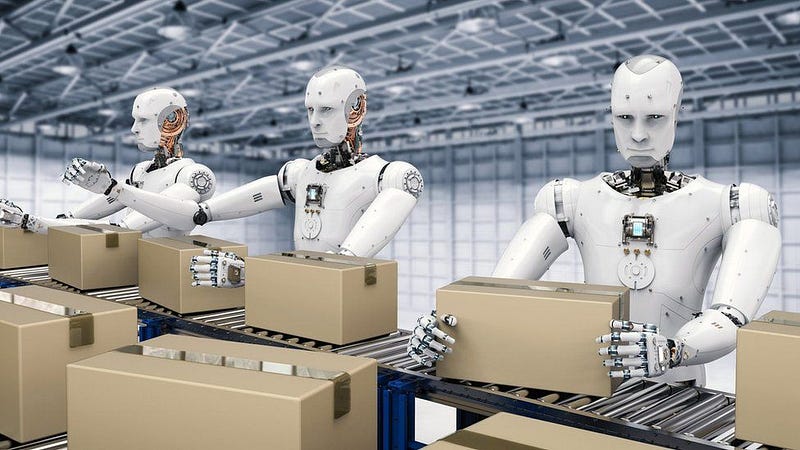
(Image Credit: bbc.com)

Automation is scary!

It seems like every year there is a report saying that half of the current human employees in the United States are at risk of being replaced by software and steel.

  • In 2016, the World Economic Forum reported that US jobs losses could range “from 22.7 million job losses by 2025 to 80 million over the next few decades.”
  • In 2017, McKinsey & Company reported that 51% of working hours ($2.7 trillion in wages) could currently be automated.
  • In 2018, PwC (formerly Price Waterhouse Cooper) reported that close to 40% of US jobs were at risk of automation by the end of the 2030s.

With stats like those, who wouldn’t be worried about losing their job to the shiny new machine that doesn’t take lunch?

But do we really have to worry about machines taking over the workplace, or are these fears overblown?

The answer is as complex as the human workforce itself, so let’s dive right in.

The Fear of Replacement

Replacement by automation has been on our minds since the first machines were installed on automobile factory floors, making precision welds while not incurring health care costs.

Machine integration in the manufacturing sector has been advancing ever since.

The issue at hand is that software, artificial intelligence, and big data have now allowed the creation of machines (i.e. computers) than can replace some white collar work as well, effectively putting the entire workforce on notice.’

If you don’t believe that, just look at the rise of “shadow work”, both on the job and at home.

  • Secretaries who once took dictation, typed letters, and answered the phones have been replaced by voice recognition software, e-mail, and voicemail.
  • Travel planners have been almost fully replaced by Expedia.
  • Open outcry stock traders have all but vanished due to electronic trading.

It’s happening all around us, and almost no one knows how to control, redirect, or otherwise absorb the coming technology into our current jobs.

The COVID Effect

Automation replacement was already on our collective radars before the pandemic.

Now it is at the forefront of the minds, threatening to become reality.

As the U.S. economy rebounds from the COVID-19 pandemic, employers are turning to greater use of automation, including robots, rather than calling back workers or hiring new ones in many cases.

The trend is affecting almost every sector, including manufacturing, distribution, transportation, retail, restaurants and many kinds of personal and government services.

Here’s a blurb from a recent report by Fortune about how the adoption of software automation has gone vertical in a post-COVID world.

The outbreak of the COVID-19 pandemic has compelled companies to shut down their branches and physical stores. Hence, they are relying more on digital solutions to automate front-end and back-end processes.

The demand for advanced software is surging rapidly as more firms are looking for transforming their engagements with stakeholders, customers, suppliers, and employees.

The shutdowns forced companies to work without or with many fewer employees than they had ever expected. This made them realize a few things.

  • There was little need for the number of employees they currently had.
  • They could get by with a lower level of service that could be handled by a robot.
  • The cost savings of automation was huge.
  • Automation was the only way to increase production when no humans were available.

Just take a look at what is happening with pharmacists.

Decades ago, pharmacists used to be a primary source of medical information, with many customers consulting them before going to their primary doctor.

However, the emphasis on streamlining processes and cost reduction during the 70s and 80s led to the entire industry being merely highly-educated assembly line workers, counting pills and manning the drive-through.

A lot of the changed with COVID.

Pharmacists have made monumental progress recently in coming out from behind the counter.

In the wake of COVID-19, many pharmacies are turning to automation technologies to help pharmacists work at the top of their licenses, support operations, and take over redundant tasks. This means reallocating time for immunizations, with a goal of getting patients in and out of pharmacies most effectively.

In a post-COVID-19 world, allowing automation to take the place of filling and supporting verification can get the pharmacy team to focus its attention on patients, which most agree is far more impactful than just filling prescriptions.

And that’s just the tip of the iceberg. Most companies are rolling out automation, with COVID being the main driver.

A survey by Swiss engineering giant ABB Ltd. of more than 1,600 businesses globally found that 8 out of 10 workplaces will introduce or increase the use of robotics and automation in the next decade, with 85% saying Covid had been a game changer for their business.

The Skills Gap

Another major factor that will only accelerate the adoption of automation is the skills gap in the manufacturing sector.

Anyone who has followed Mike Rowe over the years, either on Dirty Jobs or through his foundation mikeroweWORKS, has heard about this skills gap, but here’s a primer.

It is estimated that as many as 2.1 million manufacturing jobs could go unfulfilled by 2030, costing the economy up to $1 trillion. That is an astounding number given that the US is still millions of jobs in the hole compared to before the pandemic. This gap will only be exacerbated by the recent onshoring efforts and a focus on domestic manufacturing and material availability.

So why do manufacturing jobs go unfilled?

  • Entry level positions aren’t attractive.

While they can pay almost double the federal minimum wage, these jobs, “do not require technical know-how or industry knowledge” but need “a basic level of human capabilities, such as following directions, willingness to learn, and follow-through.”

  • New manufacturing jobs require new skills.

The factories of today can’t be run by employees of yesterday. They require a higher set of (digital) skills that many current employees are either unable or unwilling to learn.

Regardless of the cause of this crisis, manufacturing companies are faced with a shortage of skilled labor, but their product demand is forecast to be either unchanged or higher than today.

It’s a simple matter of supply and demand, and any economist will tell you that in the presence of a lack of supply, consumers (the manufacturers) will purchase a substitute (machines) to fulfill their desire for a product (labor hours).

White collar businesses are facing the same problem. Due to economic reasons (unemployment ) or health reasons (fear of catching covid), many customer- or coworker-facing positions are going unfilled (link), pushing companies to more quickly adopt machines to fill those roles.

Artificial intelligence was already threatening to replace these workers prior to the pandemic.

The Balancing Act

So what does the future really hold?

Will the machines replace us all, or will we rise up like the Luddites of old?

The reality will be somewhere in the middle due to the fact that machines don’t really replace jobs; they replace tasks. For the most part, a job is made up of many individual tasks that come together to create a unit of output, which is determined by the human.

…[A]rguments against automation largely ignore the past; any glance in the history books will prove that it has in fact been fueling the economy since its inception.

In fact, many believe that automation will simply do the monotonous tasks currently performed by humans, allow them to perform higher-level, creative work.

[Automation] will automate many white-collar jobs that are tedious and tiring.

A recent IBM report shows that 90% of executives in firms where IA is being used believe it creates higher-value work for employees.

The Takeaway

COVID accelerated many of the issues that were steering companies toward automation, and as an employee, it is vitally important to adapt to this new normal.

Many employers believe that understanding automation makes an employee more valuable.

According to UiPath research (via CMS Wire), more than 70% of executives and managers stated that when they’re choosing between two candidates, they’ll pick the one with experience in automation and AI — even if the job description for the role doesn’t list those skills as a necessity.

The 1980’s destroyed the idea of working for a company for 30 years and retiring with a pension.

The 2020’s are going to destroy the idea of working solely with humans, without any robotic or software automation whatsoever.

Automation is the future, so weave yourself into that future.

Most Recent Stories

Don’t miss my next article! Click here to get notified when I publish new material.

If you love the articles published in Money. Daily., then become a member of the Medium community and get full access to our full archives.

This article is for informational purposes only, it should not be considered Financial or Legal Advice. Not all information will be accurate. Consult a financial professional before making any major financial decisions.

Money
Finance
Economy
Politics
Business
Recommended from ReadMedium