
Wigan
A fabric, a town, and a man about town

Today’s New York Times Spelling Bee letters:
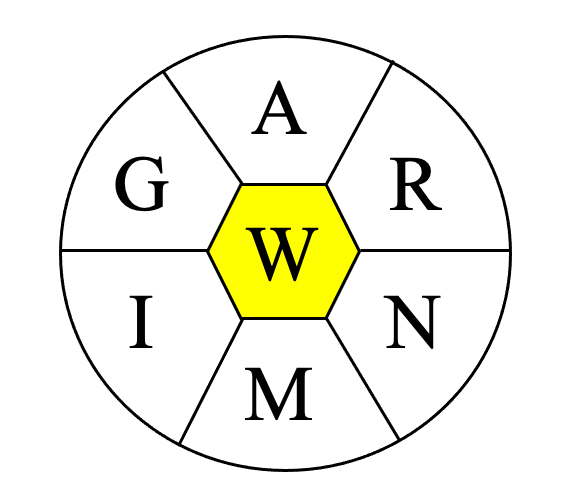
A, G, I, M, N, R, and center W (all words must include W)
Merriam-Webster says…
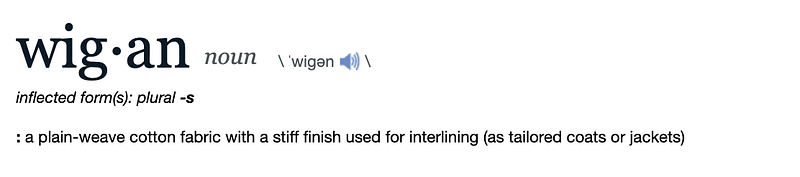
Silly little dictionary! Don’t you know that wigan can’t possibly be a word if the New York Times says it ain’t?
For further fascinating facts, check out the Spelling Bee Master.
What’s your favorite dord* from today’s puzzle?
My Two Cents
It’s Friday, which means we here at Silly Little Dictionary! attempt to use mild clickbait (acceptable per the old 1984 rules of Medium) to hook potential readers and reel them into to the depths of language that we cover only superficially in these articles.
Hence that picture of the cute pug at the top of today’s column. Why did that photo pop up when I keyed “wigan” into the search function of Unsplash? who knows… and who cares? I found a cute picture of a pug! The Unsplash search of “wigan” also yielded these random images:

Maybe the dog’s name is Wigan? Maybe it lives in Wigan? Maybe it’s a dog named Wigan adopted by a woman named Wigan who lives in Wigan, England? So many questions, so little interest in actually finding out answers…
In any case, I’m glad you clicked on the link when you saw the pug. Please stay and read all about today’s dord*.
The fabric of a city
Our friends at Merriam-Webster explain that the word wigan comes from the the name of a town in Lancashire, northwestern England. It was in Wigan that this fabric was first manufactured. I assume it was around 1771, since that is the first recorded use. That makes wigan an eponymous word, much like diesel, boysenberry, dumpster, and zipper.
On the website Catwalk Yourself, Kelly Mitchell describes the material thusly:
Wigan fabric is a plain weave fabric. It is usually made from Cotton and has a very firm handle. It is used mainly to stiffen garments, usually as an interlining. To add to the stiffness, it is often coated with latex rubber. It is usually cut on the bias so that it can be used in stabilising curved areas of garments such as arm holes, hems and necklines. It is a sew in interfacing and is similar to canvas in texture, weight and weave. This fabrics name is derived from the city of Wigan in Greater Manchester where the fabric was originally made.
Wigan fabric is usually cut in strips, as shown below.
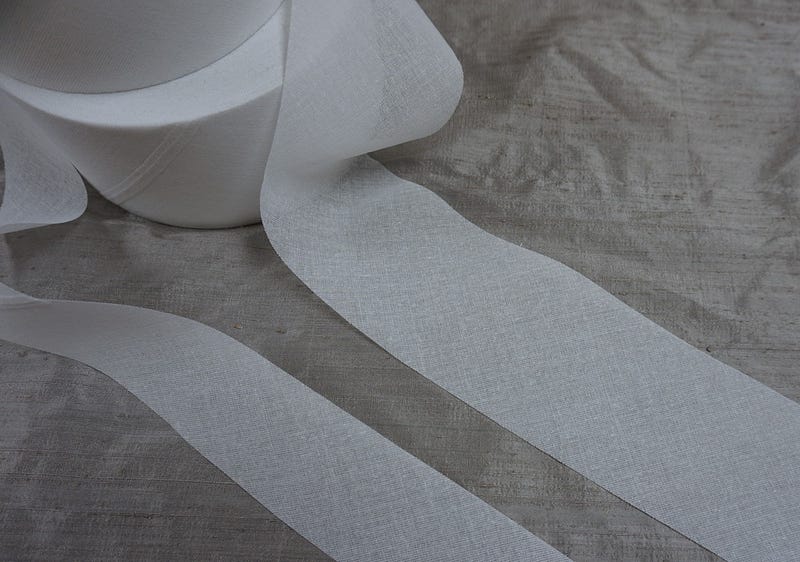
In case you were wondering what the phrase “cut on the bias” means (as I was), our helpful dictionary friends define the textile bias as “a line diagonal to the grain of a fabric, especially a line at a 45° angle to the selvage producing a cut with some stretchability and often utilized in the cutting of garments for smoother fit”.
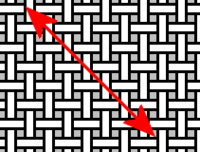
The above is known as a “true bias” because the grain is at a 45-degree angle to the warp and weft threads. If you’re not sure what those two terms mean, here is a picture that’s worth a thousand words and will definitely cut down on this articles reading time, earning me 11 cents instead of the usual 13.
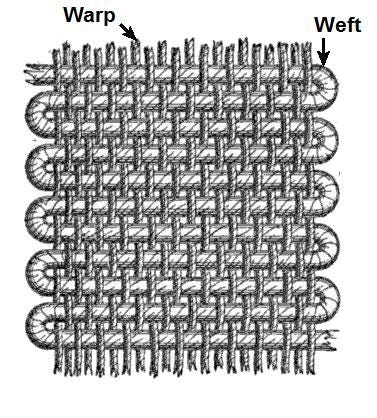
This is the fourth instance this week in which we discuss something that is prefaced with the word “true”. On Monday we mentioned “true cobras”, while yesterday’s article featured “true frogs” and “true toads”.
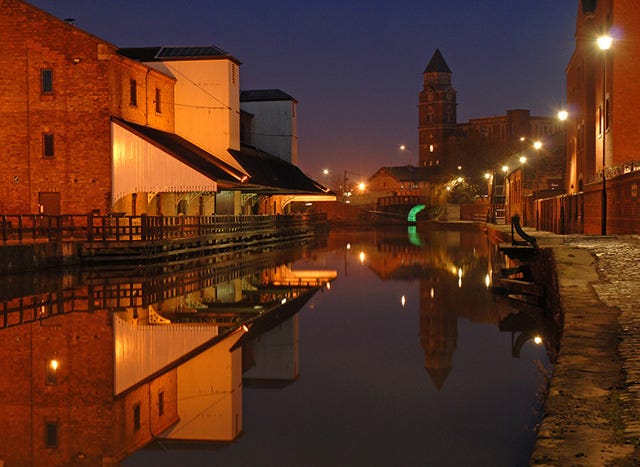
The town of Wigan is located in the northwestern part of the metropolitan county of Greater Manchester, and lies along the River Douglas and the Leeds and Liverpool Canal. This photo is of the Wigan Pier, located at the canal and made famous by 20th-century prophet George Orwell when he highlighted the poor working and living conditions of the locals in his 1937 book The Road to Wigan Pier.
Wigan was incorporated as a borough in 1246 from a charter by King Henry III of England. The 1911 Encyclopedia Britannica mentions that “the town owes much of its prosperity to its coal mines, which employ a large proportion of the inhabitants and supply the factory furnaces. The chief manufacture is that of cotton fabrics; the town also possesses iron forges, iron and brass foundries, oil and grease works, railway wagon factories, and bolt, screw and nail works.”
The cotton and coal industries are mostly gone now, after a post-World War II boom and later slump in both. But the town has managed to attract new business, including the headquarters of Galloway Bakers, the Tote chain of bookies, and DW Sports Fitness, as well as housing Heinz’s largest food manufacturing facility in Europe. There are also a couple of huge shopping centers.
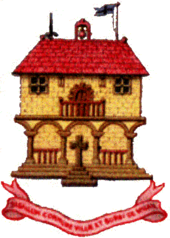
The seal of Wigan (no longer in use, apparently) was pretty cool, as it looks like it could have been part of a town in the game of Zelda circa 1995.
The town hosts the World Pie Eating Championship (Americans please note: these are meat-and-potato pies, not desserts) and has its share of well-known musical figures, including rock band The Verve and Limahl, of Kajagoogoo and “NeverEnding Story” fame. But there is one artist from Wigan who reigns supreme when it comes to fame and fortune in 20th-century England.
Wigan’s finest
George Hoy Booth, better known as George Formby, was born in Wigan in 1904. Yesterday he would have turned 118. But he lived less than half of those years, dying at the age of 56. Formby was an English actor, singer-songwriter and comedian who at the peak of his career became the UK’s highest-paid entertainer. His film career in the 1930s and 1940s introduced him to a worldwide audience (there was no TV or internet yet) and made him even more famous. He was especially known for performing light, comedic songs, usually while playing a ukulele.
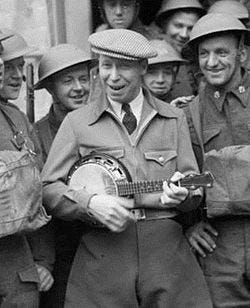
Son of George Formby, Sr., also a comedian and singer, Formby, Jr. first worked as a stableboy and horse-racing jockey. When his father died in 1921, Formby took over, basically repeating his dad’s act verbatim. Two years later he made choice that changed his life: he bought a ukelele and got married. Which was probably better than marrying a ukelele and buying a wife. His wife, Beryl Ingham, was a performer and champion clogdancer who became Formby’s manager and transformed his career. As the George Formby Society explains:
By 1939, George Formby was the most popular and highest paid entertainer in the British Isles and was estimated to be earning over £100,000 a year. The secret of his success was a unique combination of personality, natural ability and talent coupled with the driving force of his wife, Beryl as his Manager. With his natural human warmth and friendliness, George could hold a live audience in the palm of his hand as he sang and played the ukulele in his own inimitable style. He seemed to have the ability to make people enjoy what he did, and his audiences always called for more.
Although he never performed in the United States, Formby did make personal appearances and was quite popular in Canada, Australia, New Zealand and South Africa. In the latter country, he defied racial segregation in 1946 and performed in a Black venue, even embracing a girl who came on stage with a present for him. This did not sit well with Daniel Malan, the leader of the National Party that ended up officially implementing apartheid two years later. When Malan called Formby to chastise him over the phone, George simply responded: “Why don’t you piss off, you horrible little man?”
Formby’s career began to decline after he had his first heart attack, in 1952. He took some time off to recuperate and gradually came back, returning to his stage roots for his performances. In 1960 he made his last record; in December of that year his wife Beryl died from leukemia. Out of left field a few weeks later, Formby announced his engagement to a young schoolteacher. But the marriage never took place as George had his second heart attack in February of 1961 and died the following month.
Here is part of a British Pathé reel showing George Formby supporting the English troops in France during World War II. He took the job of entertaining soldiers seriously, and it’s estimated he ended up performing in front of some three million of them over the course of the war.
That’s it for today. Next time you visit Wigan, England, be sure to bring a jacket or other clothing item lined with wigan. That way, you can tell your friends you “wore a wigan in Wigan”. Your friends will think you’re cuckoo, of course… because the editors of the Spelling Bee decided that wigan is a dord*.
You can check out my previous entry on another dord* here:
*What the heck is a dord, you ask? Here’s the answer: