
Naga
Let this word spirit you away
Today’s New York Times Spelling Bee letters:
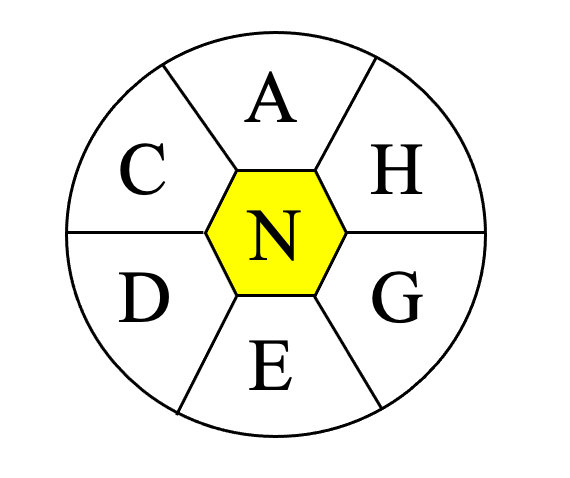
A, C, D, E, G, H, and center N (all words must include N)
Merriam-Webster says…
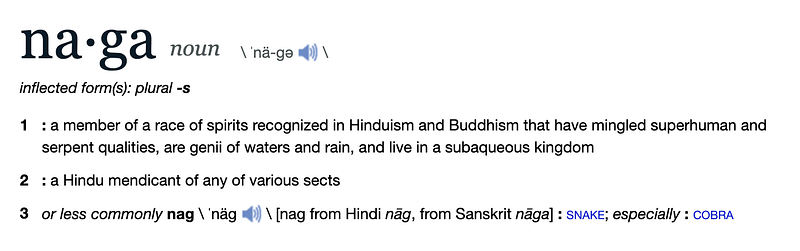
Silly little dictionary! Don’t you know that naga can’t possibly be a word if the New York Times says it ain’t?
For further fascinating facts, check out the Spelling Bee Master.
What’s your favorite dord* from today’s puzzle?
My Two Cents
Writing this column has been educational from day one. I always learn something new, and usually improve my knowledge about things I was already familiar with. New information can come from many sources; the rabbit hole that is the inter webs patently manifests itself almost every time I perform my obligatory intensive 15-minute research. But sometimes new insight is gained right here using that Medium tool we all have a love-hate relationship with: Unsplash.
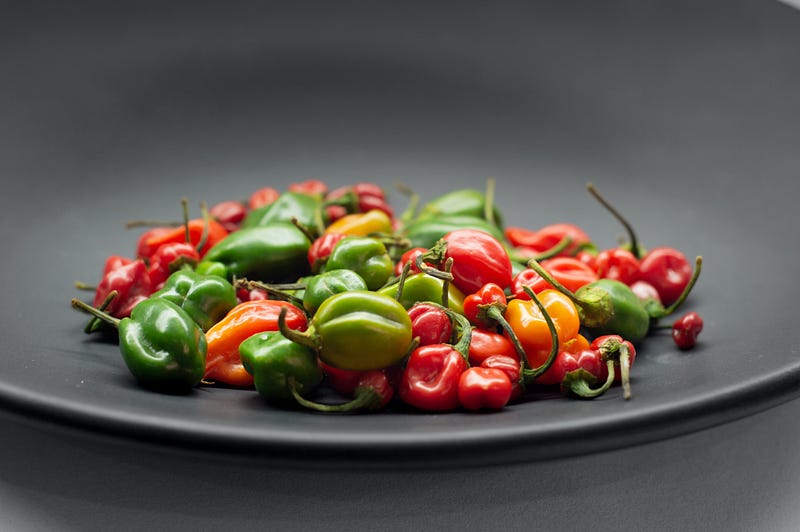
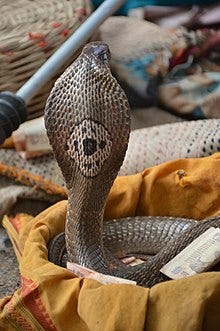
Unsplash was created as a repository of photos that are available free of charge to writers of this platform. Just click on the plus button that pops up on the left when you hit enter on your screen, then click on the magnifying glass icon, type in your word, and press enter again. You’ll get the results you wanted… and just as often you won’t. Today I keyed in “naga” and got one picture of a cobra (which is entry 3 in the dictionary). That was fine, but the image was set vertically and I prefer the horizontal ones for my article headers. I also saw a bunch of photos of peppers. Wondering why, I added two more tiresome minutes to my research.
Turns out there is a variety of pepper known as the Naga Viper. I suppose those in the know sometimes refer to it simply as Naga, and those in the know know may call it Nag. Which might be appropriate, considering this hot chili will certainly annoy your taste buds. It has a rating of 1,382,118 Scoville Heat Units (SHU) when it was entered into the Guinness Book of World Records as the “World’s Hottest Chili” in 2009. However, in 2017 was surpassed by the Carolina Reaper. To give you an idea how hot the Naga Viper is, the SHU range of the habanero pepper, considered spicy by most people, is a mere 100,000 to 350,000 units. Meanwhile, the tabasco pepper (yes, the one used in the sauce) is a wimpy 30,000 to 50,000 SHU.
The Naga Viper was created in Cark, England by chili farmer Gerald Fowler of The Chilli Pepper Company. Supposedly it is a hybrid of some of the world’s (previously) hottest peppers: the Naga Morich, the Bhut jolokia (a hybrid itself) and the Trinidad scorpion.
So today I’m forced to thank Unsplash for learning me something. Of course, I had to use one of the photos of Naga Vipers. Now that we got that out of the way, let’s move on to naga with a lowercase “n”.
Spirited away
In the 1911 Encyclopedia Brittanica entry for cobra, the author states that it is “a poisonous Colubrine snake, belonging to the family Elapidae, known also as the hooded snake, cobra di capello or naga.” The species name is given as Naja tripudians, which today has been changed to Naja kaouthia, the scientific name of the monocled cobra. And no, this venomous snake does not wear a single eyeglass to look more sophisticated. (Neither does the Monopoly Man, by the way.) The “monocle” of the cobra can be seen on its hood:
The snakes in the genus Naja are considered to be the “true cobras”. I’m warning you in case you get a visit from a fake cobra; they’re always trying to rope you into some shady pyramid scheme.
The genus name comes from the Sanskrit nāga, meaning “snake” (some explain that it means specifically “cobra”). That is the same origin of our daily dord*, which takes us to the spirit world. As the Encyclopedia Britannica explains, a naga is…
…in Hinduism, Buddhism, and Jainism, a member of a class of mythical semidivine beings, half human and half cobra. They are a strong, handsome species who can assume either wholly human or wholly serpentine form and are potentially dangerous but often beneficial to humans. They live in an underground kingdom called Naga-loka, or Patala-loka, which is filled with resplendent palaces, beautifully ornamented with precious gems. The creator deity Brahma relegated the nagas to the nether regions when they became too populous on earth and commanded them to bite only the truly evil or those destined to die prematurely. They are also associated with waters — rivers, lakes, seas, and wells — and are guardians of treasure.
I love that personalized detail of the naga being “a strong, handsome species”. Someone has a crush!
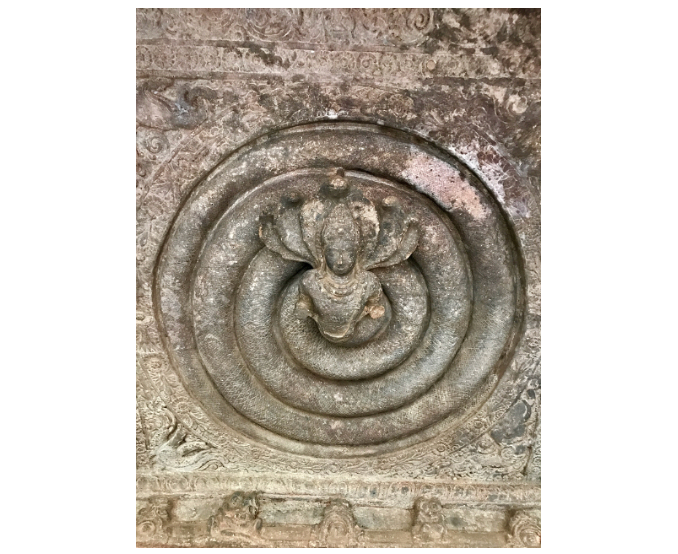
The photo below shows a 6th-century carving of a naga in the Badami cave temples, Hindu and Jain complex located in Badami, a town in the south-western part of India.
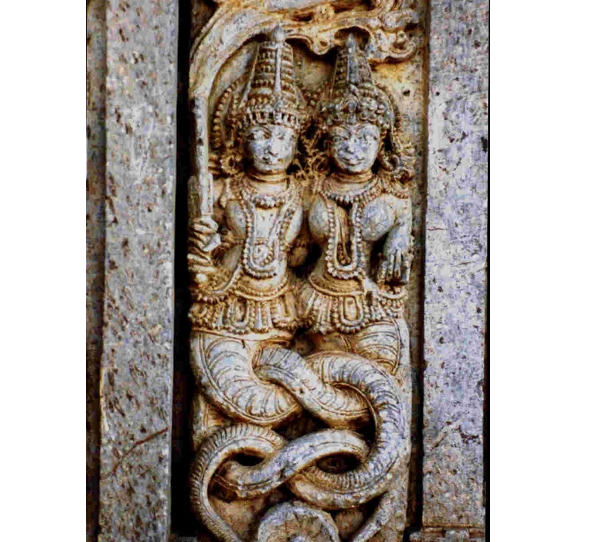
Female nagas are called naginis. Here are a naga-nagini couple from the state of Odisha in India.
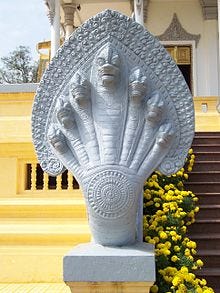
India is not the only country where there are naga legends. In Sri Lanka, the Naga people were thought to be an ancient tribe and the original people of that nation. And the Khmer society of Cambodia has passed along stories of nagas for millennia. Nagas with odd-numbered heads are believed to represent immortality, and are carved and used throughout Cambodia. Like this one at the Royal Palace in Phnom Penh.
We’ve covered definitions 1 and 3 presented by the dictionary. As to definition 2, “a Hindu mendicant of any of various sects”, I figured that mendicant meant beggar and searched for that as a translation of naga. In a roundabout way I discovered that these mendicants are actually religious ascetics, holy people in both Hinduism and Jainism who have renounced the worldly life. Oh, and they are more commonly called Sadhu (“good man””) and sādhvī or sādhvīne (“good woman”).
Sadhu means one who practices a ‘sadhana’, that is, strictly follows a path of spiritual discipline. As with squares and rectangles, the vast majority of sādhus are yogīs, but not all yogīs are sādhus. One of the subgroups is the Naga, naked sadhu known for carrying weapons like swords and spears, and believed to have once been part of an armed order established to protect Hindus from Mughal rulers.
So many Nagas, so little time
There is a plethora of Nagas with capital N. We already mentioned the Naga people of Sri Lanka, but there are also the ethnic Nagas of northeastern India and northwestern Myanmar. And the Naga Rajputs, a group of Rajput clans from India, too. That country also has an infantry regiment called Naga. There is an Indian film director born Nagarajan, but nicknamed Naga, an Indian film actor named Naga Chaitanya, and an English journalist and television presenter known as Naga Munchetty.
There are villages, towns, cities, districts, municipalities, states, hills, and even a river all named Naga. Mostly in Japan and the Philippines, although the district is in Myanmar.
There are even several fictional characters named Naga. One is Naga Sadow, a Sith Lord in the Star Wars Expanded Universe. Perhaps the best-known one is the Marvel villain created by writer Roy Thomas and artist Marie Severin. Naga made his debut in issue 9 of the Sub-Mariner comics. And just like Prince Namor (the sub-mariner), he is an aquatic humanoid species known as Homo mermanus. This mammalian-fish hybrids look like humans but have twin gills located on their necks near the clavicle bones that allow them to breathe underwater. Those from Atlantis are blue-skinned, while those from Lemuria are green. Naga is the latter.
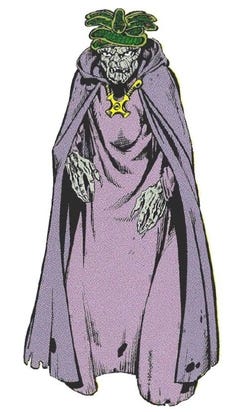
The appendix of the Marvel Universe handbook explains that the green thingamajig you see on Naga’s head is “the Serpent Crown [from which] Naga drew great mystical power from the Serpent God Set, granting Class 10 strength and the ability to project concussive energy powerful enough to lay waste to entire cities.” This despite being only 5 feet 6 inches tall and weighing a mere 135 pounds. Naga’s original physical appearance was changed from constantly wearing the crown. His face became snake-like and his skin green and scaly.
The handbook further clarifies that there is “no known connection to” the Hindu Naga… except for the fact that the name of this villain derived from that word, and he is snake-like. I guess Marvel isn’t afraid of being sued by spirits.
Now you know. Next time you’re in India or Cambodia, try to search for some carvings or statues of nagas. Just don’t tell anyone that you actually found them. They’ll never believe you… because the editors of the Spelling Bee decided that naga is a dord*.
You can check out my previous entry on another dord* here:
*What the heck is a dord, you ask? Here’s the answer: