
Maar
Coming soon to a volcano near you?
Today’s New York Times Spelling Bee letters:
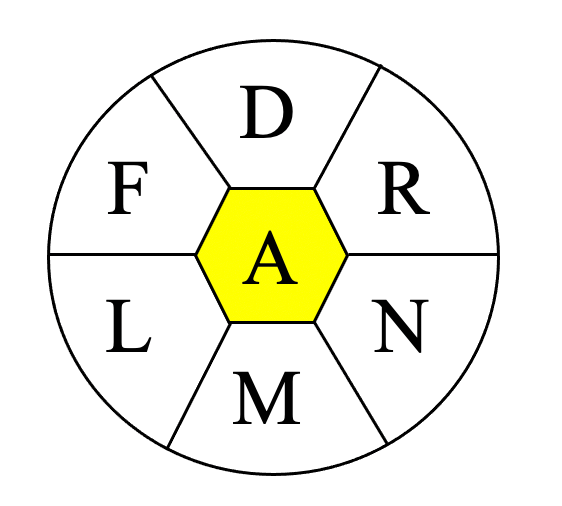
D, F, L, M, N, R, and center A (all words must include A)
Merriam-Webster says…
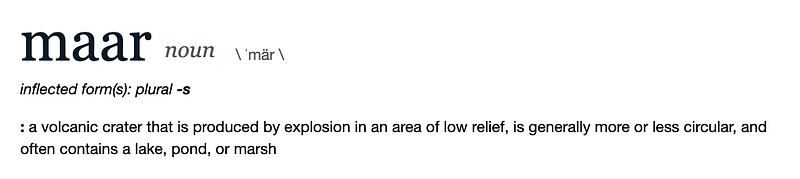
Silly little dictionary! Don’t you know that maar can’t possibly be a word if the New York Times says it ain’t?
For further fascinating facts, check out the Spelling Bee Master.
What’s your favorite dord* from today’s puzzle?
My Two Cents
My regular readers ––all four of them–– can be excused for thinking it’s deja vu all over again. Just three days ago I published an article with a very similar title, except instead of M it had an H. As in haar, which I promise is a word despite the Spelling Bee declaring it a dord*.
Both maar and haar have in common their Germanic origin (maar is actually a word borrowed from the German) and the fact that both are phenomena created under specific condition. John Carpenter horror movies aside, a haar is a fog and therefore more temporary than a maar, which is a permanent geographical feature. Permanent until the next ice age comes along, that is.
In any case, it’s by sheer coincidence that we have two articles with almost identical titles within the space of a few days. And just like haar, maar will also provide us with pretty pictures aplenty.
Lowercase m
Our friends at Merriam-Webster laconically explain that maar comes from the German. That’s it. One word in their “History and Etymology” section. Don’t believe me?

My linguistic instincts whispered that this could mean it was a borrowed word. English has a lot of these, perhaps more than you might realize: loot (Hindi) and avatar (Sanskrit) are just two examples.
The Wikipedia entry for maar in German is Maar, which, as my buddy Hemanth kindly reminded me the other day, takes a capital M. That’s because all nouns in German are capitalized, like they used to be in English some 300 years ago. Don’t believe me? Check out the first lines of the 1787 U.S. Constitution:

In case you can’t read that 18th-century script, here it is in Medium font: “We the People of the United States, in Order to form a more perfect Union, establish Justice, insure domestic Tranquility, provide for the common defence, promote the general Welfare, and secure the Blessings of Liberty to ourselves and our Posterity, do ordain and establish this Constitution for the United States of America.”
By the late 1800s this practice died out, and today English uses initial uppercase letters in proper nouns only.
Sorry, we’ve gotten off track here, and I did promise pretty pictures.
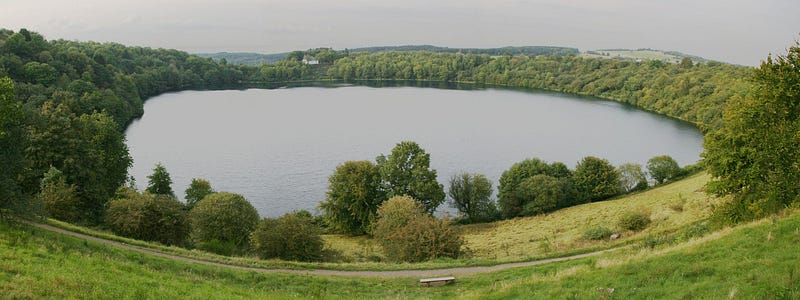
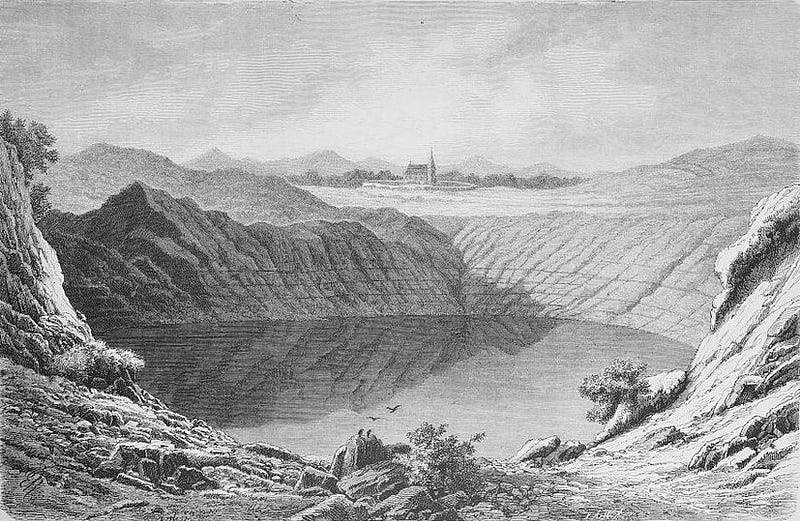
The 1911 edition of the Encyclopedia Britannica mentions maar in its article about craters, explaining that “the crater in an active volcano is kept open by intermittent explosions, but in a volcano which has become dormant or extinct the vent may become plugged, and the bowl-shaped cavity may subsequently be filled with water, forming a crater-lake, or as it is called in the Eifel a Maar.” In case you’re wondering, Eifel is not the lesser-known tower in Paris with only one F, but a low mountain range between western Germany and eastern Belgium.
In fact, that photo above is of the Weinfelder Maar, which located in the Eifel, along with its two siblings, Gemündener and Schalkenmehrener. Here all three of them. The photo was taken in a family reunion that, based on the fact that they’re not wearing masks, must have taken place pre-Covid.
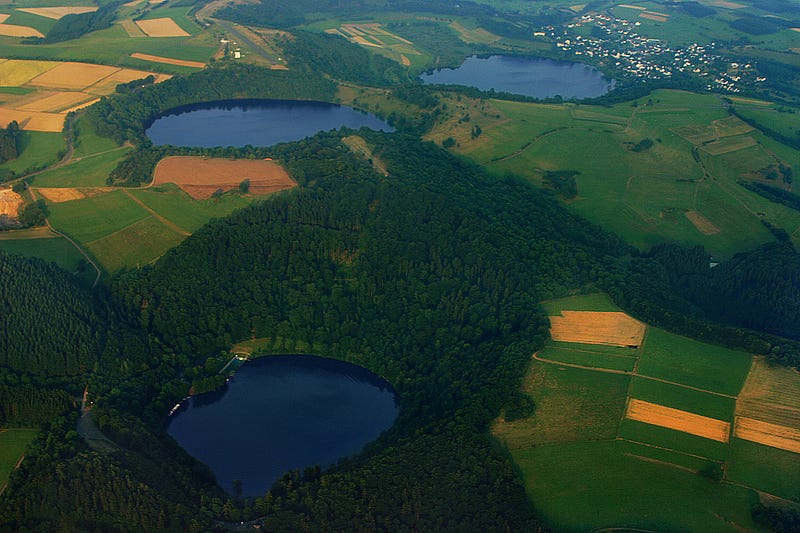
I was hoping the current version of the Britannica would provide more information than the one published more than 100 years ago, and, sure enough, I was disappointed:
maar, small crater blasted by a low-temperature volcanic explosion and not associated with a volcanic cone. The rim of ejected fragmental material around the crater often is very low and inconspicuous. The best known of these are in the nearly horizontal, nonvolcanic rocks of the Eifel region in Germany; many contain beautiful little blue lakes. Similar explosion craters have been found in flat-lying rocks in other regions.
Those beautiful blue lakes the encyclopedia mentions are also called maars, which can be a tad confusing. Fortunately, when the lakes dry up they are known as dry maars. And of course the Eifel has one of those, too.
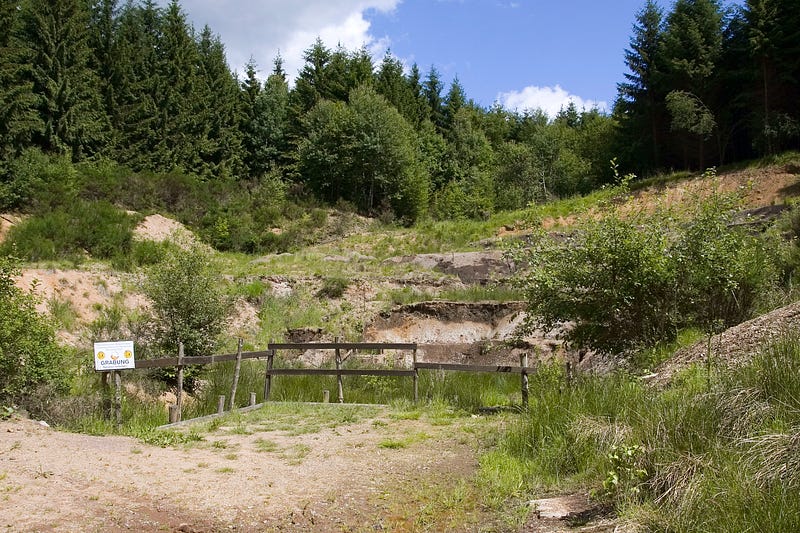
That’s the Eckfelder Maar, the oldest known maar, some 44.3 million years old. So far, it has provided scientists with around 25,000 fossils to study, keeping them very busy since the 1980s.
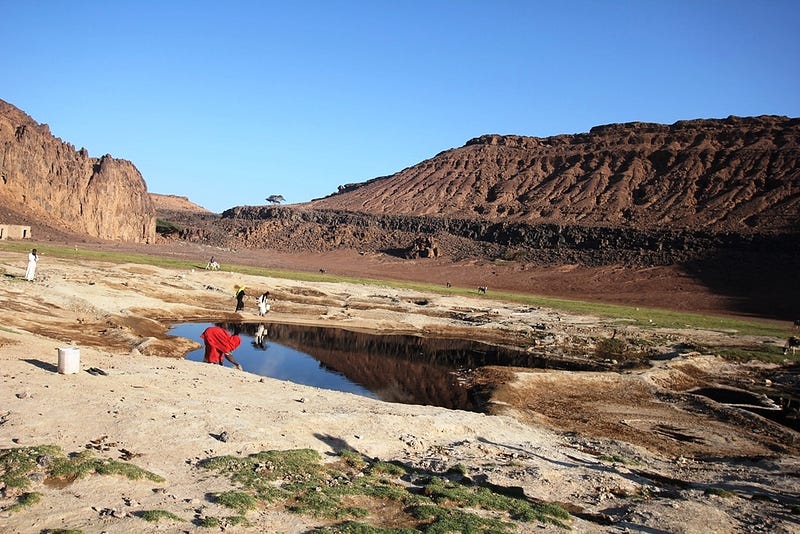
Here is another dry maar, in a volcano field of the Bayuda Desert.
Remember that “low-temperature volcanic explosion” that creates the maar? Well, we have a pretty picture of that for you, too.
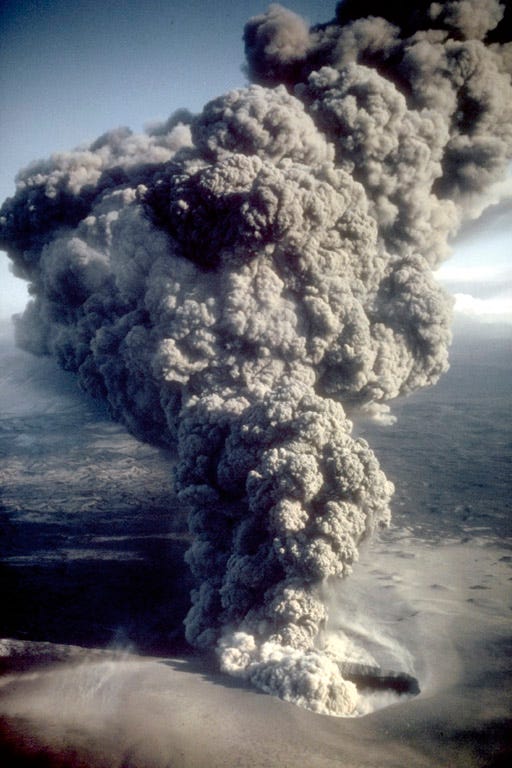
That one was taken in Alaska, which is one of the places in the U.S. where you can go see a maar. Other states that have them are Washington, Oregon, California, New Mexico, and Nevada, which has the Big Soda and Little Soda lakes. Big Soda is sooooo big… (How big is it?!?) …that you can only take a photo of a small part of it.
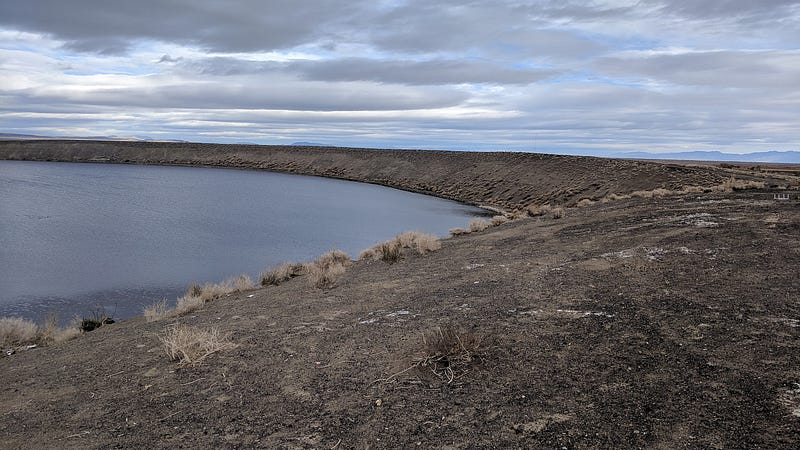
Or, at least, that was the case with Ikluft. Oh, well, at they tried.
Uppercase M
There are several Maars with a capital M, including one that also has two capital As, a capital R, and a capital S. That’s because it’s an acronym that stands for Modular Advanced Armed Robotic System, a robot being developed by British defense company Qinetiq.
There are also several Syrian villages whose names being with Maar, as in Maar Dibsah, Maar Hattat, and Maar Shuhur.
Pocket Maar is the English title of two Hindi films, one from 1956 and one from 1974. The latter is not a remake of the former. In Hindi, पॉकेटमार can be roughly spelled out as poketamaar and means “pickpocket”.
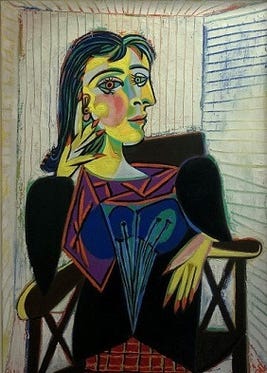
Dora Maar was the artistic name of Henriette Theodora Markovitch, a French photographer, painter, and poet who passed away in 1997 a few months shy of her 90th birthday. Sadly, she is best remembered as one of painter Pablo Picasso’s romantic interests and muses. She appears in several of his paintings, including one aptyl titled Portrait of Dora Maar.
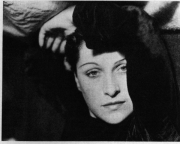
To get a better idea of what she looked like, however, let’s see Man Ray’s portrait of here:
Finally, there’s Paul Maar, a German novelist, playwright, translator and illustrator. Still alive , he will turn 85 in December, and is considered to be one of the most important modern German writers for children and young people. The biography on his website explains that…
Paul Maar was born on December 13, 1937 in Schweinfurt. After graduating from high school, he studied painting and art history at the art academy in Stuttgart, after which he worked as an art teacher for six years. Today he lives as a freelance author and illustrator in Bamberg. He is married and has three grown children. Paul Maar writes children’s and youth books and, together with his wife Nele Maar, translates children’s books from English… His books have received numerous awards… and have been translated into many languages… According to performance statistics from Die Deutsche Bühne, he has been the »most frequently performed living German« playwright in Germany, Austria and Switzerland for several seasons… His best-known (own) characters are undoubtedly Sams, a mysteriously cheeky mythical creature….
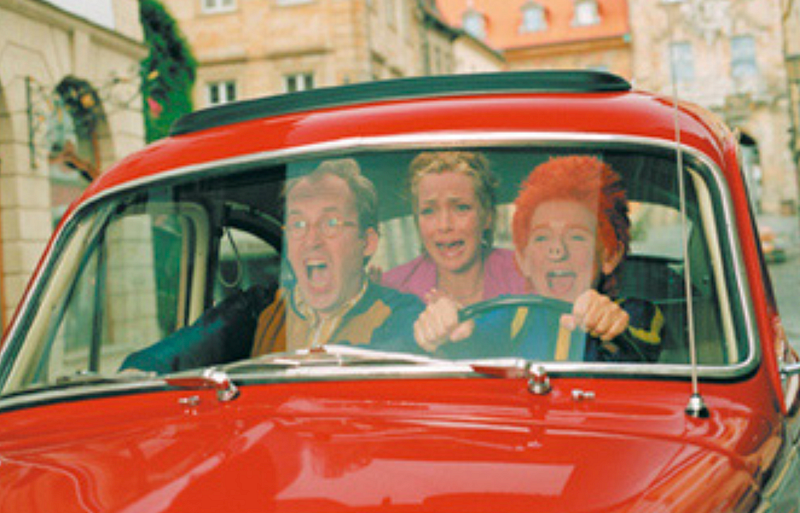
The Sams is a creature with red hair and a pig’s nose that shows up on Sams-Day (i. e., Saturday) and can grant wishes and help people. A movie adaptation came out in 2001, and was promptly translated into English as The Slurb. Which apparently is also an acronym and stands for Speckled Little Unidentified Red-headed Being. As in this creature driving the car:
If you’re curious, you can read the synopsis of the plot here.
Now you know. Next time you’re visiting the Eifel (and not the Eiffel), find a maar and pull out that old copy of a Paul Maar book you brought along. Then you can tell your friends you “read a Maar while at the maar”. Unless they’re German, your friends will have no idea what you’re talking about… because the editors of the Spelling Bee decided that maar is a dord*.
You can check out my previous entry on another dord* here:
*What the heck is a dord, you ask? Here’s the answer: