
Hangtag
This word should be machine-washed in cold water
Today’s New York Times Spelling Bee letters:
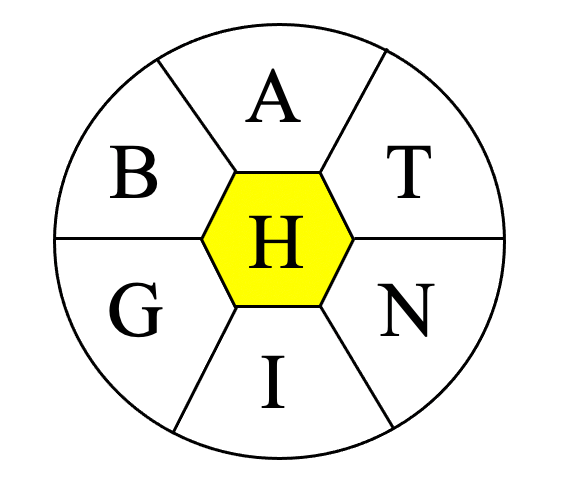
A, B, G, I, N, T, and center H (all words must include H)
Merriam-Webster says…
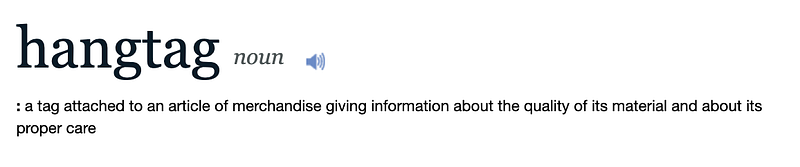
Silly little dictionary! Don’t you know that hangtag can’t possibly be a word if the New York Times says it ain’t?
For further fascinating facts, check out the Spelling Bee Master.
What’s your favorite dord* from today’s puzzle?
My Two Cents
The photo at the top of today’s article does not show a hangtag. I just placed it there to see if you were paying attention. That is a regular clothing tag that does not “hang from” the item, but instead is sewn on or attached by some other means. Here is a picture of a real hangtag, not the impostor I used earlier.
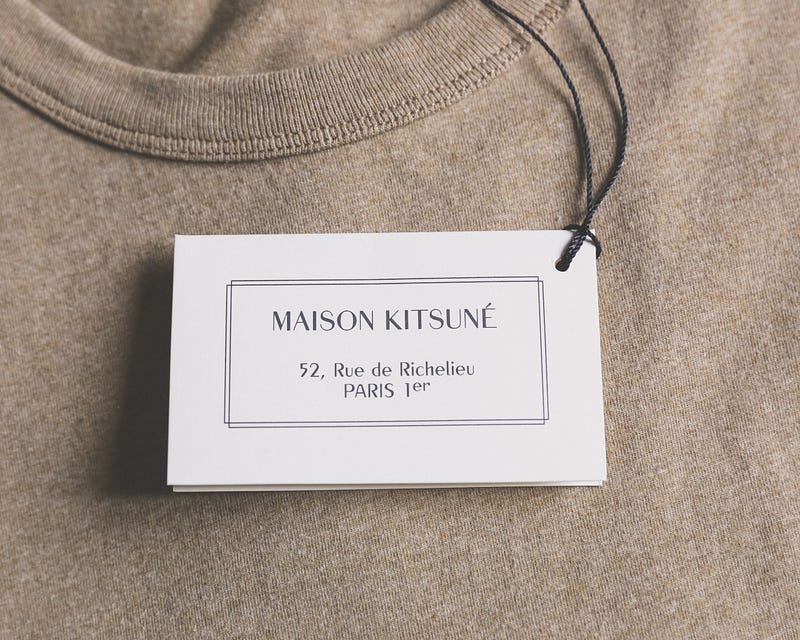
I was curious about the company on this hangtag, so I looked them up. Turns out Maison Kitsuné has an interesting history and even a short film featuring Harrison Ford’s daughter.
What can I say… sometimes writing this column on Medium comes with surprising and wonderful serendipities.
Hang in there!
Our friends at Merriam-Webster claim that the first known use of the word hangtag occurred in 1952. I’m curious as to the who-what-when-where-why of this specific year, but the dictionary elaborates no further. They also don’t provide an etymology, although common sense dictates that hangtag is simply a compound word made by gluing together “hang” and “tag”.
Tag as in clothes tag, yes, that piece of sewn material that includes care instructions for the item. Instructions that you’ll likely end up either not reading or, best case scenario, reading and ignoring. Chances are that material will annoy and itch your skin, so you’ll end up cutting it off anyway.
Speaking of origin and compound words, for the life of me I can’t understand why the Spelling Bee rejected this word. When I searched the New York Times archives, I found several articles that included the term. The earliest one was from June 24, 1968, and the header was MERCHANTS HEED FASHION SPEED-UP; Yunich Asks Apparel Group for Frequent New Lines. Yunich was David L. Yunich, president of Macy’s New York back then. Apparently he had an issue with hangtags, complaining that “some coats sold in his store have as many as eight–-including one each from the apparel, fabric, fiber, lining, and interlining manufacturer”.
It seems as though Yunich’s kvetching had some effect. Today all the above information -–and more–– usually appears on a single hangtag clinging to the clothes item.
Nowadays hangtags don’t just provide data about the material, size, provenance, care, and price of a clothing item, but can also tell you about its carbon footprint or even offer a brief bio of a vintage garment.
So why did the Spelling Bee not acknowledge the word hangtag? It’s not hyphenated, it’s not a proper noun, and I don’t think it’s obscure. We see and use them on a daily basis. Heck, even The New York Times’ late, great William Safire mentioned the word in one of his “On Language” columns way back in 1982:
Before laying me down to a conclusion, let me add this tagline: Every pillow has a hangtag to describe the material. A corner label, or silk label (made of rayon), is sewn on the ear of the pillow. The law label is a hangtag that frequently shouts, ‘’Do not remove this label under penalty of law.’’ My sister-in-law Gladys was always intimidated by these hangtags, figuring their message was directed at her and not the seller. When they fell off, she used to sew them back on, law-abidingly.
Hangtags are not limited to clothing or pillows, either. One of the example sentences given by the dictionary is from an article published last month in The San Francisco Chronicle. In it, Gregory Thomas describes a new program by the Department of Parks and Recreation. The state of California began distributing free passes to more than 200 park areas through public libraries. At one point, Thomas refers to the passes as hangtags: “Each hangtag grants entry for one carload of day-use visitors (up to 9 people). It doesn’t guarantee a campsite reservation or cover the cost of boat use or other fees. The loan period of each pass varies by library.”
In an effort to sway the minds of the Spelling Bee editors, we are including a special voluntary non-paid assignment for our eagle-eyed readers. But you’ll have to read on to find out what it is.
House of the rising fox
The name of Maison Kitsuné fuses the Japanese and French backgrounds of its founders, Masaya Kuroki and Gildas Loaëc. The former was born in Japan but moved to Paris at the age of 12. Later, while studying architecture there, he worked in a thrift shop across a vinyl record store that Loaëc had opened. That is where the future business partners first crossed paths. Loaëc also met electronic music duo Daft Punk at his shop, and ended working as their manager and creative director.
On a trip to Japan the two of them took together, the came up with the idea of creating a brand that would combine their love of music and clothes. They founded the company in 2002 and chose the name Kitsuné, which is Japanese for “fox. According to what they explained in a 2008 interview, “Kitsuné is a nice creature that protects a temple and has the power to change his appearance; Kitsuné as a brand is also like that… we are always changing faces.”
It took the enterprising pair almost a decade to build their brand, and the original website (no longer active) was launched as a record label that also sold clothes. The name of the company has since morphed to Maison Kitsuné, with many stores and cafes all over the word, a “stronghold in today’s lineup of successful lifestyle brands”, as Hypebeast refers to them. Their eclectic musical lineup includes such artists and bands as Puerto Rican Buscabulla, Japanese Fantastic Plastic Machine, English La Roux (of “Bulletproof” fame), Australian Parcels, French The Teenagers, and multinational electronic music band Thieves Like Us.
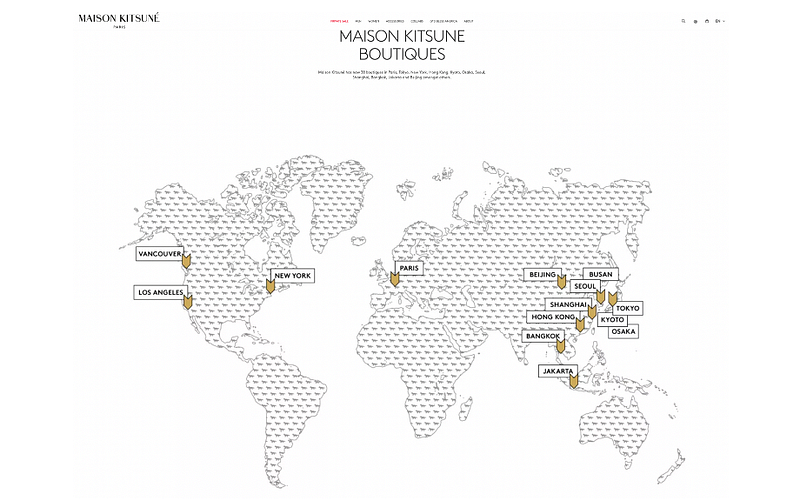
Maison Kitsuné also sells shirts, polos, cardigans, dresses, and other clothes, which I’m sure all have hangtags. But they have also ventured into the realm of film with their “Carte Blanche” series. As they explain themselves:
Maison Kitsuné asked French Director Laura Marciano to translate some of its ‘Iconics’ in motion. The result? An unexpected film featuring Euphoria’s new star Chloe Cherry and Harrison Ford’s stunning daughter, Georgia Ford. “Super glossy, ultra-sexy, funny and weird, this trilogy is 100% Americana,” says Laura Marciano. Unlike a usual fashion video, this project was approached as modernized Spaghetti Western in which one video leads to the next. Three wacky episodes, each centered on a character archetype inspired by stylized pop culture.
The first episode of the trilogy called G*d Bless America will be released this coming Wednesday, May 25th. Episode two will come out on Saturday, May 28th, while the third and final installment will be shown on May 31st. You can watch the very short teaser-trailer here:
Now you know. And here is your assignment: Next time you visit a Maison Kitsuné store (or any other clothing shop), make sure to confirm that their clothes have hangtags. Please take a picture and send it to Silly Little Dictionary! That will help us prove that there is such as thing as a hangtag… despite the best efforts of the Spelling Bee editors to try and declare hangtag a dord*.
You can check out my previous entry on another dord* here:
*What the heck is a dord, you ask? Here’s the answer: