
Why Your Perception of Martin Luther King Jr. is Smoke and Mirrors
Assessing efforts to whitewash MLK’s non-violent advocacy
America has given the negro people a bad cheque, a cheque which has come back marked insufficient funds. But we refuse to believe that the bank of justice is bankrupt” — Martin Luther King Jr. in 1963 (Sturino & Masemann, 2018).
Most Americans admire the life and work of Martin Luther King Jr., but their perception of him is smoke and mirrors. During his lifetime, the majority of white people dismissed King as a radical. Despite this slander, modern history teachers and political pundits aim to market MLK as palatable to white people. They desperately want Americans to think that he promoted peace even at the expense of justice, which is an egregious fallacy. In whitewashing history, American schools aim to create a complacent populous, uninspired to make necessary changes in a nation that systematically oppresses Black people. They clumsily declared his dream as an actuality, obscuring reality from fantasy.
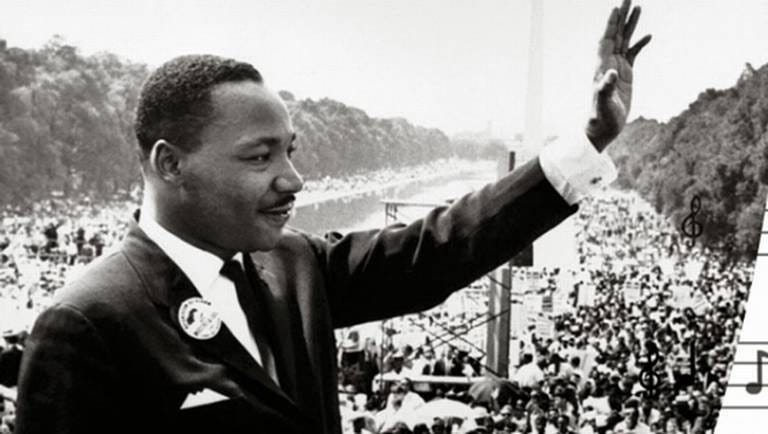
As a Civil Rights leader, he advocated for equal rights and justice. He became a cultural reformer and, with his cohorts organized sit-ins, and marches. Conservatives cherry-picked parts of his famed “I Have A Dream Speech” to distort his life’s work. The vision he so eloquently captured the nation’s attention with described a hypothetical. He wanted Americans to fulfill this aspiration. In no way, shape, or form did King say his dream came true. White people’s efforts to say otherwise are discourteous and fictitious.
1963 is not an end, but a beginning. (Yes) And those who hope that the Negro needed to blow off steam and will now be content will have a rude awakening if the nation returns to business as usual. [enthusiastic applause] There will be neither rest nor tranquility in America until the Negro is granted his citizenship rights. The whirlwinds of revolt will continue to shake the foundations of our nation until the bright day of justice emerges (King, 1963).
Historians tone police Martin Luther King Jr. by highlighting only the parts of their speech that provide a neutral tone. In his speech, he told Americans they are in for a rude awakening if they think things will return to business as usual. Until we address racial inequities, Black people will not stop speaking out, fighting for equal rights and justice. Moreover, he supported advocacy. King would not tell Black Lives Matter protesters to cease their efforts because he spent his life speaking out against these very injustices.
We can never be satisfied as long as the Negro is the victim of the unspeakable horrors of police brutality (King, 1963).
His declaration asserted that 1963 was the beginning of a movement, not the conclusion of it. When white people argue that Martin Luther King Jr promoted a colorblind ideology, they are fundamentally wrong. When he spoke, in his dream about little black boys and girls joining hands with little white boys and girls in sisterhood and brotherhood, he was sharing his vision.
Too many white people assume that because we desegregated, the racial wounds of this nation healed. However, America never reckoned with the sins of slavery, Jim Crow, mass incarceration, and systematic racism. Ironically, our relationship is assumed healed by those who have cut us down.
The fight has and always will be about equal rights and justice. Of course, we all want to live in a world where race is not a factor. King’s dream was an American aspiration; he intended it to be the spark to bring about the changes this country needs.
Since the inception of MLK Day, there has been not only a callous monetization of King’s image, but also a watering down of his radical message (Rashad Grove, 2020).
The frequent watering down of his rhetoric imposes a falsehood of American exceptionalism. White people turned his dream into a Black American’s nightmare. Our Black heroes are silenced, assassinated, and tarnished. These attempts have the same goal — to silence and invalidate Black pain.
The government, along with white leaders, have long benefited from the smoke and mirrors strategy. When we do not fight, we accept every injustice that we suffer. MLK did not want that. The systemic opposition to reforms to address inequality jeopardizes the American franchise.
There was such a concerted effort by the federal government, by many others to undermine the civil rights movement, to target leaders like Martin Luther King Jr. and really to disrupt any efforts to organize for black civil rights, (Sturino & Masemann, 2018)
Since his assassination in 1968, many white people have dishonored his legacy. They want Black people to think that peace is more important than truth, equality, and justice. Modern advocates are disregarding this vapid pacifism that dishonors the advocates who came before us.
White people feel uncomfortable when they see racial issues in the news, on their timeline, and in their communities. They want to place a wedge between their whiteness and the cruelty Black people endure. As the saying goes, “The road to hell is paved with good intentions” — meaning that good intentions alone will not get us to the promised land. We need due diligence. White discomfort will not stop Civil Rights advocates from blowing away the smoke to see a path forward.
Colorblind Ideology is a Distortion
Limiting the day to generic volunteerism, here or elsewhere, is a gross misrepresentation of King’s radical message. It also allows the holiday to be co-opted by those who would rather stand for colorblindness — like the Wall Street Journal, where an op-ed last year declared King a “colorblind radical” — instead of the racial justice that framed his platform (Rashad Grove, 2020).
Martin Luther King Jr. did not have a colorblind ideology. He traveled and spoke about the horrible lived experiences of Black people compared to white people. There was never a time throughout his life when he insisted that race is an irrelevant factor in Americans’ lives.
King dreamed that one day his “four little children [would] live in a nation where they will not be judged by the color of their skin but by the content of their character (King, 1963).
In every facet of modern American life, Black people experience systematic racism. It seems absurd to imply that King’s statements justify a colorblind ideology. Wanting to create a country where race does not impact Black children is admirable. Pretending that we already live in that country is dismissive.
Conservatives often use MLK Day to send out performative messages of support. However, they rarely follow through with the policies he spent his life trying to implement. Some even disrespectfully use his message while simultaneously supporting policies that hurt Black people and other marginalized groups.
Take President Donald Trump, who tweeted about equality on last year’s MLK Day as a publicity stunt — while his track record includes decimating key portions of the Voting Rights Act, rolling back efforts to expand affordable housing, and his racist and xenophobic comments, all diametrically opposed to King’s egalitarian message (Rashad Grove, 2020).
How someone approaches racial justice reform depends on how they view equality. While most people agree that everyone has equal worth, many assert that we should not address inequities precisely because we are inherently equal. After all, if we are all equal, helping a group like women would give them preferential treatment instead of uplifting them. They confuse inherent equity with equal opportunities. This perception is why many white people oppose closing the racial wealth gap. They believe or purport to believe that we are all already given an equal opportunity. Colorblind ideology, like gender-blind ideology, is dangerous primarily because it refuses to acknowledge inequality. Suppose a woman complains about equal pay, for example. A gender-blind doctrine would assert that she had an equal opportunity to earn it and just failed to do so.
King’s message’s malformation is troublesome because in confusing his fight for equality for colorblind ideology, it accomplishes the opposite of what he set out to do. No matter what each of us becomes or achieves throughout our respective lives, none of us want people to disrespect our life’s work. He is an American hero, and there is a national holiday named in his honor. That is a big deal, especially for a Black man labeled as a radical during his lifetime. Americans should honor MLK by embracing his entire message, which is why he rose to receive the honor in the first place.
He Fought Against Police Brutality
When white men say the world is already equal, they must be looking in the mirror. Any survey into American history will show Black people’s prejudicial treatment at the hands of law enforcement agencies. No matter which time you turn your history book to, the result is the same.
The police violence in Birmingham was “the sparking point” for this revolution, and “millions of people — North and South, black and white — felt the fangs of segregation and, at least in spirit, joined the protest movement, TIME observed (Waxman, 2020).
Police brutality leaves victims in its wake. As a result, Black people mourn and, in doing so, feel the pain of the oppression. All of the tears and anguish they usually hide to get through each day come spilling out. When Black people march, white people feel afraid not because they believe Black people are trying to hurt them, but because they feel uneasy. They think that because they treat us so cruelly that we will do the same. However, it is racist to assume that Black people want to hurt white people even after suffering indignities. We are not savages, and most Black people do believe in America’s potential.
Unfortunately, we cannot mourn without the media accusing us of chaos. What we want is justice and to make it seem otherwise is dehumanizing. Are we not worthy or capable of wanting justice in America?
In “I Have a Dream,” “You hear King saying that there’s no time … to take the ‘tranquilizing drug of gradualism (Trent, 2020).
King did not believe in the incrementalism that washes over the modern neoliberal movement. He understood that Black Americans needed structural change to heal from the oppressive governance throughout hundreds of years. The Trump administration’s decimation of The Voting Rights Act is an example of how easily progress can become undone. The volatility of American progress motivated Martin Luther King Jr.’s fight for structural change. In the same light, modern Black Lives Matter advocates fight for structural transformations in law enforcement, housing, education, and healthcare access. Advocates are the hands that bend the arc of the moral universe towards justice. Only through persistence and active participation will change come to pass.
The dilution of Martin Luther King Jr.’s ideology caused riffs between the liberal advocates supporting significant structural changes and the moderates choosing to endorse incremental methods. The moderates often purport that they follow the great Civil Rights Leaders while dismissing their message’s radical aspects. In other words, they choose an easy peace over an active resistance. Too often, these decisions maintain inequities.
The Distortion of MLK’s Message
Part of the way that we have effectively made him a consensus builder is by making sure that we don’t talk about very key parts of his message, Connolly, a professor at Johns Hopkins University, told The Current’s Anna Maria Tremonti (Sturino & Masemann, 2018).
Americans often describe MLK as a consensus builder. Many conservatives and moderates ask liberals, “Why can’t you be more like MLK? He would not approve of this course of action”. However, the truth is, Martin Luther King Jr. was a radical man. He always placed the righteousness of Black justice over white comfort.
We must come to see that, as the federal courts have consistently affirmed, it is wrong to urge an individual to cease his efforts to gain his basic constitutional rights because the quest may precipitate violence (MLK in Birmingham Jail, 1963).
If the police decide to abuse protesters in response to them exercising their freedom to assemble peacefully, their efforts are consistent with Martin Luther King Jr’s rhetoric. Overall, gaining constitutional rights, such as equal protection under the law, is more important than the conflict that may arise from pursuing justice. Historians and pundits purposefully took the nuance away from his campaign.
Training Advocates to Endure Micro-aggressions
We began a series of workshops on nonviolence, and we repeatedly asked ourselves: “Are you able to accept blows without retaliating?” “Are you able to endure the ordeal of jail? (MLK in Birmingham Jail, 1963).
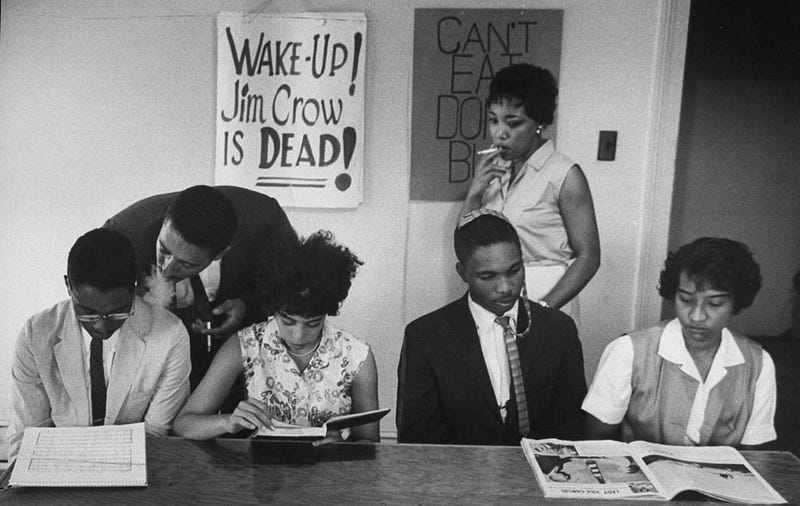
MLK promoted a nonviolent approach because he believed in the inherent goodness of humanity. For him, peace in the face of brutality would show a clear moral contrast between southern segregationists and Black people. He hoped that after seeing that contrast, most Americans would side with Black people.
I have earnestly opposed violent tension, but there is a type of constructive, nonviolent tension which is necessary for growth (MLK in Birmingham Jail, 1963).
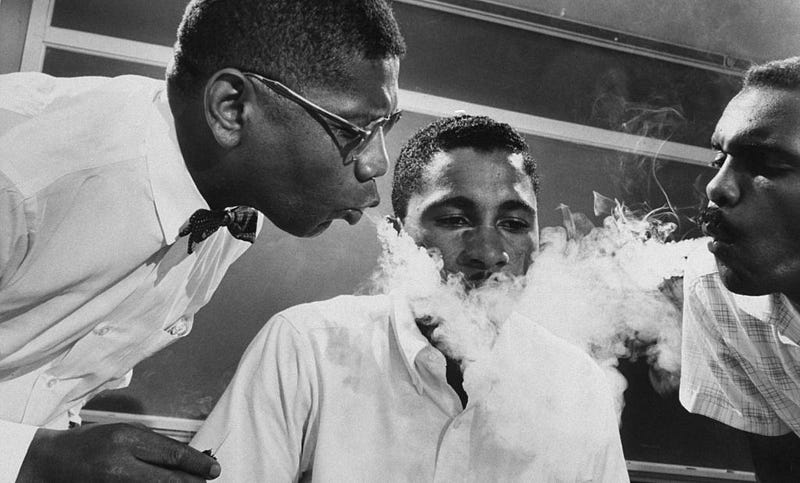
He trained advocates to endure micro-aggressions. They learned to endure smoke blown in their faces, slaps, punches, and getting spit on. The goal of this training was to create advocates who would not respond to white brutality. They risked their safety and livelihoods to show a clear contrast between a morally driven campaign and the cruelty of white supremacy. King supported the breaking of unjust laws, and officers arrested him 29 times. There is a stigma about having a criminal record that negatively impacts Black men and women. He transcended that stigma, unbound by the unjust laws segregationists enforced.
A Radical Transformation of Values
He felt that in order for America to really transcend issues of racism and poverty and militarism, that the nation itself had to undergo a radical transformation of values — Newsome (Sturino & Masemann, 2018).
Too many Americans remain in denial about the real crux of racism. It is easier for them to condemn the Klan and Proud boys, rather than call out ways in which the system maintains white supremacy holistically. Individual bias and bigotry are symptoms of a racist, oppressive system. We need reform, and the obscuration of his message aims to hinder progress. Martin Luther King believed that America could change its value system by addressing inequality.
Looking Ahead
His nonviolent resistance never meant private abandonment of self-defense or even complete conversion to pacifism. … He was adamant that his nonviolence did not constitute passivity or mollification, but a militant commitment to change. Modern activists do not need to take this same tactic to effect change (Mathis, 2018).
King could have remained silent, maintaining the peace, while Black people suffered. He chose advocacy, attempting to guide Americans to a worthy path, putting his life and safety at risk. It is time to set the record straight about this Civil Rights giant — he was nobody’s pacifist.
When people try to characterize him as a colorblind advocate, they defame his legacy. Black people have every right to protest the indignities suffered under this system. It is time for us to stop letting their smoke and mirrors distract from his real message — racial equality. Once the haze clears, we can see that King valued the fight for equality even over beloved peace.
Author’s Note: *Modern Advocates may not apply MLK’s approach on enduring micro-aggressions. However, the spirit of the movement is embodied through non-violent civil disobedience
Articles Curated in Race, Equality, Women, & Beauty:
References:
King, M. L., Jr. (1963, August 28). “I Have a Dream,” Address Delivered at the March on Washington for Jobs and Freedom. Retrieved October 10, 2020, from https://kinginstitute.stanford.edu/king-papers/documents/i-have-dream-address-delivered-march-washington-jobs-and-freedom
King, M. L., Jr. (1963). Letter from a Birmingham Jail [King, Jr.]. Retrieved August 04, 2020, from https://www.africa.upenn.edu/Articles_Gen/Letter_Birmingham.html
Mathis, D. (2018, April 03). King’s Message of Nonviolence Has Been Distorted. Retrieved October 03, 2020, from https://www.theatlantic.com/politics/archive/2018/04/kings-message-of-nonviolence-has-been-distorted/557021/
Rashad Grove, F. (2020, January 19). MLK Day of Service fails the man it’s meant to honor: Opinion. Retrieved October 09, 2020, from https://www.inquirer.com/opinion/commentary/mlk-day-of-service-philadelphia-politics-activism-20200119.html
Sturino, I., & Masemann, A. (2018, April 05). Much of Martin Luther King Jr.’s legacy distorted in modern times, says historian | CBC Radio. Retrieved October 09, 2020, from https://www.cbc.ca/radio/thecurrent/the-current-for-april-4-2018-1.4603321/much-of-martin-luther-king-jr-s-legacy-distorted-in-modern-times-says-historian-1.4603344
Trent, S. (2020, August 28). Police brutality, voting rights, racial justice: Echoes from 1963′s March on Washington. Retrieved October 11, 2020, from https://www.washingtonpost.com/history/2020/08/28/1963-march-on-washington-police-brutality-voting-rights/
Waxman, O. (2020, August 27). March on Washington: What MLK Said About Police Brutality. Retrieved October 11, 2020, from https://time.com/5882308/march-on-washington-police-brutality/


