
Why Web3? 7 Reasons for World Change with Living Systems
There’s always more to know…
Why Web3?
- Infrastructures are the most important changemakers of today. In the physical space of cities and villages, it is the roads, train tracks, and waterways that can clean the water and infiltrate it into the groundwater. Making sure we have malaria-low cities. It’s the solar roads that make sure we do not need batteries in cars anymore and can stop the destruction by mining (lithium). Less is more if we design for functions. In systemic designs of economies and societies, the infrastructures are on their way from Web 2.0 to Web 3.0 and Web3 now
- Lazy people are innovative people. People are lazy. They just want a fun life. And the best inventions have always been done by lazy people. Look at permaculture. Farming for lazy people. Put a piece of cardboard on the soil, and 30 cm of compost, and voila, no more hunger… Easy growth of food… Global Goal #1 is solved in one line of explanation. Everyone can start doing it HERE & NOW
- Imagine a peer-to-peer world without banks taking money. Now, banks are making debts bigger by charging interest. The new world has short chains. Everything local. And no consultants or middlemen to make things expensive. The simple life is Web3 living with demurrage instead of interest in the systems. Good systems are fair and sustainable BY DESIGN
- Imagine a new democracy. With a long-term vision. And voting rights for ALL. We can code it right now… So, I educate coders on the ethical aspects of infrastructures and algorithms
- Imagine a digital twin of the earth. Predicting tsunamis. Detecting a small fire before it becomes a wildfire. Making our cities and rural areas adaptive and resilient to climate disasters
- Imagine we can see the unseeable like the oceans. We can understand the flows. Solve plastics problems. And clotted seaweed blooms that block the light for sea species
- Imagine an internet that uses little energy. Algorithms that are fair with good feedback loops. Calculating power with Superformula (math 2003). No big data centers or destructive energy plants are needed anymore. It all became possible
We just have to understand the HOW and DO it…
Have a look at our YouTube Channel Abundance 4 ALL for more explanations about HOW.
What Is Web3?
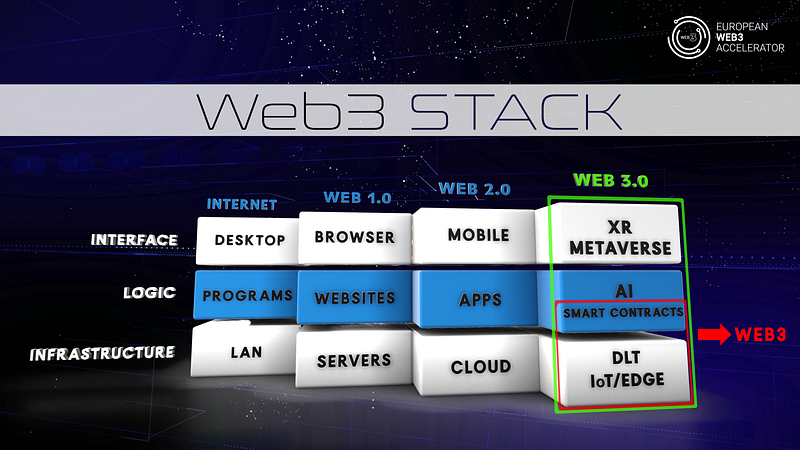
We are going to a world where we combine biological with physical and virtual. No use being Don Quixote. No use fighting windmills... Just understanding it and living a meaningful life is enough.
The future can never be known. Embrace uncertainty, my friends…
You can read deeper about Web3 and all the terms in my stories. I will write more about how we design modern, ethical systems right now in the world. In a story soon to be published in Predict, I explain deeper about living systems design with Web3.
Hummingbird
The hummingbird is a special kind of bird. She always dives deeper. Looks beyond the obvious. Refuses to live a superficial life. She’s a warrior. A seeker.
She stands still in the volatile flows and opinions around her. She is a keen observer and knows what’s what. She has common sense. And finds truths. Truths are her food, her nectar. She makes life simple with intuition.
She meditates on airflow. Drinking water from beautiful flowers. Finding hope in images and colors and hugs from her (grand)children. She harvests frequencies of kind people. Only kind people… Not arrogant ones…
She is… a bit like me…
We ARE nature…
What’s your human nature? A bird? Or a whale? Or a microbe creating 20% of the oxygen on our planet? Making our breath every day?
Do you know the secret story of the tiny algae diatomic?
I once wrote I’m a deer. But I think I’m a bit of a diatomic as well. Changing solar roads to become cleaners of water with 95% efficiency transforming light into energy. Stopping mining…
I know Dennett is a squirrel.
And Marcus aka Gregory Maidman is a … Greg… is a Marcus… is a…
Who are you? Tell me, I really want to know…
Here are some options in the shamans' list of animal communication manifested in skulls...
Thank you, Gaia, for giving me Wild Writing © Désirée Driesenaar, 2023