
CITY DESIGN
5 Wildly Surprising Nature-Based City Solutions
Europe and Asia are in the lead
My life as a systemic designer is fascinating and adventurous. I travel to my projects, stay longer, and help cities and rural areas become healthy places of life and work. In our current era of trying to survive and thrive on a volatile planet, the built environment is an important changemaker.
Water, soil, buildings, and roads. We care. We make everything multifunctional and healthy…
Happy & Healthy People IN a Healthy Planet
A hotter Earth is our problem. This year is an El Nino year. Breaking through the boundary of +1.5 degrees from 2023–2027, scientists predict. We are in rollercoaster times of hurricanes, wildfires, flooding, and droughts.
“The annual mean global near-surface temperature for each year between 2023 and 2027 is predicted to be between 1.1°C and 1.8°C higher than the 1850–1900 average. This is used as a baseline because it was before the emission of greenhouse gases from human and industrial activities.”
Cooling the planet is the solution. Cities are the cause of drought and heat stress right now. Black asphalt, concrete without shade. No evaporation from plants and trees. City redesigns are a huge solution.
I want to bring you hope and solutions from other continents than yours. America often has blinders on. You think you are the most innovative place on Earth. Well, in the case of nature-based solutions, you might not be.
Europe and Asia are way ahead of your game when it comes to ESG, sustainability, and nature-based solutions.
So, let me update you on some of the trends and systemic designs on my continents. I’m Desiree, a Dutch professional systemic designer with Indonesian roots. Director of a Biomimicry Futures Academy.
Biomimicry is the #1 innovation method right now. Also in America. It’s logical. 80% of design and tech nature strategies are not used yet in our human manufacturing. So, there’s much room for improvement.
Let’s dive into the deep end immediately...
…and talk solutions…
1. Healthy Building Architecture
In Europe and America alike, people are spending 90% of their time indoors. And the air quality inside our buildings is 2–5 times worse than outdoors.
Hmmm… time for improvements… No more headaches and sick-building syndrome. Without and with machines. Without is cheaper. And machines give noise pollution.
So, without machines is always my personal preference. Just design. Dutch Design…
The first example comes from my home city, Venlo in the Netherlands. In the past 4 years, our science think-tank Abundanism = Abundance 4 ALL has been part of a hugely innovative project about healthy buildings in NL and Germany. Together with a Cradle 2 Cradle team and architects.
What are the main insights?
- The University of Maastricht did research about chess players and indoor air. When the CO2 got to certain levels, the chess players made their decisions as if drunk. CEOs apparently do the same in our toxic buildings. High time for healthy buildings
- It all starts with healthy materials. No glues, paints, or fire retardants. No emission of Volatile Organic Compounds (VOCs). An hour in a meeting, and because of our out-breath CO2 levels spiral out of control. It’s wise to use sensors to measure VOCs and CO2 in a room and ventilate properly
- Healthy ventilation and temperature regulation can be done over height instead of by machines. Modern architecture uses so-called natural air conditioning. Termite ventilation. When you DIY, make sure cool air comes in from the ground (nights, mornings). Open a window on the top floor and let the airflow over the stairs into the rooms. Slow ventilators help to spread the fresh air. Hot air rises and needs to be let out at the top
- We design healthy buildings on a few themes: indoor air & climate (ventilation, breathing materials), healthy light (no invisible flickering due to AC energy supply) & sound, look & feel (biophilic design), and movements of people through the building (we sit too much)
- Redesigning existing buildings or designing new ones starts by choosing themes. Energy, circular water, materials, historic and soil/water maps around the area of the building
- We describe materials in material passports so they become reusable after the lifespan of the building. Reduce. Reuse. Recycle
- We financed the 13 million extra costs of this building by combining budgets. Initial investment, maintenance, and demolishing. Combining building budgets and health budgets (sick leave). In a building, 1% of the cost is energy. 9% is materials. And 90% is personnel health costs. We also calculated with cashflows instead of ROI. We achieved black figures in the 2nd year instead of after 15 years by using ROI. This helped in getting the spending agreed upon
- There were many biomimicry innovations in this project. But that’s for another story
- One very interesting innovation involves plants to clean indoor and outdoor air. In 1989, NASA gave us research on indoor air cleaning by plants. We also chose our outdoor plants carefully for functionality.
2. LAVA Architect Lab
My favorite architectural lab is in Germany right now. They use the biomimicry Superformula (new math from 2003) in their designs and they think so innovatively about everything building and city, it’s beautiful.
Here is an explanation from founder architect Chris Bosse about how to change an existing building into a healthy building with 2 foldable membranes. One indoors and one outdoors. Little costs. And immediately, the termite ventilation over height goes to work. We can open up the building for healthy light. Insulation is no longer an issue. Sound is regulated. And the logistics flow inside a building is optimized.
And the beauty… Yummy…
This is biomimicry in her best possible form. Copying the principles of nature. Flows. Not per se biobased. Just minimal and light materials. Multifunctional solutions.
We love it!
3. Sponge & Edible & Malaria-low Cities
Sponge cities are a Chinese and EU concept. Powered by Delft University, the city where I was born. Roads are cleaning and infiltrating water. Wetlands around the city regulate floods and make sure there is enough drinking water around. The principles are now also used in the EU to redesign existing cities.
Soil and water maps are always the starting point for designing nature-based solutions. My country is a water country. River heaven. We redesign rivers now to be meandering again. Trap the toxic sediments in one corner and use phytomining to extract the scarce heavy metals. They can be the basis for regional economic growth and becoming independent from Chinese geopolitics.
Holland is ASML country, remember? We produce the technology and machines for chip-making. This year, we were forced to limit our China export. The world is getting into shape by having all our needs met in regional economies. Inside our own currency scopes, just like American economist Stephanie Kelton teaches us.
No financial capitalism. But (post-)industrial capitalism with asset-creation as stability for our currencies.
So, our next step might be limiting imports of scarce metals too. No more mining. Phytomining is also called agromining. Personally, I think there’s so much pollution around everywhere, we can easily reverse-engineer and become self-sufficient locally. All of us…
Edible cities are done like in example 1. Edible plant walls. Food forestry. And tiny city forests. We plant food forests according to the Miyawaki Method.
Dense planting. Quick and healthy growth.
Malaria-low cities arise when we design cities from the perspective of a mosquito. Be careful with the wetlands and other still water near homes. Clean roof drains. Mosquitos lay their eggs in still water. Water needs to be either infiltrated into groundwater or flow in rivers.
Old knowledge shows that walnut trees can be planted next to ponds for mosquito prevention. The insects also don’t like the lavender and citrus herbs smells. Plant them around your terraces. Or put them on your plant walls…
4. Underground Projects
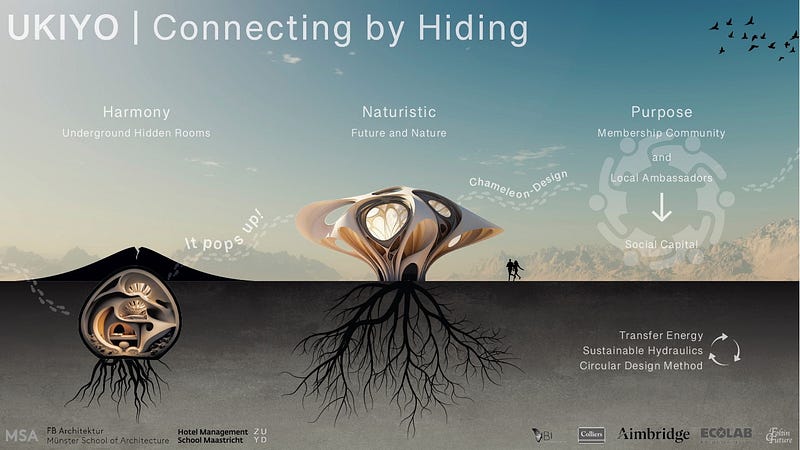
I love this concept made by the Hotel Design Academy in my country. It’s full of biomimicry innovations. Energy-efficient hydraulics. Healthy building materials. It comes with a modern business model based on customer loyalty and community forming.
Reconnecting to nature is the theme. And reconnecting with other people. Locals and visitors.
The Green Key of the hotel business is turning a boring grey. In light of this hugely innovative UKIYO hospitality concept. It will most probably be implemented in Dubai first.
5. Blue Hearts Digital Twins
The European Space Agency (ESA) had many astronauts in space already. My country is high on the list with 4 astronauts. Small country. Big ambitions. That’s us. The Dutchies.
In the EU, there’s the Destination Earth program with a specific field for Mission Ocean. One big digital twin of the earth consisting of many different projects. In the future, we can predict tsunamis with it. And detect a small fire before it becomes a wildfire. We recognize algae bloom, ocean plastics, and microplastics on beaches.
So the ocean can be cleaned up and algae used for energy and fashion.
This is my favorite project now. I’m a mermaid. I love to snorkel, swim and float. I love to do my work in coastal areas. Restoring corals and mangroves. Sea grass and seaweed.
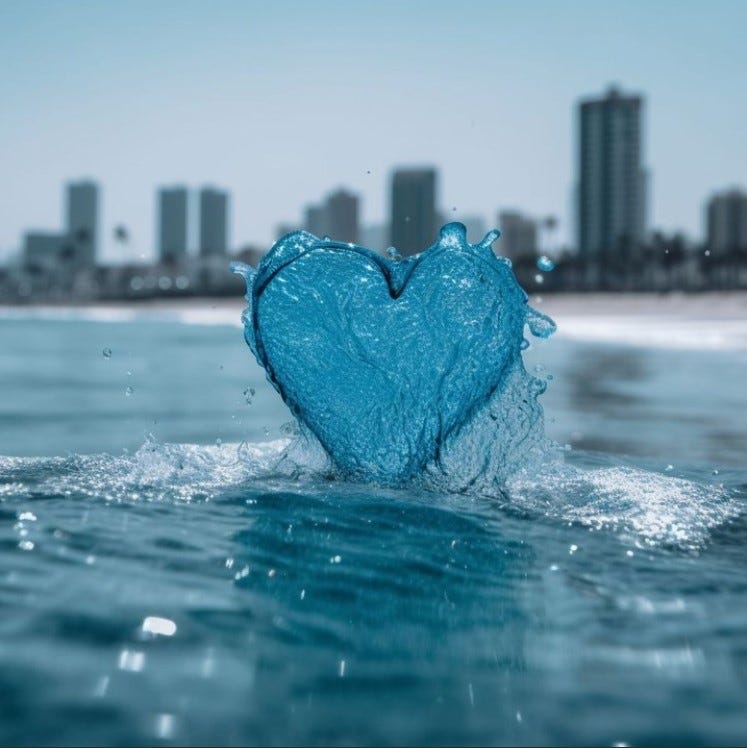
Water is the biggest changemaker right now in my humble opinion. Water is the problem. And water is the solution.
With our Blue Hearts Network project, we create dataverses for nature-based solutions. With a group of professors and entrepreneurs. AI and spectral imaging. And because satellite sensors are dumb, we check the images with divers and seaweed farmers in real life and feedback data to the AI learning networks.
Storing carbon is 20 times for efficient in seaweed, seagrass, and mangroves than in normal wood forests. This means we are designing now for carbon credits. We can grow seaweeds for healthy food, feed, fertilizers, and fibers. We can build buildings with kelp and make fast fashion from Sargassum.
All products are strong during their lifespan and biodegradable afterward.
Those are true solutions for fast fashion!
Learning LAB
Let’s be inspired, dear friends, with nature-based solutions. Biodiversity, economy, and cities go well together. And if you need help with the HOW, come to one of our international LABs on Mondays.
Every first Monday of the month it’s free of charge. Biomimicry & Superformula (new math 2003) innovation. Including resonance for engineering and green chemistry. The other subjects are 20 euro per 2-hour session. Very accessible. Our aim is to make it easier to adapt all good solutions in the world to local ecosystems and local cultures.
Come, and design with us.
Here you can find the YouTube Channel — Abundance 4 ALL. A collection of real-life systemic design examples. Learn with us. Design with us.
© Désirée Driesenaar, 2023


