
Why We Should Make Thanksgiving a Day for Atonement Instead of a Racist Feast
Assessing the harmful revisionist history
When American school teachers introduce school children to the Thanksgiving holiday, they often ask students to use their hands to make a colorful turkey or create a Pilgrims’ hat with a buckle on it. Like many educators who came before them, they participate in a socially harmful revisionist history. When American children grow up thinking that the pilgrims peacefully traded with Indigenous tribes, it introduces a both-sides narrative that prevents Americans from engaging in restorative justice.
Generations of Americans have told themselves a patriotic story of the supposed first Thanksgiving that misrepresents colonization as consensual and bloodless (Silverman, 2019).
There is nothing patriotic about celebrating Thanksgiving Day unless you consider war crimes admirable. European invaders used their religion to rationalize biological warfare, rape, theft, and genocide. White people have a terrible habit of forgiving themselves for their crimes against humanity, and the celebration of Thanksgiving is a notable case study on revisionist history.
The holiday attempts to legitimize a nation by focusing on gratitude without fully explaining why Europeans felt thankful. In many ways, America unveils the story of Europeans who recreated their culture far from home while callously dismissing the humanity of any group who stood in their way. American freedom is not arbitrary or self-derivative; it reflects white people’s will over people of color.
While each of us has something to be thankful for, Americans created Thanksgiving to show gratefulness for European dominance. They would not celebrate if the natives maintained their liberty. It is absurd to teach children about pilgrims as innocent European adventurers who welcomed help from Indigenous tribes. Moreover, it creates a harmful sense of patriotism.
Children grow up believing in American exceptionalism because educators and family members insist on telling a pleasant lie, avoiding the unpleasant truth. I doubt most children would knowingly celebrate white-dominance, driven by religious extremism. They would not feel motivated to make a paper mache hat because the Pilgrims were not the heroes in this story.
Americans should participate in patriotism, but if that pride comes from brutal conquest, their comfort represents a wanton ignorance at best and boastful cruelty at worst. Throughout history, Americans expanded rights to minority groups and these times warrant celebration. However, it is time to stop celebrating Thanksgiving as the racist feast between the conquered and the conquerors. Instead, Americans can find pride in treating this day as an opportunity for atonement.
Since educators found a way to make colonization palatable to children, they can indeed find a way to tell the story of Thanksgiving with the historical integrity this issue deserves.
The Wampanoags, who are the Indians in this tale, have long contended that the Thanksgiving myth sugarcoats the viciousness of colonial history for Native people. It does. The Pilgrims did not enter an empty wilderness ripe for the taking. Human civilization in the Americas was every bit as ancient and rich as in Europe. That is why Wampanoag country was full of villages, roads, cornfields, monuments, cemeteries and forests cleared of underbrush. Generations of Native people had made it that way with the expectation of passing along their land to their descendants (Silverman, 2019).
Thanksgiving represents the capitulation of power at the end of a long bloody conflict. The Pilgrims were not brave explorers in anew world; they were war criminals who created a white supremacist system, disregarding developed nations and implanting their own.
The American federal government should acknowledge the real history of Thanksgiving so that the country can move forward. Still, treating Thanksgiving as a day of atonement would first require that citizens reckon with the bloody past. They would need to address white people’s inclination to revise history, making their ancestors, the Europeans, look like heroes. America has a lot to be thankful for, but genocide is not one of them.
We repaid their kind welcome with a shameful record of stealing, swindling, enslavement, displacement, and deliberate infection (Hernandez, 2011).
Thanksgiving reflected white supremacy in action
American history gets whitewashed for a reason. White people feel uncomfortable when they consider the cruelty used to establish America and other colonized nations. Even describing Indigenous people as “Native Americans” and “Indians” comes from a rewriting of history that rejects their original tribal names’ legitimacy.
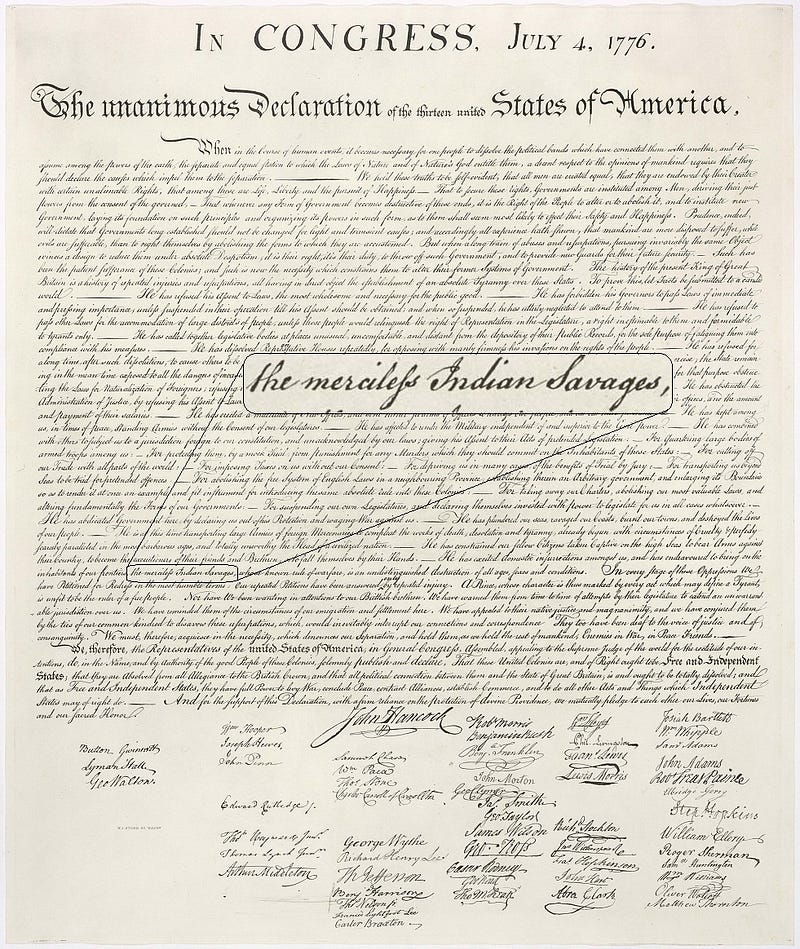
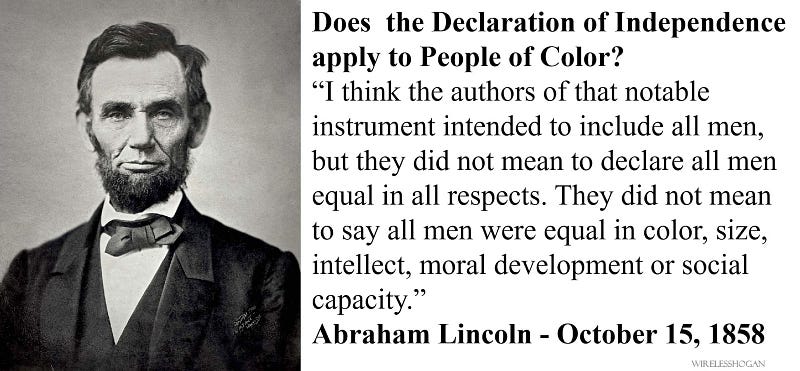
The story of Thanksgiving shows white supremacy in action, as the Wampanoags had no choice but to join in conciliation. Europeans disregarded the original tribes because they never viewed them as entirely human, calling them savages repeatedly throughout historical documents. Within the Declaration of Independence, signed on July 4, 1976, the founders referred to Indigenous people as “Indian Savages.” Also, Lincoln clarified that freedoms enjoyed by white Americans did not extend to people of color.
The majority of America’s founders failed to acknowledge African Americans’ full-citizenship and people of color. Lincoln’s statement highlights the significance of the civil rights movement, which attempted to address America’s long-standing disregard for marginalized groups. While activists have much more work to accomplish, it is essential to understand how Americanism is inseparable from white supremacy. While many white people insist that those who do not like America should leave, this perspective implies that white people are the rightful owners of this nation when they live on stolen land.
The challenges are undoubtedly stark. The Native American past and present tend to make white people uncomfortable because they turn patriotic histories and heroes inside out and loosen claims on morality, authority and justice. They threaten to tear down monuments and rename buildings (Silverman, 2019).
The Wampanoags fought for years to defend their nation from conquest but eventually lost their land and freedom. As a result, they joined in a meal where the Indigenous tribe members sat on the ground. While American historians often portray this as the first meeting between the Europeans and the Wampanoags, they first met in 1524. During that time, Pilgrims sold many into slavery, while they forced others to become interpreters and guides. They did not stop there. A European ship brought an epidemic in 1616, which decimated the Wampanoag population for three years.
Their weakened state left them vulnerable to attacks from surrounding tribes, which had already fallen to European influence. The infamous Squanto became a go-between for Europeans but only knew how to speak English due to his captivity in Spain and England. While American history portrays Squanto as an eagerly, helpful Native, he only helped them because he had no choice.
What Europeans portray as kindness is a response to white-dominance. Thanksgiving puts the social hierarchy on full display. The Indigenous tribes and Pilgrims did not come together to break bread and celebrate a successful harvest. Indigenous people sat on the floor because Europeans wanted to establish and maintain dominance at all costs. Revisionist history protects white people from the horrible truth — every freedom they enjoy today was established by taking liberties away from others. The first Thanksgiving resulted from a forced surrender rather than the joyous festival depicted in school plays.
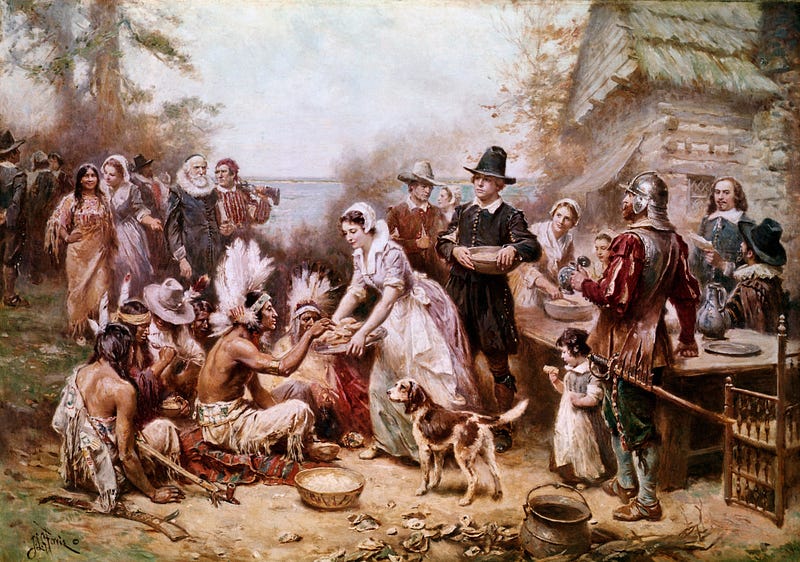
The Thanksgiving myth also sanitizes the power politics of the Pilgrim-Wampanoag alliance. For years afterward, Ousmequin threatened rivals in and outside the Wampanoag tribe with violence from his English allies. Such intimidation played a far more important role in the Wampanoags’ alliance with Plymouth than the first Thanksgiving (Silverman, 2019).
Thanksgiving reflected a racist “send them back” movement
Americans have always created unity by sacrificing marginalized groups. Sarah Josepha Hale advocated for the creation of Thanksgiving as a nationally celebrated holiday. She used persuasive essays to accomplish her goal, petitioning the President and other politicians to expand the holiday traditionally celebrated in the Northeast.
Hale’s vigorous advocacy for nationalizing Thanksgiving for the sake of a ‘complete moral and social reunion of the people of America’ was rivaled only by her uncompromising advocacy for the removal of free Black people from the United States (Petrella, 2019).
While many people think of Thanksgiving as a day that dishonors Indigenous tribes, the actual holiday also disenfranchised Black people, with Hale trying to kick them out of the country. Lincoln signed the Emancipation Proclamation in 1862; Hale started petitioning the government to create the holiday in 1846, nearly twenty years prior. Her writings aimed to justify slavery and colonialism; she considered America a white nation. This nationalism still runs through the country today; the celebration of Thanksgiving is also a reaffirmation of white feminism.
Yet her conception of ‘all of the people’ who would observe this holiday excluded at least one group: free black people, as she made clear in an 1830 article titled ‘Fourth of July’ that appeared in the Ladies’ Magazine and Literary Gazette. In that piece, Hale wrote that ‘it should not be urged to have the slaves set at liberty till they can be sent to their own land, because they never can be free here’ (Petrella, 2019).
Let’s run that back. Hale said that the slaves would never be free in America, insisting that Black people must go back to Africa. Her perspective was and remains illogical. Because European colonists kept no personal records of origin or birth certificates for slaves, they had no idea which countries they should send Africans back to. Also, Indigenous and Black people mixed on plantations with one another. Black women suffered years of rape to ensure that the slave population stayed ample to supply white landowners with free labor. So, there would be no logical way of sending Africans back with any order or dignity. Instead, she advocated rounding up Black people to “send them back.” Given the history of Europeans with Indigenous and African people, it seems implausible to believe this would not lead to more racial hostility and brutality.
Like many white nationalists, Hale advocated for American racial purity that certainly left out Black and Indigenous people. While there is nothing wrong with coming together as a nation, there is something profoundly irresponsible about pretending we are unified, obscuring history.
Educators cannot separate Hale’s calls for unity from her reluctance to include Black people and people of color into the union. This whitewashing is harmful because it makes any discussion about European war crimes seem off the beaten path. However, a look at history reveals just how intertwined the narrative of white dominance and celebration became a staple of American society.
The “send them back” narrative has a dark role in American history. This scheme proposes ridding America of Black people without engaging in restorative justice. After hundreds of years of hard work, large swaths of Americans did not want to see Black people enjoy the spoils of prosperity. Historians dubbed Hale the Godmother of Thanksgiving because, through her advocacy, it became a national holiday. However, this day has always reflected white dominance over Black people, excluding them from legitimacy.
Where do we go from here?
Years before Thanksgiving became a formalized national holiday; people celebrated the fall harvest. Families came together, shared stories, and even heated conversations. This time of year encourages reflection and gratitude. Nevertheless, Thanksgiving only exists as a formal, national holiday because of the genocide of Indigenous tribes.
They never wanted Indigenous or Black people at their Thanksgiving Day fest. Instead, they wanted them to sit on the floor. And, in the case of Black people, Europeans, and their descendants wanted them to leave America so that they could rejoice in their version of unity, ironically leaving out people who built the nation free of charge. Thanksgiving highlights America’s painful truth as many find delight in the success of their ancestors’ successful conquest.
These crimes, committed in the past, reflect the nonchalance with which Americans maintain holidays that disregard others’ humanity. Still, all is not lost. White supremacy is a system, and like any system, people can dismantle it. We can start by acknowledging that the Pilgrims were not heroes; they were conquerors.
The real heroes are the Indigenous tribes who defended their land and the African slaves who tried to flee captivity. If Americans center the celebration around atonement, they can engage in constructive ways to participate in restorative justice. However, in its current state, Thanksgiving celebrates colonial conquest. Black and Indigenous people do not feel thankful for white dominance. Americans need to create a culture that atones for the past misdeeds. We can only become unified if we acknowledge the need for inclusivity, rejecting the whites-only exclusivity that created the Thanksgiving holiday.
Curated Articles about Race, Equality, Women, & History:
References:
Hernandez, J. (2011, November 24). Thanksgiving as a Day of Atonement. Retrieved November 25, 2020, from https://www.commondreams.org/views/2011/11/24/thanksgiving-day-atonement
Petrella, C. (2019, November 28). Perspective | How the fourth Thursday in November officially became Thanksgiving. Retrieved November 25, 2020, from https://www.washingtonpost.com/outlook/2019/11/27/how-fourth-thursday-november-officially-became-thanksgiving/
Silverman, D. (2019, November 27). The Vicious Reality Behind the Thanksgiving Myth. Retrieved November 24, 2020, from https://www.nytimes.com/2019/11/27/opinion/thanksgiving-history-racism.html


