
Winner — The Collector’s September Writing Challenge
The Statue of Liberty is the Embodiment of Juneteenth
Did You Think It Was Created to Honor Immigrants?

Most Americans learned that France gifted the Statue of Liberty to the United States. However, people often overlook the purpose of the gift. If you ask Americans about the importance of The Statue of Liberty, most will insist it symbolizes immigrants’ migration. While it is true that the statue has come to signify a beacon of hope for immigrants, The French did not create it for that purpose.
The white-washed history of the Statue of Liberty distorts its meaning. The French abolitionist, Édouard de Laboulaye, and the sculptor, Frédéric-Auguste Bartholdi, designed and gifted the Statue of Liberty to celebrate America’s decision to free enslaved African people, finally becoming a worthy beacon of freedom for all the world to admire.
Lady Liberty was originally designed to celebrate the end of slavery, not the arrival of immigrants. Ellis Island, the inspection station through which millions of immigrants passed, didn’t open until six years after the statue was unveiled in 1886. The plaque with the famous Emma Lazarus poem — “Give me your tired, your poor, Your huddled masses yearning to breathe free” — wasn’t added until 1903 (Brockell, 2019).
When those Frenchmen designed, raised money, and created the statue, immigrants were not the inspiration. Immigration did increase in the 1800s, and one of the main ports of entry was New York City. Upon seeing the Statue of Liberty, immigrants felt welcomed and inspired, but they did not, at this stage, understand the meaning of the statue. Their misconception, along with opposition by former Confederates, perpetuated a mischaracterization of history.
They talked about the idea of creating some kind of commemorative gift that would recognize the importance of the liberation of the slaves, Berenson said. (Brockell, 2019).
The Design
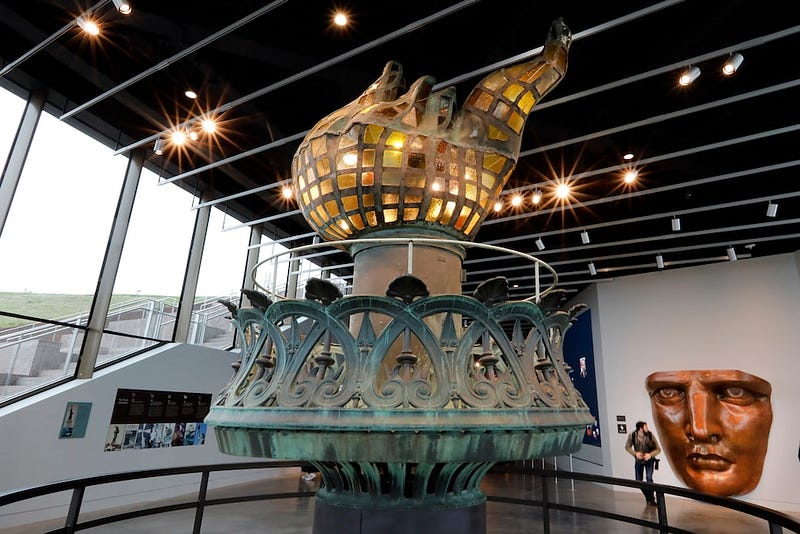
Initially, the statue’s design wore shackles on her feet and hands. Yet, the version we see today only has chains on her feet. These chains represent a celebration of liberty while acknowledging the pain and hardship that enslaved people endured. The torch that she carries is not a light shining the way for safe passage into the harbor by soon-to-be Americans. Instead, the torch represented enlightenment, lighting the way to liberty. The meaning is entirely different when American educational institutions teach students to believe the French gifted the statue to honor immigrants.
The inspiration for the design came from the Roman goddess, Libertas. In her depiction of Roman coins, she wore a cap made of felt. Within the empire, freed slaves proudly wore the hat to commemorate the day they became free, celebrating their status. In Roman tradition, the master brought each slave before the magistrate, and through this process, the former slave received the felt cap. Libertas was a quintessential symbol for liberty within the empire, recognized throughout the Western world.
When the sculptor, Frédéric-Auguste Bartholdi, designed the statue, he intended to bestow America with a gift to honor American abolitionists’ success. Facing France and the ships entering the harbor, Lady Liberty welcomed visitors and migrants from all over the world.
Think about how essential the Statue of Liberty could be as a beacon of hope for Black Americans, disenfranchised in American society. When historians only tell the story that rejects Black people as fundamentally American, they take hope away and replace it with indifference.
Why Does It Matter?
Our understanding of history shapes how we view the world, and American school children do not have access to a comprehensive record of some of the most noteworthy historical events. Common misconceptions can also obscure the significance of historical treasures.
During the Civil War, many countries looked on in horror at the domestic instability. In defeating the Confederacy, which the other world powers never acknowledged as a legitimate state, and freeing the slaves, America came off looking good, organized, powerful, and conscientious. Without understanding the real story, Americans may not understand how fundamental freeing slaves was to the United States’ assertion as a powerful and independent state.
The liberty referenced in the name of this monument referred to the freedom of enslaved Africans. This statue is the embodiment of Juneteenth, a holiday that commemorates the emancipation of slaves.
In political discourse, pundits often refer to the Statue of Liberty in the context of the fight for immigrants’ rights who came to America looking for better opportunities. Advocates often boast of Emma Lazarus’ poem as proof to the statue’s purpose. This revisionist history is crucial because it drives at the heart of who is American, and whose freedom is represented by this icon. Society should not celebrate the acceptance of one group of Americans through the erasure of another.
In the final model, Lady Liberty holds a tablet inscribed with the Roman numerals for July 4, 1776. The broken chains are still there though, beneath her feet, “but they’re not all that visible, Berenson said.(Brockell, 2019)
The architects wrote the real purpose of the statue on the tablet, held by Lady Liberty. The French abolitionists, joyous over Union’s win, wanted to show solidarity with an inclusive ideology, recognizing its citizens’ humanity and rights.
In Closing
Although many immigrants migrated to the United States between the 1880s and 1930s, Ellis Island did not process immigrants when the French built the Statue of Liberty. It is disingenuous to discuss the meaning of the statue without considering the state of Black Americans. If American pride amongst the civilized world relies in part on its citizens’ freedom, maintaining that freedom is paramount.
Laboulaye was a strong supporter of President Abraham Lincoln and “saw abolition not only as a way to eliminate immorality, but also as a way to protest repressive tendencies in France (Stanglin, 2020).
Wanting to push back against France’s oppressive dynamics, Laboulaye praised America and, with the same tribute, rebuked France’s current political dynamics.
Understanding the history behind the statue does not undermine the validity of immigrants in America. However, educational institutions’ failure to teach this demonstrates an unwillingness to embrace Black people’s liberty. The story of the Statue of Liberty highlights the importance of freedom within America. It was not just the freedom of the religious minorities that left Europe or those who came during the 1800s to pursue better economic opportunities, but the freeing of the slaves that humanized and characterized America on the world stage after dispelling upheaval within its borders. In the modern sense, the monument represents both the liberty of enslaved people and the acceptance of immigration, which became a staple of American ideology.
Aequa Libertas means equality before the law, equality of all personal rights’ and equality of the fundamental political rights (Wirszubski, 1968).
In a year where America is confronting civil unrest due to Black people’s mistreatment, we should all reflect on what this country stands for. France’s gift showed that America is worthy. However, Americans have an important responsibility — to ensure that the government deals with its citizens justly. The country must embrace and celebrate the freedom of Black people, with liberty and justice for all.
Author’s Note: The Collector’s September Writing Challenge
Articles Curated in History & Equality:
References:Wirszubski, C. (1968). Libertas as a Political Idea at Rome During the Late Republic and Early Principate. Retrieved September 06, 2020, from https://books.google.com.pr/books?id=lXnljY5lhicCBrockell, G. (2019, June 07). The Statue of Liberty was created to celebrate freed slaves, not immigrants, its new museum recounts. Retrieved September 03, 2020, from https://www.washingtonpost.com/history/2019/05/23/statue-liberty-was-created-celebrate-freed-slaves-not-immigrants/Stanglin, D. (2020, June 18). Fact check: U.S. didn’t reject an earlier version of Statue of Liberty that honored slaves. Retrieved September 06, 2020, from https://www.usatoday.com/story/news/factcheck/2020/06/11/fact-check-u-s-didnt-reject-statue-liberty-honored-slaves/5333534002/


