
Everyday Fashion is Killing our Finances (and the World)
Save your money, sanity, and the world by optimizing your wardrobe.
Last updated: May 10, 2022

Here’s a quick quiz.
Do you know…
- …the full contents or your closet?
- …how much you spent on clothing last year?
- …how many shoes you have?
If your answer to any of these was “No”, then your shopping habits might need some tidying up.
We have been trained by the clothing industry that style is next to cleanliness, which itself is “next to godliness”, which has led to an almost religious fervor in our clothing purchases.
And the impact of those purchases can be felt well beyond our wallet.
The manufacturing, shipping, marketing, sale, and disposal of clothing can be felt in many categories, from your mental health to the global environment.
Our Closets Are Destroying the World
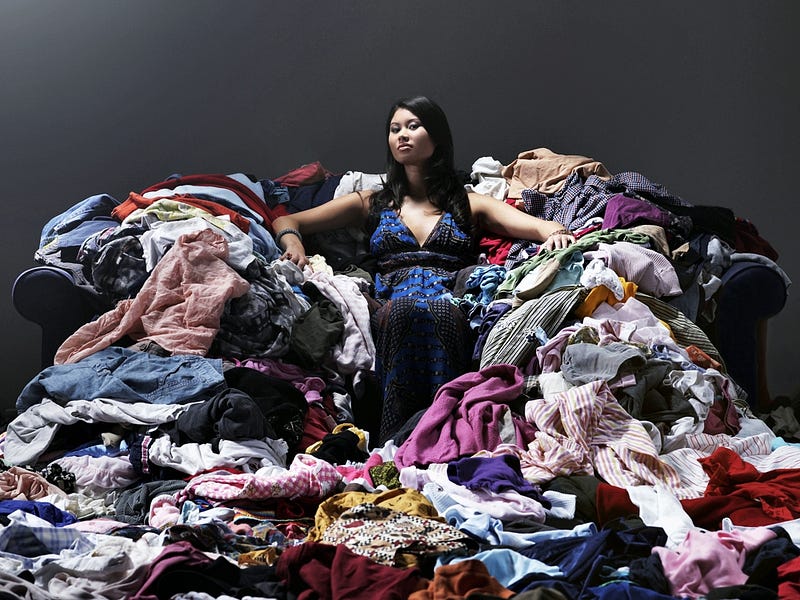
A few years ago, my family moved from a 2,300 square foot house (with additional storage in the two-car garage) to a 900 square foot apartment.
To prep for that move, we KonMaried the hell out of our belongings. I was embarrassed by the sheer volume of old clothes that I wore so few times and ended up at Goodwill or the dumpster.
(I don’t think people want my 20-year-old high school graduation t-shirt with first and last names of my entire graduating class.)
By this point, I was wearing my capsule wardrobe and not being completely wasteful, but the 14 plastic tubs of clothes that were old, outgrown, and obsolete solidified my stance on a minimalist wardrobe.
I started thinking about the national impact of purchasing clothes and came upon some staggering numbers.
Fashion Waste is Immense
More than 15 million tons of used textile waste is generated each year in the United States, and the amount has doubled over the last 20 years.
Let’s put this in perspective.
There are 2,000 pounds per ton, so the total US textile waste is 30 billion pounds.
That’s billion…with a “B”.
Given the US population is estimated at 330 million people, that gives us a total of 91 pounds per US citizen, per year.
We Keep Buying More Clothes
The average consumer bought 60 percent more clothes in 2014 than in 2000, but kept each garment for half as long.
This is an increase of more than 400% in clothing purchases.
Say you used to buy 5 t-shirts to last you for one year in 2000. If you are an average consumer, you are now buying 10 t-shirts that last you only 6 months, or 20 t-shirts per year.
The Apparel Industry is Manipulating Us
In a 2014 UK study of 2,000 women, clothes will only be worn 7 times.
Did you know that in 1927, the United States Secretary of Labor admitted that “the textile mills of this country can produce all the cloth needed in six months’ operation each year” to meet the clothing needs of US citizens.
Back then, people had a two-season fashion calendar. Hot weather and cold weather. And the hot weather clothes were oftentimes merely the ones worn under the heavier cold-weather garments.
Unfortunately for the industrialists, the restraint shown even during the Roaring ’20s turned downright miserly when the Great Depression hit, and the low demand was financially untenable for manufacturers.
To combat the lack of demand, the companies decided to manufacture desire for new products, most notably described in the article “Keep the Consumer Dissatisfied”.
This Gospel of Consumption has led to the creation of the four-season wardrobe, which evolved into monthly styles and, ultimately, fast fashion and the weekly clothing cycle.
In 1930, the average American woman owned nine outfits. Today, that figure is 30 outfits — one for every day of the month.
The High Price of Fast Fashion

You are not your job. You’re not how much money you have in the bank. You are not the car you drive. You’re not the contents of your wallet. You are not your fucking khakis. You are all singing, all dancing crap of the world. — Chuck Palahniuk, Fight Club
Unfortunately, we must now purchase all of the clothes that the marketers have convinced us are absolutely necessary for “living the good life.” Money that many, if not most, of us, simply do not have.
The data is a little hazy, but the average household (including both families and single people living alone) spends about $1,800/year on clothing.
That also means many of us are spending much more than that.
In a previous article about my clothing choices, I explained how I came upon the idea of a workplace uniform and made the decision to wear one. Below is the math of my clothing choices.
Here is what I wear to work every week, along with the cost.
- Land’s End Poly Polo: 5 shirts @ $14/each = $70
- Land’s End Chinos: 4 pair @ $35/each = $140
- Foundry Jeans: 1 pair @ $50 each = $50
- Skechers Leather Oxfords: 2 pair @ $80 each = $160
- Goldtoe Blue Athletic Socks: 6 pair @ $22/6-pack = $22
- Hanes Beefy-T Undershirt: 6 shirts @ $11/each = $66
The grand total for my entire work wardrobe is $508. If I wear this outfit for exactly one year, my clothes will cost me:
- $42.33/month
- $9.77/week
- $1.95/weekday
I’m sure that there are incidentals that will push up the cost a little higher, but all in all, not a bad price for a year’s worth of work attire. Especially when we have more important things to pay for, like health insurance.
Your Clothes Cost More Than Money
(Quick Note: I am completely guilty of buying clothing sourced from locations described in this section. My conscience is not clear in many of my purchases, and I fully realize this. Rectifying this mistake is the next phase of my wardrobe evolution.)
Politics aside, the cold hard truth is that most cheap clothes are made in countries with cheap labor (i.e. not in the United States). That cheap labor comes at a cost, though, via low or absent workplace safety regulations.
The inverse is also true. Most high-quality, durable clothing is made in the US or Europe, where workplace safety has been increasingly codified and, more importantly, enforced over the last 100 years.
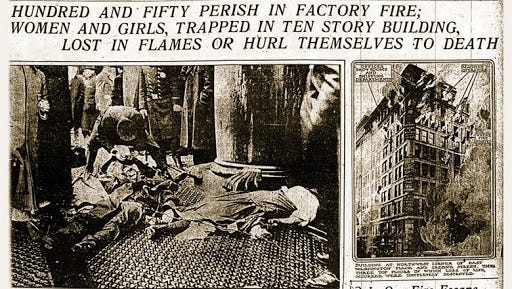
1911 — New York City, USA
To see how the shift started, we need to look no further than the Triangle Shirtwaist Factory fire. Worker protections were minimal at best, flammable material was not properly disposed of, and emergency exits were chained in an effort to reduce theft.
The fire was a turning point in the United States, with increased workplace safety regulations and an active union membership fighting for workers’ rights, both of which increased the cost of doing business.
2012 — Dhaka City, Bangladesh
Fast forward 101 years, and you have the same conditions in a garment factory creating the same hazards.
The only difference is that it occurred in a poor, foreign country.
The Dhaka garment factory fire in 2012 killed at least 117 people and was caused by the same lack of safety regulations, poorly designed emergency exits, and improper storage of flammable materials.
Today, manufacturers of cheap clothes have merely taken to offshoring the labor protections, with the lower cost sometimes being paid for with human lives.
And if you think this is just a fluke, a garment factory completely collapsed not one year later in the same city in Bangladesh, killing 1,134.
- The cause for the physical collapse? Poor structural integrity.
- The cause for so many deaths? Management forcing workers back into the building after it had been declared “unsafe to work in”.
Mental Overload From Too Many Choices
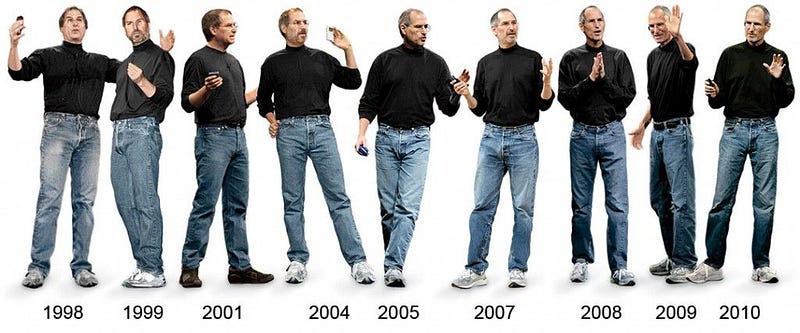
With a 52-week fashion, calendar comes the unspoken requirement to wear chic clothes 24/7.
To counter this, people have been moving towards a standardized wardrobe.
Having a limited number of outfits in your closet is a huge benefit to your mental health. Let’s take a look at three distinct benefits.
Decision Fatigue
When it comes to making decisions, the struggle is real. The average person makes 35,000 active, conscious decisions every day.
The problem? We only have so much willpower.
Adding fuel to this fire is that we are most creative in the morning.
So do you really want to drain your mental energy first thing in the morning deciding on clothes? Probably not.
Autonomy and freedom of choice are critical to our well being, and choice is critical to freedom and autonomy. Nonetheless, though modern Americans have more choice than any group of people ever has before, and thus, presumably, more freedom and autonomy, we don’t seem to be benefiting from it psychologically. — The Paradox of Choice
Time
If you have a standardized wardrobe, then you not only take less time figuring out what you’re wearing each day, but also take less time when you have to replace an item.
Take my work uniform. If one of my shirts gets ruined during a rooftop inspection, I know exactly what size, color, and store I can get it replaced.
No shopping around.
No price comparison.
No muss. No-fuss.
Healthy Relationships
Okay, so this one is a stretch, but I have to put it in there.
When you have a set of standard clothing, you are almost guaranteed to spend less money (and time) on your clothes. Those resources can then be redirected to your significant other.
It’s been shown time and again that having more money leads to better relationships since money is the #3 cause of divorce.
I’m not saying that a capsule wardrobe will save your marriage, but it probably won’t make it any worse.
(P.S. Steve Jobs was kind of an asshole to his family, coworkers, and pretty much everyone else, so take this last benefit with a grain of salt.)
The Takeaway
So how do we go about shopping for clothes, knowing all the bad stuff that can happen when we mindlessly shop? For a short answer, check out this article about how to approach your apparel choices.
In it, the author suggests asking ourselves three questions before making our next clothing purchase.
- How much will I wear it?
- How much do I already own?
- How long will it last?
Put another way, these can follow the Michael Pollan approach to food.
Some years ago, the food advocate Michael Pollan, author of In Defense of Food: An Eater’s Manifesto, succinctly summed up the best advice he could offer on how a human should eat:
“Eat food. Not too much. Mostly plants.”
It’s so simple you’d hardly think it need be stated, and yet the global rise of obesity and diabetes, coupled with an overcrowded marketplace of fad diets, makes its necessity clear.
A formula much like Pollan’s could work equally well in for clothing, and it would go something like this:
Buy better clothes. Buy less of them. Wear them more.
A $5 shirt worn once is an outrageous price (and waste) compared to the $50 shirt worn every week for a year.
Listen, sometimes we make a mistake, buy the wrong shirt, and then never wear it.
I’m completely guilty of this. Many times over.
A great way to avoid this error is to standardize your wardrobe. That way, your clothing choice is already made, and you don’t even have the opportunity to make a mistake.