
Why I Wear the Same Work Clothes Every Week
An aspiring minimalist’s evolution of office attire.
Last update: May 10, 2022
Quick question.
Do you know what you’re going to wear to work on Monday?
How about Tuesday? The rest of the week?
For me, the answer is, “I absolutely know what I’m going to wear every day of the week.”
You see, I wear a work uniform.
I don’t wear the exact same thing every day; just every week.
It took me years to come to this decision, but it’s the absolute right choice for me.
So how did I get here?
Well, my fashion sense for office attire has advanced with each new job I have taken. So let’s start at the beginning.
The History of My Closet (Skeletons Not Included)
Outside of sporting an Andrew Luck neck beard as a college freshman in the fall of 1999, I have never been fashionable. (In that case I wasn’t wrong. I was just early.)
Other than that, most of my life has been spent vacillating between stylistic oblivion and fashionable mediocrity.
That’s not to say I tried.
I did.
I really did.
For many years.
But I finally concluded that spending the time, money, and effort to keep up my aesthetic appeal in order to make an impression is, in the end, simply not worth it to me.
Just Starting Out — Clothing Chaos
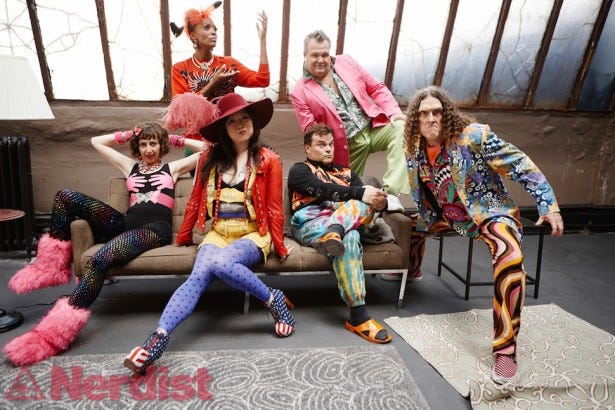
When I entered the workforce right after college, I had no style sense whatsoever. At my first job, I threw together whatever collared shirts I had in my closet with a couple of new pairs of pants, and voila, my outfit was complete.
And a complete mess.
You name it, I had it.
Busy patterns and solid colors. Bright pastels and subdued greys. Short sleeve polos and long sleeve button downs.
I never knew quite what to wear each morning and was hoping for the best when I got out of the shower.
There were several reasons for this, but for the most part it boiled down to the fact that I was barely keeping my head above water in just about every aspect of my life.
I graduated into the Great Recession in May of 2009, got married in September of 2010, had a new baby in April of 2011, and started business school (while working full time) in January 2013.
My finances were in the red, my marriage was brand new, my baby was even newer, and I was perpetually sleep deprived.
The last piece of the puzzle was that I was working at a small company that was made up of engineers-turned-salesmen, and I was the backroom guy.
I was never seen in any sales meetings or brought along when talking with customers. I’m not sure if that happened because I dressed poorly, or I dressed poorly because I realized I had no future there.
Regardless, my fashion sense was a mess at the time.
Government Clothes — Not Good, But Better
Some time during my next job, I thought I knew what I wanted to dress like. Unfortunately, it wasn’t too much better than what I had previously been wearing.
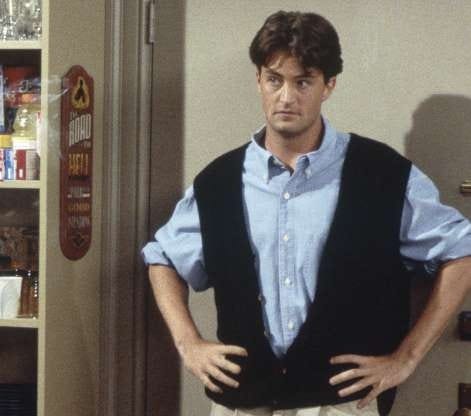
My work wardrobe consisted of lots of multi-colored, thinly striped, plaid button-down “dress” shirts that were two sizes too big, along with some also-too-big Dockers.
I thought the larger shirts would provide that “billowy” look from the 90’s, but it just ended up looking like I added a couple of buttons to a twin size bed sheet.
After a few months, I realized that I didn’t look good. And I felt it, too. The problem was that I didn’t know what to do.
That’s when I met another large guy who worked at my job.
Steve.
Steve was about my weight, with an extra inch or two on me. But he always looked SHARP.
It didn’t matter what he wore…it always fit just right. From wearing a suit while arguing a murder case on appeal to slacks and a polo for casual Friday, he looked good.
And here’s the kicker.
Even though he was technically obese, no one would ever imagine calling him fat. He was merely a “big guy”.
So I started Googling fashion in general, especially for fat men, and learning everything I could. The best primer I found on clothes for big guys is The Big Man’s Guide to Sharp Dressing.
About the same time that I was researching fat man’s fashion, my wife was doing her own research into capsule wardrobes. After talking at length about how to approach our respective work outfits, we decided capsule was the best choice.
In a stroke of serendipity, I found a new job in the field I wanted. After being offered the job, I took my work wardrobe seriously.
Moving On Up — The Capsule Wardrobe
Taking all the lessons I learned from the interwebs on how to dress as a large man, I went shopping. I didn’t want any of the assumptions that people have about fat employees following me to the new job and the new city.
Besides, I wanted to make my mark, believing the quote by Mark Twain.
Clothes make the man. Naked people have little or no impact on society.
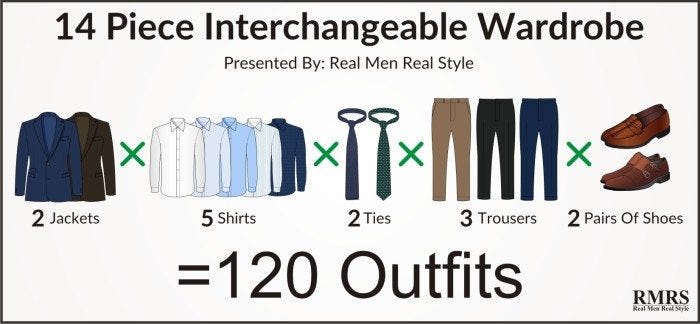
So I put a plan together to create my very own capsule wardrobe for my overly large frame.
I bought six ties, five solid color long sleeve button down shirts, four pairs of pants, three sets of suspenders, two pairs of shoes, and one fedora. (And you thought I was going to say, “and a partridge in a pear tree.”)
After the first few months and the winter got cold, I added two full sweaters and two sweater vests.
Dressing up was weird for me, as I had always been the casual, kind of sloppy, happy fat guy. And now I was the fashionable new person in the office.
The biggest lesson I had to learn had to do with standing up straight. You see, when you’re fat, you try to “hide” your belly by stooping over a bit. While it makes your stomach just “thismuch” less pronounced, it also has the consequences of making your frame shorter and rounder, which presents timid body language.
By learning to stand up straight, I had to accept that my belly was in fact protruding, but I also had my head up and shoulders squared, presenting a pose of confidence. It took months for me to feel comfortable, and I hardly looked coworkers in the eye, much less complete strangers, as I was awaiting the inevitable (to my mind, at least) comments that I was fat.
However, the complete opposite happened.
I started getting compliments from my peers, and the complete strangers even randomly praised my dress.
The most satisfying example of this was during a cool autumn day. I was taking a quick break to grab a coffee from the local shop two blocks away, when I rounded a building and almost ran into a group of three twenty-somethings.
We avoided a full-on collision, and I offered my standard, “Pardon me” as I stepped aside. Instead of a nod or grunt, my comment was returned with a, “Looking sharp, my man.”
It was the first time in….ever….that I had received a compliment on my appearance.
After that encounter, I stood a little straighter, realizing that Mark Twain’s quote was so very, very true.
Standardization — The Work Uniform
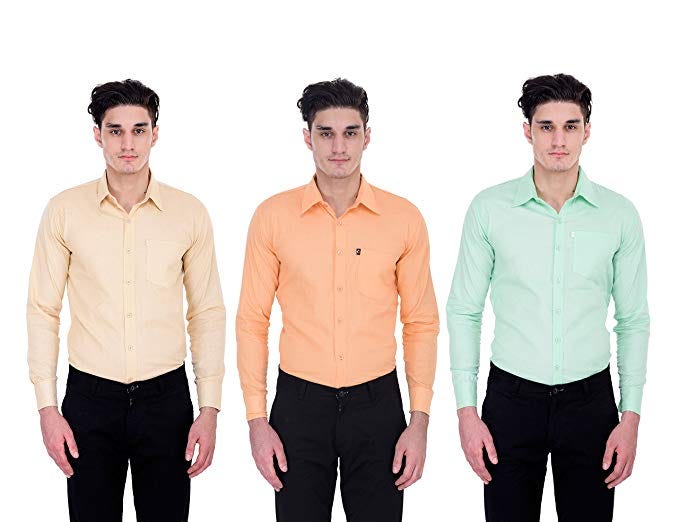
As a reality check of the privileges I do or do not have, I will say this.
I’m not rich enough to pull a Steve Jobs or Mark Zuckerberg and wear the exact same outfit every day. But I am male enough and white enough to wear the exact same five outfits every week without causing a raucous.
After my promotion, I moved from the second tallest building in downtown to a one-story vehicle maintenance facility next to a whiskey distributor.
Go figure.
I soon realized that a suspenders and tie would be out of place, as I spent most of my days working with facility technicians and vehicle mechanics, not departmental directors.
The guys I worked with were all union and were assigned identical uniforms. So I thought to myself, why don’t I just get myself a uniform, too?
My new job had me out in the field anyways, climbing up on roofs to look at an HVAC unit or kneeling down on wet concrete to inspect a bulk fuel container. This was no place for worsted wool slacks and silk ties.
After some more research, I decided on standard khakis and short-sleeved, solid color polo shirts as my everyday work attire.
This outfit is cool enough in the summer and can be layered in the winter. It can be dressed up with a sport coat or blazer for official meetings, while taking a beating when crawling through a basement.
Standardization and Sexism
I want to be clear, there is a flagrant double standard between the sexes when it comes to fashion. More is expected of women. More variety, more show, more allure.
In this article from Fast Company, a woman claims that people were too busy to notice her work uniform until 5 weeks went by.
Okay, that’s a decent amount of time.
Now, guess how long it took for someone to notice my standardized clothes.
Not 5 minutes.
More like 5 months.
Almost half a year passed before anyone said anything, and even then it was, “Man, you really like polos.” Like I had an obsession with polos and was wearing a different one every day rather than the same exact ones over and over.
Another few months went by and I finally admitted my clothing strategy. Their response was, “Huh, I guess you do wear the same thing. That’s nice.”
No one cared.
And I believe that was due in large part to me being male.
The Takeaway
Capsule wardrobes and work uniforms might not be everyone’s cup of tea, but I will argue that there is more than enough benefit there to warrant taking a second look.
If you take a minute to honestly compare a standardized wardrobe to the randomness that might be hiding in your closet, and you might realize that an over abundance of choice just isn’t worth it.


