
Why Waste? Why not? How Can We Do Better in Our Business Models?
Ecological intensification can create multiple benefits
After working for 25+ years in business management, I changed course. Because it is needed, we cannot go on wasting resources, polluting and feeding an economy that makes a few people rich and leave many behind in poverty.
The old economy is done. Let’s design a new one together. The good news is: it can be done. We can shift from scarcity to abundance, from competition to collaboration, from useless products to products that matter. But we have to take a different view.
In this article, I have a look at waste and how we can design our production processes in such a regenerative way that waste is a resource for the next product. Use ecological intensification wisely. Let’s use the synergy of products to create a multiplier effect within business cases.
This radical business model innovation is most easily done in start-ups because they can start afresh. Regenerative farmers can use it easily to create more income with organic waste in their models.
Waste matters
Waste is so easy, so natural in our consumerist world. We don’t think about it. Or we only think about it when it ends up in our oceans and we see pictures on social media of birds and whales dying because they ate plastics.
And we think: “Well, that’s not us. We recycle.” Well, you wish… It IS us! Waste matters! Waste is a waste. A waste of resources that could be used for beautiful products that last. A waste of time from all these employees producing the stuff.
And in the end, it will be waste polluting our soils when collected in a landfill. Waste polluting our water when washed into our rivers, our oceans. Waste really matters…
Linear production process
Why do we create waste? Waste is created because we produce our products in a linear process. We take a resource, produce a product, consume the product and throw it away when not needed anymore.
And during this process of producing and consuming, waste is created. In the end, all is waste.

Systemic design
How can we do it differently? We can design waste into our business models as a resource for new products. In the Blue Economy, business models are always designed as a system and often part of a bigger regional economic system.
At the Polytecnico di Torino you can study a master systemic design and develop business models or complete regional networks that really contribute to sustainably living within the boundaries of our planet ánd creating abundance.
These business models use synergy as a benefits multiplier in the business case. Benefits here can mean money, but it also includes other values, such as clean water, clean air or healthy food.
And the business models will as much as possible give back to nature, because that is where our resources come from. Reciprocity is high on the agenda! Waste in this way will never be waste, but it will regenerate the soil. Or the seas. And do extra good instead of less bad.
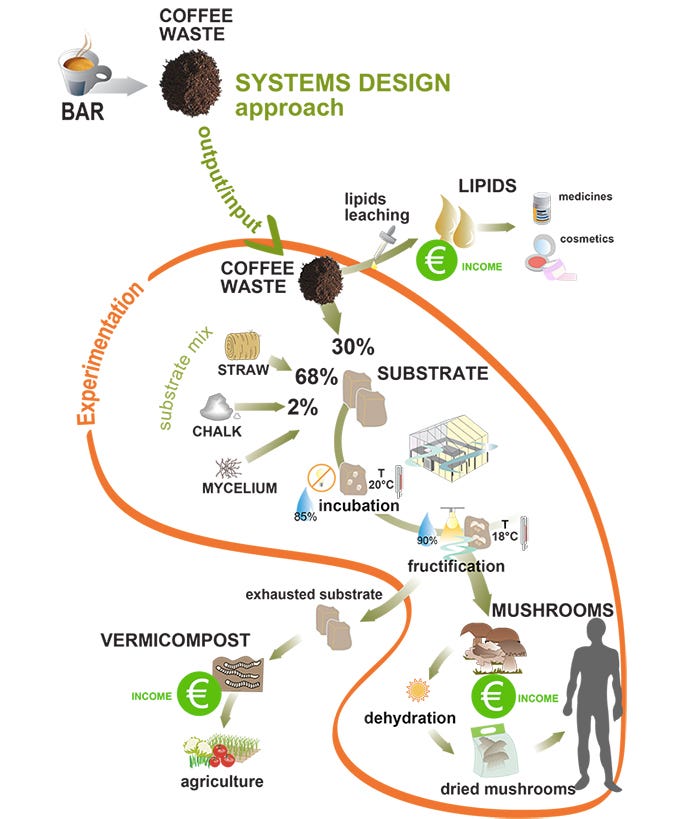
Mushrooms grown on coffee waste
The business case in the picture is the one for mushrooms grown on coffee waste. If you want to place it in a circular economy, it is situated in the left wing of the Ellen MacArthur Foundation butterfly model, the biological cycle.
Only 0,2 percent of the coffee is used to make a cup of coffee. The remaining 98,8 percent is thrown in the trash. What a waste! Because coffee is one of the most valuable resources known to man.
It has many wonderful qualities:
- it contains cellulose, which can be a building block for many products
- it contains cafeine, which will speed up several biological processes
- it contains lipids, useful oils that can be used in medicines and cosmetics
- it reduces smell, so think about the benefit for clothes, shoes, etc…
Ecological intensification
In a synergy business model, we always look for ‘ecological intensification’. It is a term used in agro-ecology, trying to produce as much as possible within the boundaries of ecology.
In a synergy business case, it means we will also look for intermediate products to add as much value as possible within the system. Mushrooms are an example of such intermediate products.
We could use the coffee waste directly as a soil enhancer, but if we produce mushrooms first and use the substrate after use as a soil enhancer, we have created two products in one.
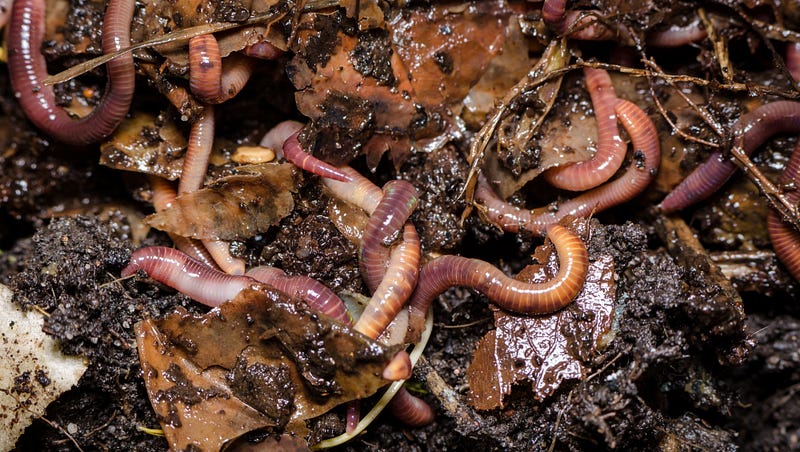
Another example of intermediate products is insects or worms. We can use organic waste directly as feed for animals, but what is the nutritional value then? If we use organic waste to grow insects or worms, they add value in the system.
The animal feed is a richer source of protein and the insects or worms open up other business opportunities as well. So think for a moment about opportunities for intermediate products in your business model. What will add value? What can be created with the resources you already have?
An example that also gives an income stream to organic farmers is shown by the company Straw by Straw. Everlyn buys the straws from organic farmers and makes a business case with it, transforming the restaurant industry on the subject plastic waste…
Organic is the way to go
We want to use resources to the full, so we can create as many benefits as possible from one resource. If we grow organic mushrooms on coffee waste, minimizing the need for energy input, we will have a very useful and very delicious food.
Mushrooms give people the protein needed without having to grow and slaughter animals and the used mushroom substrate can be input for the next process again.
And of course, we can add extra value in the model by making other products using the mushrooms. Vegan snacks, pasta filling, tapenade, etc. So think for a moment of all the benefits and the wealth of opportunities that one large stream of waste (in cities the coffee waste is available in abundance!) will give us.
And why organic? In the biological cycle, we need organic because otherwise the waste stream of the mushroom substrate cannot be used in the next process as a soil enhancer.
Chemical elements will kill the micro-organisms and fungi used to create the products in the first place. So organic is the way to go if we want to intensify our processes in a responsible manner.
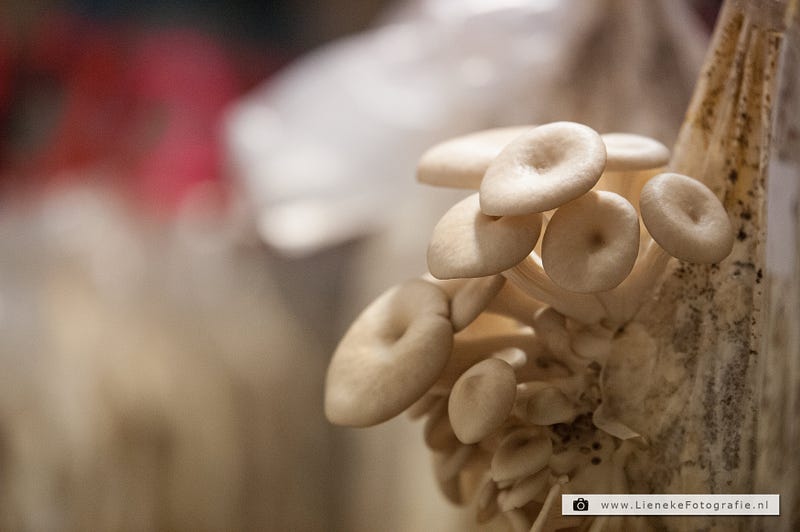
Coffee waste used in practice
Luckily, many entrepreneurs around the world are actually finding their feet with this mushroom business case. Let me first mention the two mothers of mushrooms: Chido Govera with her foundation The Future of Hope in rural Africa and Ivanka Milenkovic with her business System Ekofungi in Belgrade, Serbia.
They are actually changing the world with organic mushrooms, both in their own way. They will not necessarily use coffee waste in their substrates, but any local waste stream abundantly available that contains cellulose and can be purified with minimal input of energy.
As a biologist understanding mushrooms to the core, Ivanka has also done great innovation work on this last part: purifying the waste stream with minimum energy input.
Coffee waste has the advantage that hot water already ran over it. If you work with fresh waste and follow the right procedures, the mushrooms will not be outnumbered by other kinds of fungi. But with other cellulose sources, such as straw, purifying the waste stream with minimum energy is an art that Ivanka masters.
Mushroom projects in Europe
In Europe, the business case for organic mushrooms is becoming very popular. For city entrepreneurs, Rotterzwam can be an inspiration. This company is founded by Mark Slegers and Siemen Cox in Rotterdam, the Netherlands in 2013.
It has been the basis of a whole network of diverse sustainable entrepreneurs, innovating and creating the new economy in Blue City. Rotterzwam concentrates very much on coffee waste in city applications. But there are other waste streams used for mushroom growing as well.
In Greece, for instance, Christiana Gardikioti and her Meraki People grow the mushrooms on olive tree cuttings. In order to make the knowledge of mushroom growing in this special way as widely spread as possible and learn from each other, a network of European entrepreneurs has been founded: the mushroom learning network.
So if you are interested in growing mushrooms, innovating your business model in the process and add to the mycelium of sustainable entrepreneurs changing the world, join the network of Ivanka, Mark, Siemen, Christiana and many others! You will gain many friends in the process!
Business model values
Business model innovation is desperately needed if we want to grow from an economy as we know it now, to an economy that is regenerative and inclusive. Entrepreneurs are needed at the forefront because governments will only take action if the change is inevitable.
Protests can be drivers for change, but building on the positive side of things can also be a change maker. One thing is certain: waiting for the government to take action is a no go. They will not move until their people make the shift themselves.
Let’s show them that we want it. Let’s vote with the money we spend. Let’s be the entrepreneur showing that it can be done with new synergy business models.
I really hope more business models will appear that reflect these values:
- Each product contributes to basic needs and solves a real problem
- Waste is a resource for a new product
- Synergy is used for a multiplier effect within the business model
- Waste is always considered when designing the business model
- The mindset will change from linear to systemic thinking
- Create many benefits by adding value upon value within the model
- Benefits will be more than just money
Beautiful, useful and durable
As an afterthought that is much more than an afterthought, I would like to add a story by Satish Kumar, one of the founders of Schumacher College. At Schumacher College, you can study for a university master in Ecological Design Thinking and Economics for Transition.
The Guardian gave a review of Satish’s book Soil, Soul, Society, which gives an idea of the wealth of knowledge this man possesses and shares. I spent many enjoyable hours listening to this pilgrim of life during his fireside chats at the college.
And one of his stories that stuck in my mind was about his mum and her BUD principle. Products should always be like a bud: beautiful, useful and durable.
Beautiful to look at and made with love and attention. But only beautiful is not enough. They should be useful as well. Inspirational to look at or helpful in a practical way. And they should be durable, used for a long time and repairable.
Start-ups
I hope start-ups will be inspired by ecological intensification as I tried to explain it, by designing regenerative business models with lots of synergies and added value and also by this BUD principle.
Please consider in your start-up to design waste as a resource and to multiply the benefits your company will be creating. A new product is a valuable creation, why waste it?
If you want to connect, please find me on LinkedIn or somewhere in my food forest experimenting with ecological intensification…


