
Why Two Types Of Wisdom Are Needed To Grow In Today’s World
The ancient Greek ideas of Sophia and Phronesis
“So, how are you going to get it off your truck?”
My question wasn’t a hard one. But soon I saw the excited faces of my young customers droop into a sudden despair. The couple of early twenty-somethings had just bought a $12,000 eight-hundred-pound heated pressure washer to expand their new business.
- They watched videos about this unit
- Both realized its higher flow would make them quicker and generate more money
- The two understood the giants in the industry used this type of machine
- Amazingly, they even found a way to fund the equipment at their tender age
But after my fork truck plopped it down into the bed of their pickup, neither could figure out how they’d remove it when they got home. And I took pity on them. Not just because they paid me, but I used to be them.
As a kid, my face was always buried in books, which clouded my mind a bit. I thought knowledge was something pure.
It consisted of ideas, higher thought, and this enlightened wisdom got passed on by impressive figures known for their brain power. In other words, wisdom and knowledge never got messy.
Socrates, Plato, Aristotle, Einstein, and Beethoven didn’t get dirt under their fingernails. Likewise, they didn’t sweat. For me, knowledge lost practical application, and this stunted my growth.
But the ancient Greeks had a remedy and came to see knowledge and wisdom in a deeper way. In fact, it comprised of two words: Sophia and Phronesis.
The Dual Nature Of Wisdom
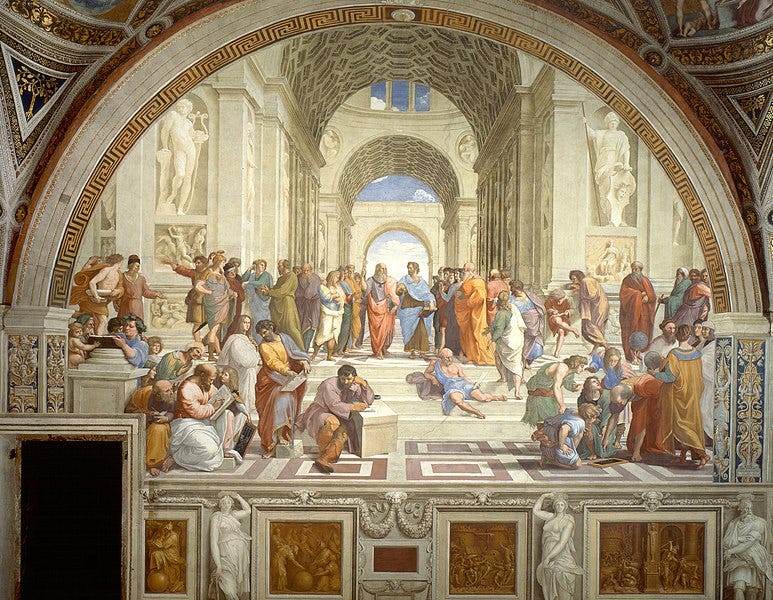
The early Greek philosophers talked about wisdom or “sophia” in terms of abstract thought. Socrates mentioned “the good.” While his student Plato talked about something of a similar nature called “forms.” According to historian Will Durant in The Story of Civilization:
“Knowledge is possible through ideas. Through generalized images and forms that mold the chaos of sensation into the order of thought.”
In other words, “humans” can die, but the concept of humanity lives forever. “Light” can be extinguished, but the idea of light continues. While the physical thing expires, or suffers from imperfection, the form is immortal and perfect.
It’s why my college has a statue which symbolizes the flame of wisdom. This higher knowledge illuminates your path. Likewise, it’s why Plato loved geometry, not for its usefulness in building. Durant explains:
“All mathematical forms are ideas — eternal and complete. Everything geometry says of triangles…would remain true, and therefore real, even if there had never been and never would be any such figures in the physical world.”
But as beautiful as these ideas are, Aristotle saw them as incomplete. Durant says he became like a proto-scientist, seeking out examples in the real world, capturing specimens, and physically doing things to learn.
Brett & Kate McKay at the AOM Podcast mention the philosopher used a word for this type of knowledge: “phronesis” or practical wisdom. They quote Aristotle’s Nicomachean Ethics as saying:
“Practical wisdom is a true characteristic that is bound up with action, accompanied by reason, and …not concerned with the universals alone, but must also be acquainted with the particulars…”
So, not only must you figure out how to buy the expensive machine, and see its potential for doing wonderful things, but also figure out how to get it off your truck.
Without the practical, the abstract can be just that — abstract. And in keeping with this thinking, let’s look at those who’ve combined abstract and practical.
What Happens When You Mix Sophia And Phronesis
“I can’t estimate his IQ but he is very very intelligent. And not the typical egg head kind of smart. He has a real applied mind.”
— Jim Cantrell (SpaceX co-founder describing Elon Musk), Farnum Street Blog
Professor Craig Wright in his The Hidden Habits of Genius says both Elon Musk and Nikola Tesla were avid readers as children. The latter made his own candles to sneak reading at night. While the former read all the books in the local library, and his parents used him as a human Google.
Call it sophia on steroids. Yet, each could apply this abstract wisdom in very practical ways.
- Tesla used his scientific knowledge to create a coil which spewed wireless electricity in 1891 when most were riding horses.
- Musk not only learned about Aristotle’s concept of First Principles, but used them to break down rockets into their base elements, and figure out it would be cheaper to build his own.
Although the king of mixing sophia and phronesis is T.E. Lawrence (Lawrence of Arabia.) While a popular movie, and glamorized pictures show him in uniform or in adventurous Arabic dress, he started as an “egg head.”
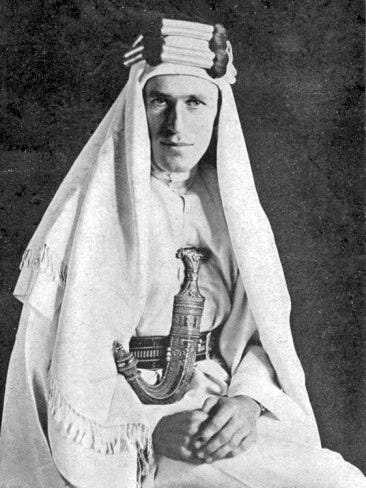
As a young teenager he cycled around France studying castles, eventually becoming an archeologist. He also became an officer in the English army. But in his book Seven Pillars of Wisdom, he says his training was sophia-like.
He learned of war by reading about the ancient Greeks like Herodotus and Thucydides, then learning from books written in Napoleon’s time by Carl Von Clausewitz, and Antoine-Henri Jomini.
Lawrence saw these lessons weren’t applicable in the Middle East. His Arab allies couldn’t field large armies. In fact, they worked better smaller. So, he’d fight a different kind of war; one with as little killing possible.
Lawrence blew up seven-nine railroad bridges, terrorized supply lines, and rarely attacked fortified positions.
In his book he uses the words of an educated scholar, describing the desert and palms in beautiful poetic language. Yet a page later he tells the proper way to blow up a railroad, how far a camel can travel, and what supplies you need for a long desert journey.
So, it’s not a stretch to say mixing sophia and phronesis can help you grow into something special. However, we’ve gone a bit off course. There’s still a truck to unload.
Taking An Eight Hundred Pound Machine Off Your Pickup Truck
The kids had told me they planned to eventually put the machine on a trailer. That was the key. I told them when they get home, hook up the trailer to the truck, then use a ramp to slide the unit down onto it.
From the truck bed to the trailer was only a few feet.
It crushed the plan they had in mind: get friends to help lift it off the truck to the ground (all eight hundred pounds.)
The whole interaction was phronesis in action. While my early self thought wisdom was never messy, fixing equipment, lifting heavy things, and learning martial arts taught me something else.
A wisdom does accumulate by getting dirt under your fingernails. And while “knowledge is possible through ideas,” wisdom should be “bound up with action, accompanied by reason, and …not concerned with the universals alone.”
Part of me thinks we’re losing this with our ever-present screens and technology which keeps us in the comfortable world of Plato’s forms. So, one capable of both sophia and phronesis becomes truly unique.
That’s why two types of wisdom are needed to grow in today’s world.
If you’d like to read more stories like these, please sign up for my mailing list. I’d also appreciate if you join Medium so you can access other writers like myself. It’s well worth the $5 per month. I’ll also get a tip for the referral.


