
Mathematics Was A Religion Of The Ancient World
Science and spirituality worked hand-in-hand before modern times
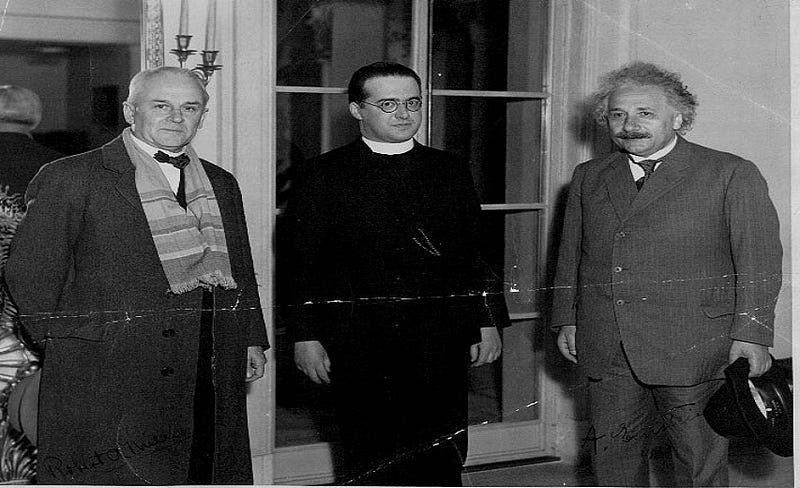

Georges LeMaitre appears odd in our present time. The Catholic priest, who got a PhD from MIT, spent lots of time thinking about the heavens, but in a different way than you’d imagine. Two years before Edwin Hubble’s famous discovery, LeMaitre — after reading Einstein’s work— proposed the universe was expanding. Next, he took it a logical step forward.
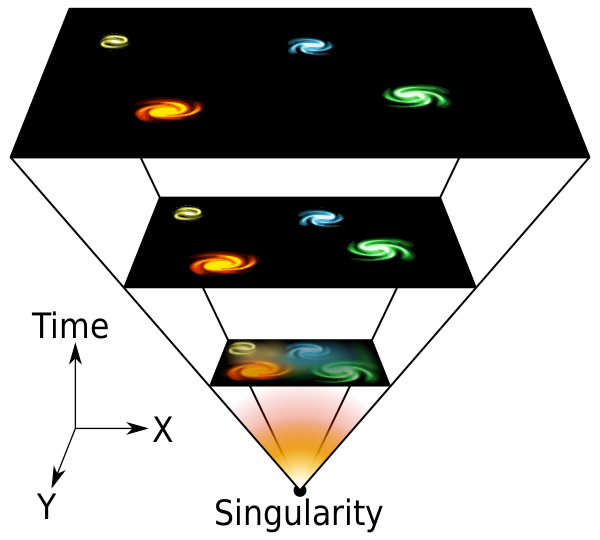
If the universe is expanding in the present and future, what happens if you roll the clock backwards? It all pushed together into one point. He referred to this as a primeval atom.
While LeMaitre called this “the beginning of the world,” a broadcaster at the BBC later referred to it as The Big Bang Theory. As interesting as the story is, I’m sure you’re stuck on LeMaitre’s uniform because it naturally doesn’t fit into the realm of science. A priest formulating the Big Bang sounds weird.
Why? Well, science and faith mix like oil and water. Or at least we think this nowadays.
But it wasn’t always this way. We use the scientific language of mathematics to design, measure, and build. But great thinkers of the ancient world saw it as a tool of higher thought, using it to expand their minds and even find God. In fact, philosophers were the original math teachers.
While you may know Plato from his dialogues, he might have been one of the greatest math teachers in the ancient world. Stick with me, it’ll make sense soon enough.
What Does Math Have To Do With Philosophy?
“Let no one ignorant of geometry come under my roof.” (Mèdeis ageômetrètos eisitô mou tèn stegèn)
— Phrase engraved at Plato’s Academy
According to historian Will Durant in volume two of The Story of Civilization, Plato left Athens and traveled widely after the execution of Socrates. He spent part of these travels with Pythagoreans. Brings to mind right triangles, annoying geometry teachers, and the nightmarish word hypotenuse, huh?
But the Pythagoreans were much more interesting than your geometry teacher. This odd group of philosophers believed in reincarnation, had strict diet and behavioral codes, plus thought mathematics was a pathway to enlightenment. They had a major influence on Plato, as you’ll see.
Upon his return to Athens, Plato purchased land around the outskirts of the city and set up his Academy. Presently, the word means a school. However, Durant refers to it more as a religious fraternity dedicated to the worship of the Muses. They also taught through dialogues.
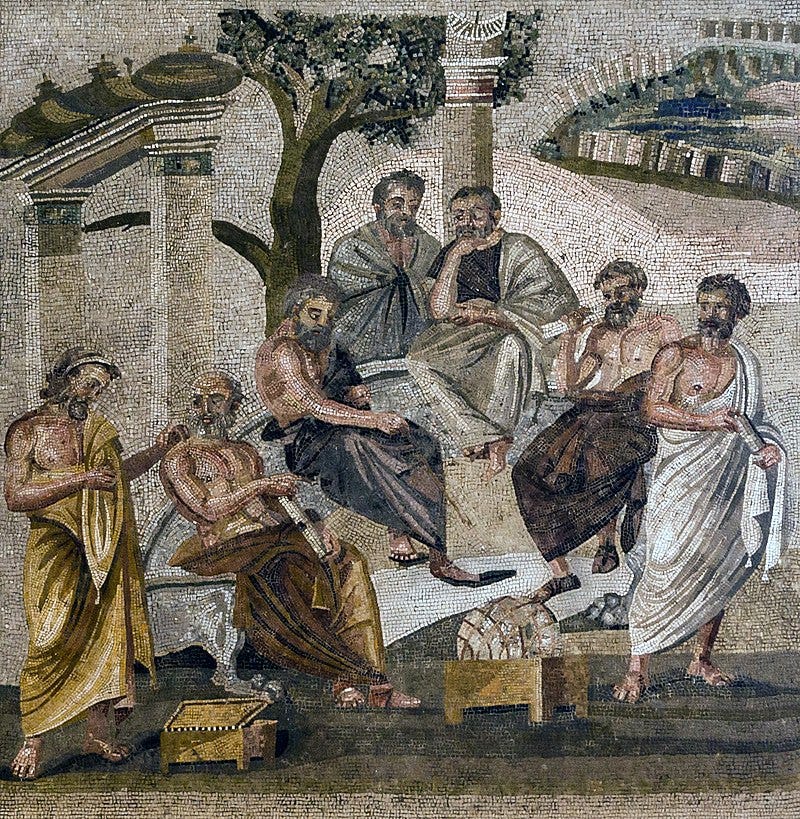

The main studies were philosophy and mathematics. But above all, Plato focused on “the forms,” or the ideal representation of a thing. Durant explains:
“Knowledge is possible through ideas. Through generalized images and forms that mold the chaos of sensation into the order of thought. If we could be conscious of only individual things, thought would be impossible. We learn to think by grouping things into classes according to their likenesses, and expressing the class as a whole by a common noun.”
In other words, “man” can die, but the concept of man lives forever. “Light” can be extinguished, but the idea of light continues. While the physical thing expires, or suffers from imperfection, the form is immortal and perfect.
For instance, imagine drawing a triangle at the beach. You’ll notice no matter how hard you try, it’s never perfect. Plus, wind, water, and toddlers stomping on the sand can erase it, but the concept of triangle can never be erased. It also reaches perfection, where your awful beach drawing couldn’t.
Durant tells us Plato’s forms dovetail perfectly with mathematics. He says:
“All mathematical forms are ideas — eternal and complete. Everything geometry says of triangles, squares, cubes, spheres would remain true, and therefore real, even if there had never been and never would be any such figures in the physical world.”
Therefore, mathematics is the highest form since it’s an idea itself, just like philosophy. And even God, the First Cause, being the perfect form that never changes shares in this similar nature.
So, philosophy, religion, mathematics, and science formed four legs of a chair. But different from the one we sit on today.
Platonic Solids: Ethereal Not Practical
“Most of the mathematical advances of the 4th century were made by men who had studied in the Academy.”
— Will Durant, Volume Two, The Story of Civilization
Joshua Mark at the World History Encyclopedia notes Plato often echoed teachings of the Pythagoreans in their use of numbers to prove the existence of the soul. But he also used geometry as well.
Durant relays Plato saying, “The figures of geometry are eternally and absolutely beautiful, and the law by where the heavens are made are fairer than the stars.”
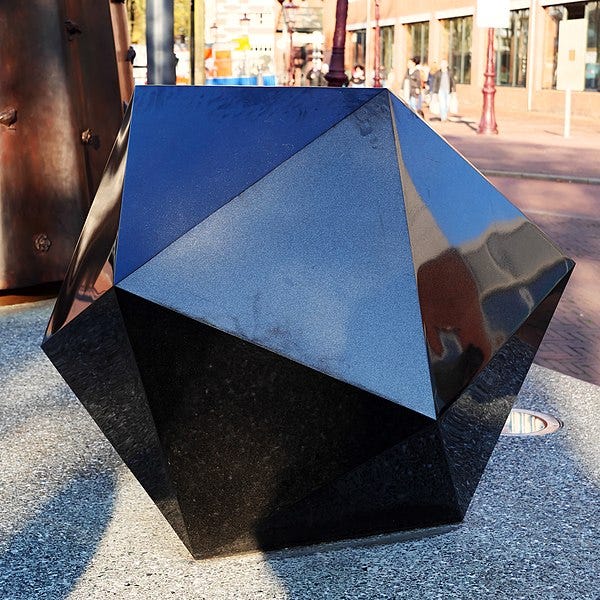

The philosopher concentrated on what became known as the Platonic Solids. He believed these geometric shapes composed the universe.
- the tetrahedron (made of four regular triangles) symbolizing fire
- the octahedron (made of eight triangles) symbolizing air
- the icosahedron (made of twenty triangles) symbolizing water
- the cube (made of six squares) symbolizing earth
- the dodecahedron (made up of twelve pentagons) symbolizing the structure of the heavens and stars
Plato required those learning at his Academy to demonstrate various geometric proofs: square the circle, double the cube, and trisect the angle.
Strangely, he didn’t teach these skills for the practical reasons we would today. A “graduate” from Plato’s Academy didn’t run out and get a job at an engineering firm or designing temples. Durant points out geometry’s purpose was to build the mind and soul.
This takes us back to our beginning and Father Georges LeMaitre.
Mathematics And Religion

The picture of LeMaitre standing next to Einstein appears strange in our modern age. We separate religion and mathematics. To us, they’re two opposite forces on different sides of a spectrum — faith versus proof.
But they weren’t this way to the ancient Greeks. To them, mathematics was the highest form, fully representing ideas that didn’t suffer from imperfections or fade away. In ways it resembled faith, and a search for a First Cause — the thing which caused everything else.
Then, in the 1920s and 30s, we have Father LeMaitre searching for a First Cause of the universe through mathematics. Is it that far of a stretch? Especially when you consider Plato and the Pythagoreans.
In the ancient world philosophy, religion, mathematics, and science formed four legs of a chair. Now, our seat tends to lean to one side or the other.
But if you look deep into their history and nature, you can balance between the pull of each leg. In many ways, they’re closer than you think. I’m sure Plato, the Pythagoreans, and Father LeMaitre would agree.
