
Why the Double Diamond is the Most Precious Diagram in UX Design …
… and Unearthing its Potential Can Provide Stakeholders and Team Members with Exponential Benefits
User Design is not an end-goal. Rather, it is a long-term process, involving stakeholders, researchers, designers, developers and other team members. When we engage in projects, whether it’s building a brand-new project or redesigning an existing one, we need a high-level value structure to refer to throughout the process. We must clearly define the points along the time continuum of a UX project.
A project team must work synchronistically and refer to these points in the project evolution. Without a defined value structure with definitive points in its path, stakeholders and team members will not know where the project stands at any given time.
Step 1: What Are the Principles of the Double Diamond?
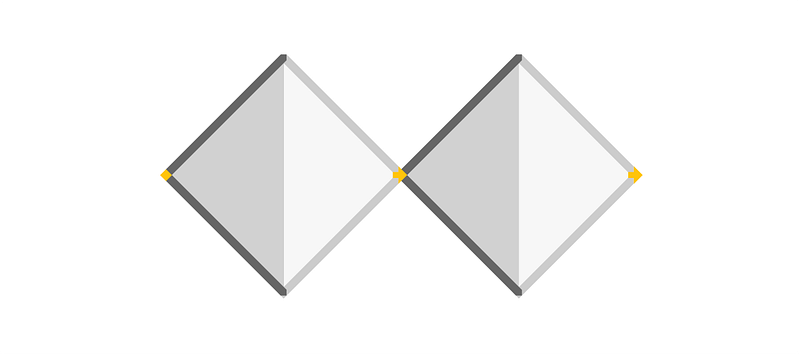
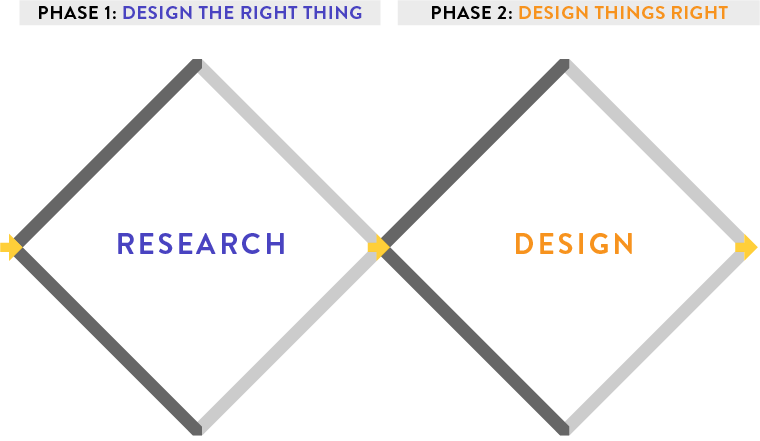
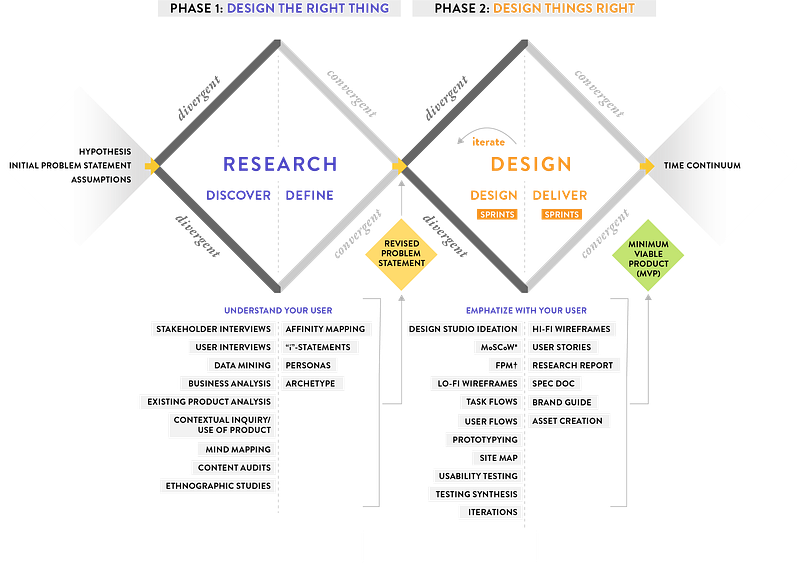
The Double Diamond is a process model created in 2005 by the British Design Council. (1) Its structure is simple, two squares at an angle. The first diamond represents the research phase, the second the design phase.
Fig 1: Double Diamond basics
Step 2: How Are Phase 1 and Phase 2 Initiated?
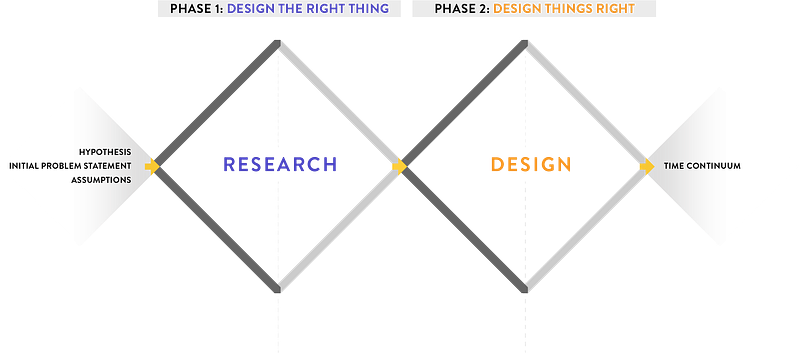
For a research phase to get started, we need a catalyst, a spark to ignite the thinking process. Often, this spark is encapsulated in the initial problem statement: identifying our persona, problem and goal. The problem statement might be expressed as “How might we help the user accomplish a specific action by providing the support needed.” If a problem statement cannot be identified, we start with an assumption, or a hypothesis. These entry points—problem statement, hypothesis—will define what the research process will look like. (We’ll talk about that in Step 3.)
Fig 2: Research entry points
Step 3: Research that Leads from Discovery to Synthesis
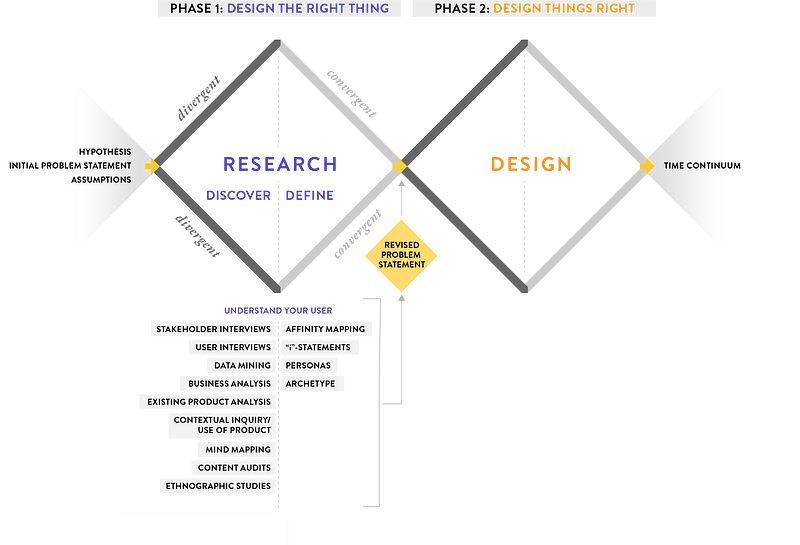
Assuming we have an initial problem statement, we can begin with our research discovery phase. We embark upon getting to know the users as thoroughly as possible. This is a divergent zone, where we gather as much data as possible, and embrace the complexity of the problem. Listening to the user’s insights and stories and documenting the data becomes the key activity. We have many tools at our disposal to achieve such results.
Once we have gathered all this valuable research, we are ready to start with defining our data. This becomes the convergent zone, where we use many tools to aggregate and validate research data. Themes, patterns and trends emerge through affinity mapping and persona definition, which can lead to a necessary revised problem statement. Such revision of the initial problem statement is extremely important, as it sets up the phase 2 design stretch.
Fig 3: Understanding research tools
Step 4: From Revised Problem Statement to Entering the Design Phase
With a solid revised problem statement, we can now embark on the design process: designing for the Minimum Viable Product (MVP). We start with a divergent design phase, where we develop multiple options driven by usability testing. Design studio sessions are initiated to brainstorm design solutions. Feature prioritization and MoSCoW* mapping are important tools to reign in featuritis.** Mid-fi wireframes and prototyping lead to the first testable work-in-progress. Usability testing should start early in the design process, so that feedback is gathered when changes can be implemented easily. The iterative design process can be repeated as often as necessary with mid-fi prototyping. Check-ins with the dev team are important touch-points throughout the design phase.
The design phase contracts from a divergent phase into a convergent mode during the hand-off to the developers. Important documents such as a spec doc, brand guide and asset library are created for the dev team. The delivery output is focused to deliver a Minimum Viable Product, an MVP.
Fig 4: Understanding design tools
* MoSCoW=Must Have/Should Have/Could Have/Won’t Have, a feature analysis tool to avoid featuritis.
**Featuritis is defined in Wikipedia as an excessive ongoing expansion or addition of new features in a product, especially in computer software and consumer and business electronics. https://en.wikipedia.org/wiki/Feature_creep
†FPM=Feature Prioritization Map, a tool to prioritize features based on research.
In Summary: The Double Diamond Functions as a Product Design System Matrix that Focuses the Team Throughout the Product Design Cycle
Throughout the entire Double Diamond project phase, we need to embrace complexity while looking for the non-obvious leverage points. This might include expanding upon research during a divergent phase, before entering a converging synthesis phase. Once the research/synthesis phase 1 is completed, we then again expand into our divergent design phase 2 during which we conduct as many usability tests as possible, before entering the convergent, product-defining stretch for MVP hand-off.
The Double Diamond matrix serves as model to anchor the product design cycle until an MVP for handoff can be achieved.
The Double Diamond has been tested over and over again and remains robust and reliable even as MVP demands are growing and expanding.
Join Medium
Read more about some of the research tools outlined in the Double Diamond diagram
Atomic Design and Its Modular Application in UX/UI Design
How to grasp the concept quickly
medium.co
Thank you.
Reference:
(1) https://www.designcouncil.org.uk/news-opinion/design-process-what-double-diamond
All images and infographics © Eva Schicker, 2018/2019/2020.


