
Why Schools Fail — Part V: They Can’t Work
The model is fundamentally flawed. Money and incremental changes will not fix the problem.
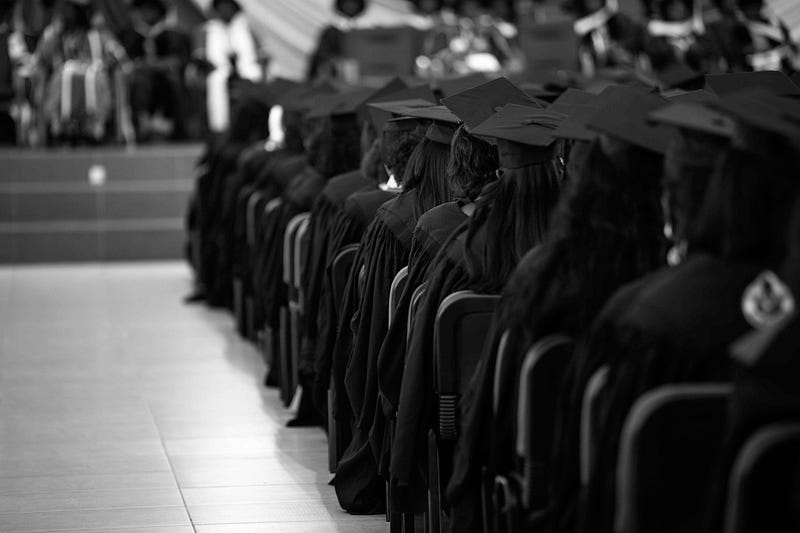
“A graduation ceremony is an event where the commencement speaker tells thousands of students dressed in identical caps and gowns that ‘individuality’ is the key to success.”
— Robert Orben
The education system is broken.
Teachers, parents, and educators already know this.
This is a worldwide issue. The problem exists in every country with perhaps the only exception of Finland. Outside of a few career academics, I find that no educators support the current model. I find few parents who support the model.
And students are unhappy, bored, depressed, and suicidal.
Yet, like sheep, parents, teachers, and administrators continue to support and perpetuate a broken model even though they know it doesn’t work.
Tragically Broken
We see story after story from teachers explaining how to fix the system. They have solutions for curriculum, pedagogy, reading strategies, resources, and management structures. All are good ideas and may make incremental improvements.
But at its core, education does not work. As I wrote in my prior article, Spirit Disconnected:
We are all familiar with the mantra: go to school, get good grades, earn a degree, find a good job, make money, get married, have kids, and then you will be happy.
While aspects of this achievement model work for some people we know too well that this path does not always lead to happiness. In fact, the opposite is often true.
The majority of children are unhappy in school and the majority of adults are unhappy at work. This is devastating when we consider we spend approximately 70% of our lives going to school and work.
Perform a simple Google search on the problems in education and millions of results will appear. It is almost pointless to rehash the discussion when we all know the issues. There isn’t one article on Medium that discusses the joy of teaching and the incredible education system.
There may be happy teachers sharing what they are doing to try and make the classroom better. But underlying every story is a feeling of frustration.
Yet we continue to perpetuate this failed system. Over the last decade, we have seen a disastrous and tragic result of broken education: suicide and depression.
Even knowing this we continue to accept the collateral damage of our children taking their lives and being miserable.
We participate in an immoral and unethical game because we don’t have the strength to simply put a stop to it.
Teacher of the Year
A strong voice against the system was John Taylor Gatto.
Gatto was a teacher for thirty years in New York. He wasn’t just any teacher. He was named New York City Teacher of the Year and New York State Teacher of the Year. He was critically acclaimed and was a voice for change.
Gatto’s most important novel was Dumbing Us Down: The Hidden Curriculum of Compulsory Schooling. This should be mandatory reading for all educators, parents, and students.
Gatto summed up his views on the U.S. school system:
School is a twelve-year jail sentence where bad habits are the only curriculum truly learned. I teach school and win awards doing it. I should know.
Gatto’s views were clear that mass schooling damages children. He declared that we don’t need more of it, we need less of it. He was frustrated with educators constantly presenting new solutions that were expensive, self-serving, and always involved greater centralization.
If the system was working to improve the lives of children and society, then we would be fine. It doesn’t work and hasn’t worked for over a hundred years. Gatto is not opposed to education. He is opposed to the current schooling model. He devoted his life to children and worked at the highest levels to make improvements:
Do we really need school? I don’t mean education, just forced schooling: six classes a day, five days a week, nine months a year, for twelve years. Is this deadly routine really necessary? And if so, for what?
Gatto outlines his ideas for how to improve education. His primary solution is decentralization, open learning environments, stronger community involvement, and breaking away from a failed metric of grades and testing. He supported giving the children more autonomy as they are natural learners.
His views are not new. As he outlines in his book, research has shown for over eighty years the failure of the system:
In 1930, sixty long years ago, Thomas Briggs, delivering the Inglis Lecture at Harvard, charged that “the nation’s great investment in secondary education has shown no respectable achievement”; two decades later, in 1951, a survey made of 30,000 Los Angeles school children discovered that seventy-five percent of eighth graders couldn’t find the Atlantic Ocean on a map and most of them couldn’t calculate fifty percent of thirty-six.
What is fascinating about Gatto is that he feels education is doing exactly what it was created to do: control, conformity, and obedience. While I don’t agree with some of his assumptions, I fully agree with his assessment of the current state of affairs.
Education is broken. We know it. Let’s stop discussing it and fix it.
Breaking Patterns and Beliefs
Depression and suicide rates are off the charts among young people. The reasons are multi-faceted. But what is very clear is that school compounds the problem.
Children are bored and depressed the majority of the time in school. Forcing them to sit in walled rooms, complete endless homework, take tests, focus on grades, compete and conform only exacerbates this problem.
The solution over the past ten years has been to throw money at the issues with more school counselors. Instead of trying to fix the problem we layer on another for-profit industry on top of a failed system. I support the role of school counselors but their job is meaningless when the system is creating the problem.
I have been in education for over twenty years. I have run schools, helped to start schools, worked with governments at the national level on their education policy, taught in classrooms, hired teachers, and continue to work on new models of learning. I have sat on many higher-education boards and lectured at universities. I know first-hand the problems. While research helps to validate the problems, I see the issues.
I am a big believer in common sense. When I sit with any parent, teacher, or student, I don’t need research to tell me that the child is unique. Every child learns differently. Every child sees the world differently.
And contrary to some opinions, every child wants to learn.
So how can we believe that a system that pushes conformity and obedience is good practice? Why do we feel that we need to continue to put ourselves into debt to receive a degree that too often doesn’t help us in life and only adds to our unhappiness?
The typical response to this is What are we supposed to do?
For working within the system, there are many options. And there are alternatives all over the world.
It needs to start with us, the parents and educators. We need to stand up and draw a line on this madness.
Every time I read of a child’s suicide, I cry. I know the statistics on suicide. I speak publicly on these issues. We know there is a direct causal link between depression and suicide and the failures of our education system.
How do we justify supporting a system that isn’t working and is killing our children? These are not dramatic words. These aren’t written for attention or effect. These are truths.
We need to stop with the idea that throwing more money at school is going to help. I support paying good teachers more. But outside of this, we are wasting our time and money.
The system is broken. We can fix it.
And if we don’t, we know the outcomes.
“Why Schools Fail” is a series of articles on the state of our education system and what we can do to make things better.