
A Child’s Song Offers a Roadmap on Education
This simple example shows how to fix a broken system.
“It is not only fine feathers that make fine birds.” — Aesop
The education system is broken.
This isn’t an issue for any one country. It is a worldwide problem that I know first hand having spent over twenty years in education.
Yet as we do with most every topic from climate change, mental health, homelessness, health choice, gender issues, and energy proposals, we spend time arguing from an intellectual platform as we throw around research and statistics to support our opinions.
There is merit to intellectual arguments. But they lose their value once we become disconnected from what we are actually supposed to be focusing on. This is often the case in education where we too often talk about everything except the only thing we should be discussing: children.
So here is an example as to how good education actually works. I won’t comment through the story about where the learning is happening. I will share that afterwards.
This story involves a 5-year-old girl and a polar bear.
Bali Starlings
My daughter, Chenoa, came home from school one day and showed me a letter about a competition that was happening at her school in Bali.
The school did a lot of work around conservation and had some very rare Bali starlings on a breeding site on the campus. To support the starlings, the school student-driven newspaper was running a competition where students would draw a picture of the birds and then write a story.
My daughter wanted to participate but she couldn’t write at the time so I wasn’t sure if they would allow her.
I asked and they did. She told me her story and I transcribed it for her. She also drew a picture of the birds and submitted her story. They accepted it (along with all the other stories) and published it in their student magazine.
My daughter was so excited and proudly showed me the magazine.
As we were driving to school the next day she said to me that she wanted to help some animals. I asked her which ones to which she replied, polar bears.
And the journey began.
The Polar Bear Song
We arrived at school and my daughter approached the first teacher she ran into at the entrance of the school. The mornings at the school had students, parents and teachers mingling, talking, enjoying coffee together. It was a social gathering before the children started school for the day.
Chenoa explained to the drama teacher, Sarita, that she wanted to help the polar bears. Sarita listened and spoke to her and they formed a plan to meet later that day to explore ideas.
After school I saw the two of them sitting on the lawn. Sarita was holding a guitar and they were singing. The teacher asked her questions and Chenoa explained her thoughts about polar bears and how she felt we could be helping them. Together they created a song that Chenoa gave the words to and Sarita gave the tune.
My daughter was so excited to be actively helping the bears that she decided to start a polar bear club. She approached another person, Sara, who also worked at the school in business development. They decided that Chenoa would be the president of the club and Sara would be the vice president. They shared big ideas and plans. None of these ever happened but it was an exciting moment. For a few days she was the president.
A few weeks later we were hosting an environmental festival at the school. We had a parent volunteer to film the event to capture some of the magic. One of the cofounders of the schools, John, was sitting speaking to a group of parents.
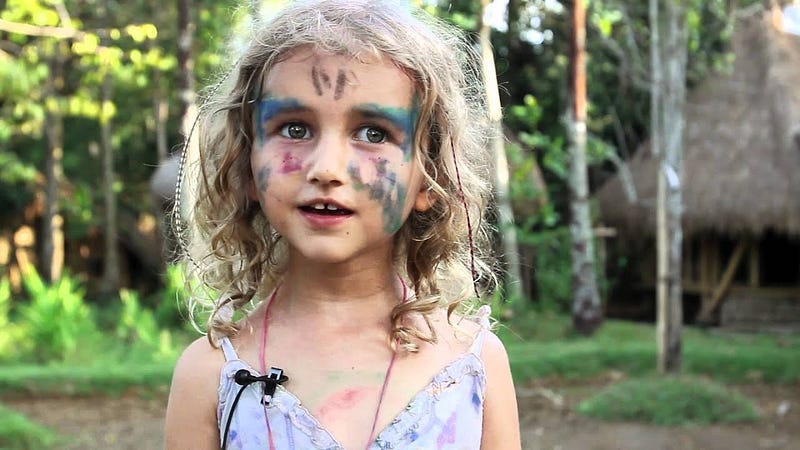
As they were talking Chenoa, covered in face paint, walked by and she was joyfully singing the polar bear song to herself.
John overheard her and asked her to come over to share her song. Then then asked her if she wouldn’t mind singing it again for the camera. She agreed and they put a mic on her.
Here is the forty-three second song that she and Sarita created together.
I cry every time I watch this not just because she is my daughter but because I know all of the parts that made up this whole.
The video was posted online by the school and was seen by tens of thousands of people. It inspired others to sing the song and send their videos back to Chenoa. The school was also approached by a polar bear organization as they wanted to use it to promote their cause. There was a domino effect, a positive chain of events that reverberated around the world.
This is how learning is supposed to happen. And it rarely does.
A Roadmap for Learning
I wish in this instance she wasn’t my daughter as then that removes my subjectivity. But I see stories like this happening all the time in good places of learning. This is not unique. But it is rare.
Here is a story of a girl who wrote a song. We can leave it at that. But what really transpired here? What was the learning we can take away from this?
For me this one example offers us the complete roadmap as to how to run a school and how to change the broken model of education.
Here are some key lessons — proven by research — that we can learn from this example. Let’s break this down and explain what really happened:
- Parents are on campus. Not having parents as part of the learning triangle is one of the biggest mistakes made in education. Teachers are incredible but have limits on their experience. Parents belong on campus.
- Adults listening and treating children as equals. At all times from the start of the day to the end, adults gave this student full attention and engagement. This isn’t unique at Green School. It is part of the pedagogy. But in most schools there exists a hierarchy where teachers dictate, students are expected to listen and adults aren’t involved.
- No overly structured time tables. This is the death of almost all good learning. Green School has flexible time tables and allows for things like this to unfold. We will often stop planned programs for the day if we have a special guest or event to allow the students to experience it.
- Every idea is fantastic. We too often tell children what they should be, how they should act, what they should focus on. When a child says they want to be a fireman we often suggest a different career path. We need to let them be, dream, explore. Chenoa wanted to start a club. The idea fizzled. That is OK.
- Music and the arts. We all know the first thing cut from most school budgets is the drama, music and arts programs. This is the broken system feeding on itself. The value of the arts in learning is immeasurable. Removing it is one of the most disastrous actions school leaders can do.
- Interconnected learning. One interest led to a project which led to a question which led to another project and so on. Learning is not structured. It is messy, flows, is integrated. If we don’t understand this then we undercut the experience.
- No grades or testing. A point of debate but the research is actually quite clear that arduous testing and focus on grading does more damage than good. The depression and suicide rates speak for themselves. But even put this aside for a moment and use your own intuitive sense. Imagine a world with no grades or testing?
- Outside the classroom. All of her learning in this example happened outside of the classroom. While the school has math and English and other subjects, none of this learning happened within those frameworks.
- Experiential. All of the research says the same thing: experiential learning is the best way for a child to integrate knowledge. Why then do we spend 40% of our time taking and/or preparing for tests within a walled room? Why do we spend 90% of our time in the classroom?
- Loving and interested teachers. There is no mystery that we underpay teachers. I believe we should be doubling all salaries and at the same time getting rid of teachers who just shouldn’t be teaching. A teacher is the critical piece in any learning model. Of course, there is more but without this there is nothing.
- Focus on the children. If you are an educator, take note one day as to how much time you actually spend on issues that have nothing to do with the children. If you are sitting in a meeting or working on a project that doesn’t involve your children then it is misguided. It doesn’t matter if you are in finance, HR, teaching, admin, management, or support.
- Holistic approach. This learning worked her because the system around her treated her as a whole being: spiritual, intellectual, emotional and physical. Almost all schools only focus on the intellect. If that was done in this case then this entire example would be void. This was not an intellectual exercise although her intellect was engaged. This was a holistic, real-world experience that she will carry with her for the rest of her life.
This isn’t only an example of exceptional learning but a practical roadmap as to how to change the current failed paradigm.
Some may say that this can only happen at a unique school in the jungles of Bali. Nothing can be further from the truth.
What is sad is that every good teacher and educator knows what the problems are. They just don’t know how to change the narrative.
Maybe just start with a song. You might be surprised as to what you learn.
🙏 🦋
What have you seen in your own learning that best worked for you? When do you see your children the happiest in school? Please share your comments. It is how we make this situation better.
Here are more of my stories on education and parenting for reflection and discussion.
If you enjoyed my story you may sign up here to receive an email for new articles. If you want to subscribe to Medium to read all the stories, including my articles, please use my link. There is no extra cost to you.


