

Why Rich Self-Help Gurus Can’t Help You
The rich self-help gurus live in a completely different world.
Flowing brown hair, a nice dress shirt, and a groomed beard. The image spilled onto my screen as a strong Texan accent could be heard. One look at the man and I recognized him immediately.
It was Matthew McConaughey. Otherwise known as MM.
I remember him distinctly in his role in The Wolf of Wall Street and immediately thought, “Oh that guy. Guess he’s doing self-help stuff now huh?”
*Clicks Skip Ad button*
The ad was all about a live event MM created a few months back called “The Art of Livin’” which like so many other events before this was designed to change your life forever.
Out of all the events that self-help gurus offer, this was the one.
With the tagline “Stop settling, and start livin,” the messaging was strong and compelling. It captures the whole idea of self-improvement paired with the motivational gusto that these big events bring.
It truly embodies the self-improvement industry. It has the oomph that it needs and tells people this is it. This is the moment when your life will change forever. The event to end all events.
Alright, alright, alright.
Especially when you have such great people like…
Dean Graziosi and…
Tony Robbins…
Sigh.
Why am I not surprised anymore?
My only exposure to this event was the ads that popped onto my screen back in April in the days leading up to the event, however, it still left a bit of an impression on me.
Unlike Graziosi and Robbins, whom I’ve seen plenty of times before, MM provides a bit of a fresh face to the whole self-help sphere. He’s someone different, and he comes from a different background than Robbins and Graziosi. He‘s a star and this was an opportunity to peel back the veil and see more of that Hollywood actor life.
It was a chance for new stories and new experiences and ultimately new perspectives that a much larger audience would be exposed to.
It was enough for me to do a quick Google search and see what people’s thoughts were on the whole thing.
While some people had some genuinely good takeaways the overall sentiment was clear what this was.
As soon as those ads appeared on my screen and I saw Graziosi’s face, I knew whatever he was peddling with whoever was a waste of my time. And sure enough, as most reviews of this live event showed, people were either excited or pissed by the mid-point when the sales pitch came in.
And even then the presentation itself was middling at best.
The VIPs who shelled out the $47USD for the VIP experience were treated to heavy moderation (especially when the sales pitch came up), a video before the event with MM talking about his experiences working on various film projects, and the opportunity for 38,160 or so people to be able to ask MM and his guests a total of 6 questions.
Oh and also be lied to because members were thrown into various Zoom private rooms and they had the distinct impression they would have the chance to talk to MM since, you know, one of the VIP selling points was a private Zoom room with him.
Even the feature where VIP members appeared in the background was kinda… weird…
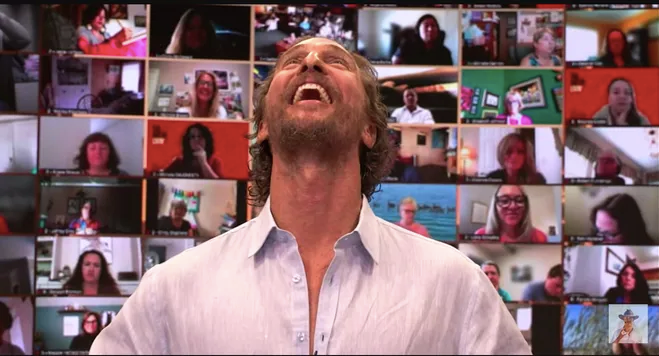
In the end, the opening act was the build-up leading to… gasp … yet another course. A course that got slammed hard. And every time after that, the course was pushed hard. The VIP members saw pressure ads like the following, encouraging them to buy immediately:
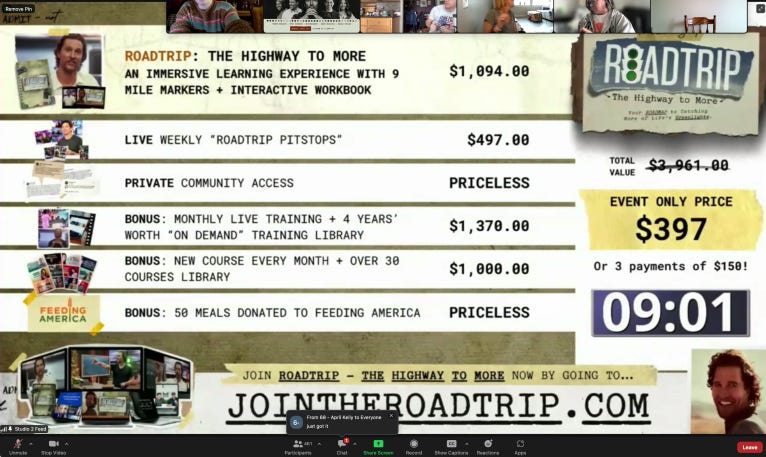
It pulled every usual trick in the self-help book to get people to buy. Between the high-pressure tactics, the carefully placed words in the pitch that make people feel guilty, and to top it off the extra bit of accessibility by knocking the price of it down to about a tenth of the price.
They even include a few priceless items like the fact some of the money will go towards the non-profit Feeding America. Oh, and that massive community too!
Even with all of this, it still begs the question…
Why is a rich successful celebrity like Matthew McConaughey even putting a price tag on this? Even as he claims this will change your life, the guy is worth $160 million dollars.
The Rich Live Different Lives And Can’t Relate
“We have all intention of supplying what you demand,”
When the sales pitch dropped, MM responded back with that.
Instead of a live audience, VIP members were posted up on a green screen and moderators used laughing tracks and claps on their soundboards.
They managed to attract nearly half a million people across their VIP ticket sales, and the Youtube and Facebook viewership when the event started. And in the lead-up to the event, they were talking about how they got 2 million people watching.
On the sales page, they consider it priceless that buying their course will prompt them to donate 50 meals to Feed America. Sure, I’m all for a charitable cause but you’re not solving world hunger here. Those meals are not going to last that long.
When it comes to these kinds of webinars or events with big names being involved, they are all the same. Here is a small group of rich people who are trying their damndest to help people out, but failing miserably.
To their credit, the extra bit of charity is nice and is different from other live events I’ve seen. But it’s still undercut by the fact that these individuals are rich and really don’t need to be charging anything for the course they are trying to sell.
It still follows the same sort of sales trope tactics that these events normally bring. They deliver a big promise that this could change your life and that this is a big deal. And then finally they drop the bomb and make the sales pitch. It’s then followed up time and again with reasons to get whatever they’re offering and they use every trick in the book.
They offer conveniences in the fact it’s so cheap and they’re planning to sell it for a much higher price “after the event is over” (seminar speak for they’ll jack up the price in a week if at all) or that how this information is delivered is through experiences that others can’t possibly go through.
In the case of MM, he figured he’d start to offer this course after he took off for a month to live in some isolated place with monks. He met with this specific monk whom he spoke to for hours and only uttered two words that literally any person could provide.
Me too.
Wow, that’s deep bro. I wish I could travel to some far-away place and have some random person say those words to me too. Not before I trauma dump them for hours at a time of course.
But the reality is most people can’t. And when it comes to rich people’s form of self-care (or how they deal with issues) it’s very different from the methods the average person has access to. For the rich, it’s flying wherever. It’s plastic surgery. It’s buying more things. It’s taking these pilgrimages.
There is still some connection that we can relate to, such as MM’s deep faith and religious vibes, but the context is vastly different. These rich individuals can get better therapists if they wanted to or resolve marriage problems or mental health issues without having to trauma dump to an AI chatbot. They can travel whenever and wherever they like for the most part and experience the world in ways we can only imagine.
It’s great to be bundling up those experiences and being able to offer them to someone that doesn’t have that privilege. But don’t put a price tag on those kinds of things.
The fact they routinely do makes it all the more disconnected from reality itself.
They Still Praise The Loop
Beyond the sales tropes, the products they offer themselves follow a similar pattern across the board. This is what happens when they follow a formula that’s presented by a rich self-help guru.
It identifies a primary concern and promises to relieve it. It then proceeds to spend hours outlining broad general solutions but nothing really all that actionable.
This formula is effective because it draws on raw emotions and leverages them. This is why when the course announcement was dropped, those who were excited were blown away and were not taking even the slightest bit of criticism.
They defended this course and claimed they needed the course and that it was an act of charity they cut the price down to a few hundred rather than a few thousand. Little do those defenders know that the product itself is about as deceptive as the perks that were offered to the VIP experience tickets.
The reason rich self-help gurus can’t help all that much comes down to the fact they are hooked to this specific formula. Even with the purest of intentions, this formula isn’t a win-win formula. Often it’s a win-lose in favour of the rich guy who is selling.
They get the money, and you’re still stuck with the same problems the product was designed to fix and address. Even with a refund policy in there, it’s pretty dubious when the live event was filled with high-pressure sales tactics and gaslighting. Expect horror stories to eventually emerge.
It makes sense they use this tactic because it’s effective in getting people in. Paired with a generous discount like this, people might even be lulled into just taking the financial hit. Even in cases where they can’t really afford the cost of the product.
Because there are few consequences for rich self-help gurus to do this, and the refunds don’t hurt them financially at all, their behaviour isn’t going to change. Even when they are unfit to truly help people, they still appeal to our emotions and use their fame in order to bolster trust.
All the while the products they offer for something that might or might not be something they genuinely wish to help you with does nothing to solve your problem. After all, the information provided could be looked up someplace else.
The Lack Of Empathy Towards Broader Human Problems
The one nice thing about MM’s course and VIP ticket sale was the fact that buying his course or the tickets for the live event resulted in meals being sent to Feed America. 50 if you buy the course and 25 for the VIP tickets.
They truly were priceless because, at the time of writing this, I don’t see MM’s name on the list of “Entertainment Council” on Feed America’s site. Nor have I seen any article stating MM sent hundreds of thousands of meals to them.
On the surface, I do like the idea of this, especially in self-improvement. There are external barriers that prevent us from growing and part of it does come from unmet basic needs. It’s hard to build muscle or lose (or gain) weight if your body is deprived of nutrients. To have someone even hint at this particular theme is something.
But beyond MM doing this little publicity stunt without following through, other rich self-help gurus barely acknowledge this in the work they do.
There is this idea that their passing of this knowledge for a price is their form of charity work. There doesn’t need to be anything extra. Even when these individuals are millionaires and really don’t need more of your money.
It instills a lack of empathy in my mind. And we see a little bit in the fact they don’t bother to change and stick to this same loop formula. They keep doing it because it's effective and they would rather bring in the crowds rather than genuinely help people out.
Even when they’re talking about issues that all of us go through like imposter syndrome, depression, loneliness, financial constraints, abusive partners or family members. All of it lacks true empathy and understanding of the situation.
Their solutions are to brute force the problems or assume a broad and general narrative that doesn’t fit your current problems.
I get that advice is general and broad and that is part of self-improvement. That isn’t going to change. But there is a difference between just relying on that information and doing some research and constantly learning and growing.
Ultimately these gurus offer these courses because they went through this one experience that was deeply moving to them and it makes them think they’re suddenly experts on this and their word is law.
And for the low low price of your fragile financial security, you can have a sliver of what they have.
Being poor, I can only imagine what a rich self-help guru is like. But through my consistent exposure to them and by reading about them, you see particular themes time and again being used over and over again.
There are still some variations like Dave Hollis losing his mind over middling sales of his book.
Or Yang Taoming using Tony Robbins techniques… and ending up arrested.
Or Tucker Carlson pushing toxic masculinity.
But they still focus on specific regressive themes which self-help gurus use all the time. If you are to be rich and successful, it’s implied you need to use these exact same tactics. And if you’re already rich, then you just need to do more of it.
Even under the guise of wanting to help, people are realizing that rich self-help gurus really can’t do much. At least with this current and old formula.
Enjoyed the article? Please consider offering your support!
👉 Subscribe to my email list here and receive emails whenever I publish on Medium!


