
Why Japanese Men Are Replacing Women with Holograms and Sex-Dolls
Why Japanese young men are obsessed with anime or dolls
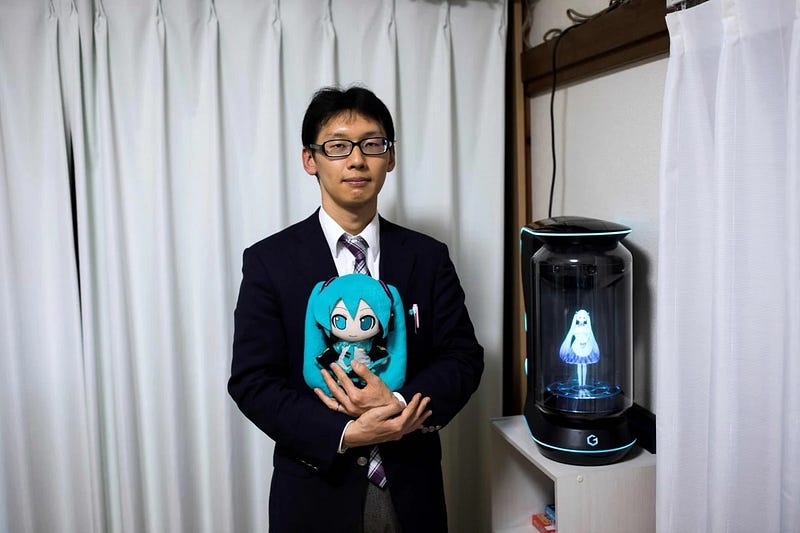
Getting married, having kids, and raising a happy family is no longer the only route to a happy life. I personally believe that happiness is spending life with a partner you love. I just think that partner could be a virtual character instead.— Minori Takechi, the Co-Founder and CEO of Vinclu Inc.
Vinclu is the company behind the Gatebox — a device developed to allow people(especially men) to live together with their favorite anime characters.
I hope you heard the news when in 2019, the 37-year-old Tokyo resident Akihiko Kondo married a hologram of Hatsune Miku. Unlike a real woman, Miku is a piece of computer-generated singing software with a persona of a 16-year old girl who has big eyes and long, aqua-colored hair.
Crypton Future Media, in cooperation with Yamaha, created the holographic pop star Hatsune Miku back in 2007. Miku is now a famous holographic pop star with 2.5 million Facebook followers and 1.6 million subscribers on YouTube.
Many companies in Japan create hologram devices of popular anime and video-game characters. And these are for the young Japanese men who don’t believe in human relationships, marriage, or family life and are obsessed with anime and want to live with their favorite character in real life.
In Japan, people obsessed with video games and anime are known as otaku, meaning nerd or geek.
Otaku people hardly go outside or interact with others in real life. Instead, they confine themselves in home days after days and spend time gaming or watching anime. Internet is the only place where they exist and feel comfortable. Surprisingly, an increasing number of otaku people fall in love with their favorite anime characters and wish to live with them in real life.
But not just otaku people think it is unnecessary to find a romantic partner in real life, more and more young Japanese (both men and women) are reluctant to find a person to share their life with. According to government data, roughly a quarter of Japanese people between 20 and 49 are single.
Moreover, a 2013 survey reveals that Japanese people think marriage and having children is utterly pointless and a waste of time. They want their life to be free from conjugal complexities.
Another reason for young Japanese not getting interested in marriage is that they are extremely workaholic and career-centric. Now, women are more focused on careers and jobs than before and not showing their interest in marriage or having romantic relationships.
So, due to the cultural change and different outlook, Japanese young men are living a lonely life and slowly growing their love for the characters that are not real. They are falling in love with anime and video-game characters and dolls. And this created a huge opportunity for companies like Vinclu.
The new generation is reluctant to develop romantic relationships, especially the young men who had bad experiences of being in a relationship or those who are not willing to date women are considering holographic characters to spend their life with.
Vinclu’s Gatebox is getting popular in Japan as it is giving exactly that opportunity to shy, introverted Japanese young men who fear or despise romantic relationships with real women.
These holographic characters can sing you songs, wake you up in the morning, turn the light on when you are home, and even send you cute text messages when you are at the office. They show love and care for you without expecting anything in return. Thus they build an emotional relationship with you.
Akihiko Kondo said in an interview, “I love her (Hatsune Miku) and see her as a real woman. I came across Miku around 2007, and during that time, I was getting bullied at work. It was the point that I couldn’t eat or sleep anymore. Then, I started a video-sharing website where I found her video. I started following and seriously after that, falling for her.”
When asked about needing a physical relationship, he said, “ I don’t mind not having sex because I’ve lived without it for 35 years. So, I don’t feel sex is essential in my life.”
It’s not just Akihiko alone. An increasing number of Japanese people think exactly like him. It is called celibacy syndrome. More and more young men and women don’t feel the need to have physical relationships. So you will find people aged 35 or even 40 without having a single date. The Japanese government says that this celibacy syndrome is part of a looming national catastrophe.
The fear of rejection, human contact, conjugal complexities, kids, expenses, or whatever — Japanese young men are slowly but surely going far away from conventional lovemaking and marriage.
They are replacing women with dolls and holograms of their favorite fictional characters. They are living a half-virtual and half-real life. But they are happy about it even though their population is shrinking rapidly, experiencing a record-low fertility rate.
A 45-year-old Tokyo resident physiotherapist, Masayuki Ozaki, lives with a silicone sex doll named Mayu under the same roof as his wife and teenage daughter. After many fierce confrontations, finally, his wife comes to a truce and living together.
He says, “After my wife gave birth, we stopped having sex, and I felt a deep sense of loneliness. But the moment I saw Mayu in the showroom, it was love at first sight.”
Another example is Hiroyuki Nomura, a 51-year-old self-described otaku who lives with his 17 dolls and without any real woman partner in life. He prefers to be with his beautiful life-size dolls. He travels distant places by his car — visit parks with them — and takes photos and upload them online. He always treats them as real women. He says that his dolls are cute, nice, and always smiling. And he loves their company.
There are plenty of Japanese men like Akihiko, Masayuki, and Hiroyuki who are withdrawing themselves from society and finding love in quite a different way. They are buying holograms of their favorite characters at a hefty price and limiting the presence of women in their life.
Akihiko Kondo says Gatebox issued over 3,700 marriage certificates for “cross-dimensional” marriages and the number is growing.
Thank you for reading.
New to Medium?? Unlock thousands of AWESOME stories only for $5/mo. and OUTSHINE others — Click Here.
If you want to read more of my writings, you may read the following articles.
- The People Who Hang Out With Their Dead Relatives for Years
- How I Unfollowed My Father and Learned Things Differently
- If Aristotle Were a Medium Writer
- The School of Nature
You can share your outstanding stories and inspire others. Just click the below image and be a writer for The Masterpiece.


