
Why It Took 55 Years for the Latest Moon Landing (Part 2)
Conspiracy theories abound, including UFOs and ETs on the lunar surface…
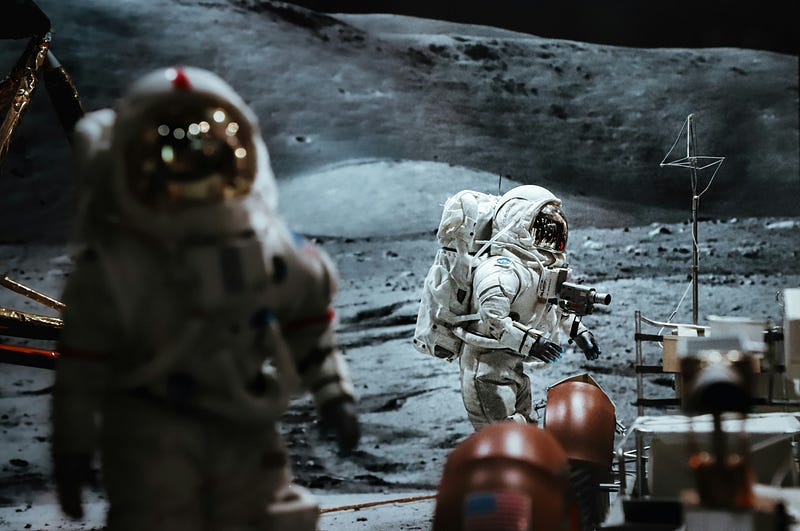
What explains the half-century gap between the historic NASA-led Apollo moon missions of the 1960s and the commercial moon landing last week?
It’s a question that’s been on my mind.
In fact, I’ve been perplexed by the official public explanation ever since I started studying the historic Apollo moon missions.
The NASA-built spacecraft Apollo 11 touched down on the lunar surface almost 55 years ago during the summer of 1969.
And last week the first private sector robotic moon lander made history of its own by doing the same.
So, what the heck took so long?
Consider the following before answering:
- If the USA was able to stick multiple manned moon landings between 1969 and 1972, shouldn’t spaceflight technology have exponentially improved by now?
That’s just common-sense thinking, right?
I would like to say this should not sound like rocket science but, in this case, it literally is about rocket science — plus other advancements in science and spaceflight technology.
Is the American government covering up the truth about missions to the moon, as some suspect?
55-Years Later
I pose the aforementioned question because something seems amiss, at least to me.
Three possible reasons why it’s taken America almost 55-years from the historic Apollo 11 mission to land on the moon again (albeit without astronauts this time) include the following:
- Cost and Political Will.
- Secret Military Space Programs.
- ETs on the Moon and other conspiracy theories.
Why is it worth addressing far-flung conspiracy theories at all, you ask? Because sometimes they prove correct, even if that’s rare.
Lest we forget that Aristotle theorized the Earth was at the center of our entire solar system. This is just one example of leading astronomers of their time being completely wrong regarding what lies beyond our planet.
Yet all is not always what it seems, especially regarding top secret government and military programs which may have presaged today’s new Space Force (which is only 4-years old).
The next part of this series will tackle the conspiracy theories — another one of which is that the moon is really an artificial satellite controlled by ETs, of course.
Another JFK Needed
Lack of funding and political will are the leading conventional explanations for the half-century disparity in American moon landings.
And the dual factors overlap.
Back in the 1960s, NASA and the nation had the historic leadership and bold vision of President John F. Kennedy to win the space race to the moon against the former Soviet Union (now Russia).
JFK doubled NASA’s budget and beefed up the federal workforce to make the Apollo program viable and successful when launched.
But NASA’s current budget is minuscule compared to the 1960s (in today’s dollars).
During testimony to Congress in 2015, former Apollo 7 astronaut Walter Cunningham, stated: “NASA’s portion of the federal budget peaked at 4% in 1965.”
However, NASA’s operating budget last year amounted to less than half of 1% of the total federal budget, so says a report from the Planetary Society.
Moreover, the premier space agency’s funding levels have never risen by more than 1% of all federal spending since the 1970s.
Well, that explains a lot, at least considering a valid public explanation. But consider that not all government spending is public.
There are so-called “dark ops” programs and other highly classified military-related line items buried in the vast labyrinth of the federal budget, for which the general public is unaware.
NASA’s budget for 2023 was 25.4 billion, according to the space agency. Yet the annual budget for the Department of Defense in 2023 was $858 billion.
The Takeaway
Compared to the high mark set by President Kennedy in the 1960s, NASA has been drastically under-funded and understaffed over the past half-century.
Additionally, today’s pathetic Congress can’t even pass an annual appropriations bill to fund the federal government, as required.
Plus, rampant toxicity and political tribalism have replaced constructive public discourse and bipartisan lawmaking.
Therefore, should it really be surprising that America has failed to return to the moon for 55-years until last week?
Then again, it depends on whom you ask.
ABOUT THE AUTHOR: I’m a longtime space enthusiast. You can learn more about me here.
- FYI — In 2016, I wrote on Medium about whether NASA or Elon Musk would be the first to land astronauts on Mars. Musk said back then that it would happen by 2024 (see below).
- I first wrote about NASA in 2014 on LinkedIn and interviewed a top tech official at NASA for GovLoop.com (a Washington, DC-based digital media platform covering government innovation and technology).