3 Reasons Why NASA’s Private Sector Space Partnership Matters (Part 1)
New commercial moon landing revives American dominance in spaceflight…
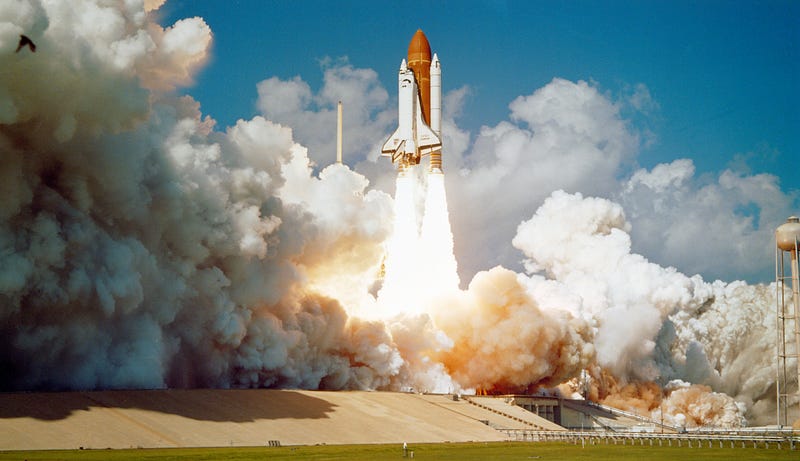
As you have heard by now, America completed its first moon landing last week since the early 1970s.
Yay USA!
But really, it’s about time the United States returned to the moon’s surface. It’s been more than one-half century since the last Apollo mission in December 1972.
What the heck took so long?
This feat marked the first time in U.S. history that a commercial spacecraft landed on the moon.
While NASA provided important oversight, guidance, and assistance for the mission, it was a private company that stuck the landing — well, almost.
Unfortunately, the spacecraft had a major technical glitch with the computer software. This caused it to land sideways, thus cutting the mission short (article below).
The spaceship Odysseus was built by Houston-based Intuitive Machines, for which NASA “contracted out” for the mission. This raises some important questions:
- First, why did NASA, the world’s dominant space agency, not send its own government-built spacecraft back to the moon — as with the groundbreaking Apollo missions?
And second, why is NASA’s new commercial partnership significant in the history of American spaceflight?
The answer is threefold.
1) Partial dormancy of NASA’s spaceflight program.
NASA’s spaceflight program had been largely nonexistent since the days of the Space Shuttle — with the exclusion of deep space exploration (with probes sent beyond the moon). The Space Shuttle program was shuttered after the doomed Challenger mission exploded on live TV in 1986, killing all astronauts on board.
2) Innovation of Commercial space startups.
NASA previously banned private-sector space startups from attempting to launch, including test flights. This period lasted from about the time Challenger blew up until the start of the 21st century — a visible downturn for the otherwise successful space agency. But today, private sector spaceflight companies are leading the way with multi-billion-dollar NASA contracts.
3) Paying Putin for trips to the ISS.
Prior to its private sector partnership, NASA paid billions of dollars to Vladimir Putin for American astronauts to ride on a Russian-built Soyuz rocket from Kazakhstan, both to and from the International Space Station (ISS). This was a temporary controversial solution to a much larger problem with the viability of NASA’s spaceflight program.
During NASA’s period of partial spaceflight dormancy, American astronauts were in Russian hands — for all practical purposes.
SpaceX Lifts Off
NASA revamped its spaceflight program years ago to leverage the innovation of the private sector to help return astronauts to the moon. Whether or not this a long-term fix to landing astronauts on the moon and Mars remains to be seen.
Elon Musk’s celebrated company, SpaceX, was the first beneficiary of NASA’s new strategy. SpaceX has since made billions of dollars from NASA by delivering supplies to the ISS, plus conducting other non-manned missions in low-Earth orbit.
The year was 2012 when SpaceX became the first private sector company to successfully launch a rocket to the ISS. That paved the way for rival companies to get into the competition, which has resulted in a new commercial space race by a multi-billion-dollar industry — which is only projected to grow in the years ahead.
Since then, SpaceX has accomplished many firsts with NASA, even though a growing number of competitors have since gotten into the game. The number of commercial space companies has only expanded over the last decade.
NASA’s unprecedented shift in spaceflight strategy did not occur overnight. Rather, it was a long time coming.
In retrospect, NASA had a rocky history with spaceflight for many years after the space shuttle program of the 1980s (again, excluding non-manned missions for deep space exploration).
Challenger Explosion
Members of Generation X, like me, can vividly recall the dark period surrounding NASA’s grounding of the Space Shuttle program in the mid-1980s (header photo above of rocket launch).
This was not only a historic setback, but also a global embarrassment from the country that was the first in history to land men on the moon.
The catastrophic disaster of Challenger shortly after liftoff stunned the nation and the world when it improbably exploded during 1986–and on live TV for hundreds of millions of shocked viewers to witness.
The disaster was marked by a period of deep national mourning in which President Ronald Reagan consoled a grieving population.
All seven astronauts aboard Challenger — including one civilian amateur astronaut, a female high school teacher— were killed instantly.
The video and pictures of the disaster were repeatedly shown by the global news media for weeks on end, which was horrifying for the collective soul of the nation.
The period was highlighted by a profoundly moving national address by President Reagan, which left some viewers in tears.
A period of national mourning followed the destruction of the Challenger space shuttle.
Final Thoughts
So why hasn’t the USA returned astronauts to the moon for over 50 years?
While the aforementioned history is instructive on a micro level, what are the macro factors?
The official explanations by government sources center on the colossal cost and lack of political will for such a huge undertaking. Yet others cite conspiracy theories about a secret military space program with lunar bases.
Then there are the more far-fetched conspiracy theories surrounding UFOs or UAPs on the moon — the latter of which is the newly preferred acronym used by the government, which stands for Unexplained Aerial Phenomena (UAP).
Could it really be possible there is an extraterrestrial (ET) advanced intelligent presence on the moon that has be covered up by the government for decades?
Don’t forget to check out Part 2 below...
ABOUT THE AUTHOR: I’m a longtime space enthusiast. You can learn more about me here.
- In 2016, I wrote on Medium about whether NASA or Elon Musk would be the first to land astronauts on Mars (see below).
- I first wrote about NASA in 2014 on LinkedIn and interviewed a top technology official at NASA for GovLoop.com (a Washington, DC-based digital media platform).