
Why I Think the FIRE Movement Is Stupid
I don’t like breakfast burritos.
Disclaimer: just because I think FIRE is stupid, doesn’t mean I think you are. Or anybody who follows FIRE (including the people I talk about in this piece).
This piece reflects my honest opinions on the movement itself, not the people following it. If you think FIRE is for you, by all means, pursue it and have fun.
Breakfast burritos.
That’s what comes to mind when I think about FIRE (Financial Independence Retire Early) — a popular millennial movement of retiring at 30.
In the world of 18-year-old millionaires, hustlers, startups, Lambos on Instagram, and “fuck-you-money”, it’s a refreshing idea.
Instead of making millions, you don’t have to change your income. Save at least half of what you make, live extremely cheaply, and in 7–15 years (depending on your savings rate), you’ll be able to live off dividends from your index funds investments.
You’ll not have to work ever again unless you want to.
Freedom!
As an obsessive type, when I first heard about FIRE, I immediately dove in everything there was on the subject. I read three books. I watched a documentary. I followed blogs that sounded more like magazines about facial hair. I found subreddits for FIRE, where people shared insights from their experience.
And, of course, I started saving money.
My girlfriend was a bit skeptical at first (“Ugh, another ‘great’ idea?”) — but I gave her a book to read (Playing With FIRE) and she was sold.
In that book, Scott — a former video producer (like me) — convinced his wife to adopt the FIRE lifestyle (like me) to live cheaply, save money, and become financially independent in just 7 years (soon-to-be-me).
As someone who struggled with money for a long time, I was as happy as a clam.
“I finally discovered the key to riches, and I didn’t even have to become rich,” I thought. I bet most people who discover FIRE think about that way.
I remember reading somewhere that if something is too good to be true, it probably is.
Jumping ahead, I’ll say that we stopped trying to live by FIRE principles after six months.
While I think it’s a great thing for some people, it’s just not for me.
Not because I am somehow better than those people who live by FIRE, but because you’ve got to know yourself. You don’t want to live a certain way just because it sounds good in the far future, or because somebody else does it.
And like with any new concept, you don’t want to go too far.
Which brings me to breakfast burritos.
Breakfast Burritos
Scott and his wife were living in a nice house in San Diego. They had friends, well-paying jobs, great weather all year, and the lifestyle of the typical middle-class Americans. They ordered things on Amazon and had two kids. Life was great.
One day Scott comes up to his wife and says,
“Pack your bags. We have to get rid of this house and move somewhere cheaper, like Oregon. We’ll live by the road because it’s cheaper. Oh, and that BMW you adore — the one you saved money for many years — we’ll have to sell that too. I am going to quit my job, but you’re going to continue working remotely, so we’ll be just fine. Oh, and I am going to record the whole thing on video.”
Ok, maybe he said it differently and I am exaggerating. But, in the end, that’s exactly what happened.
In Playing With Fire — both a book and a documentary — you see the story of a young couple with kids moving out of their house in California in pursuit of financial independence.
Scott and his wife travel around the country, move into their parents’ home for a while and calculate that if they take their savings rate up to 60%, they’d be able to retire in 7 years.
At one point in the movie, we see Scott going to the store to buy groceries. When he comes back to his parents’ house, he makes a dozen burritos. And puts them in the freezer. For later, he says.
Then you see Scott eating burritos for breakfast.
Every day.
That breakfast burrito is the embodiment of everything that’s wrong with the FIRE movement.
Not to pick on Scott and his life — I do respect him for finding his perfect lifestyle and executing on his dreams — but that’s just not something I’d want for myself.
I don’t even like burritos.
Everything That’s Wrong With FIRE
1. You live in future dreams at the expense of life today.
The basis of the FIRE movement is this: 7–10–15 years from now, depending on your savings rate, you’ll not have to work. You’ll be free. Which automatically means I am not free today.
And I am just not buying it.
On all the blogs and subreddits I read, people are too focused on their “date” (of retirement). I can’t help but see a connection to religion — suffering for the sake of redemption one day in the distant future.
We’ve got 30,000 days on this planet. You and I probably have less than that. I don’t want to merely “exist” now to live ten years from now.
Suffering for a better future is an illusion. Life isn’t going to magically change when you have enough money to say “fuck you” to work. You’ll still be you, with your anxieties and problems.
And like many people who’ve achieved FIRE, you’ll realize that the pursuit of independence was much more fun that the independence itself.
2. It’s a bad tradeoff from a financial standpoint.
Suppose you’re making a net $60,000 as a household per year. If you eat breakfast burritos every day and cut your expenses to $20,000 per year, you’d be able to save $40,000. That’s an impressive savings rate of 66%.
Now, the FIRE ideology tells you that you need to save 25 times your living expenses to retire. In our example, that would mean $500,000. If you spend $50,000 per year, you’d need to save $1.25M.
Here’s a table:
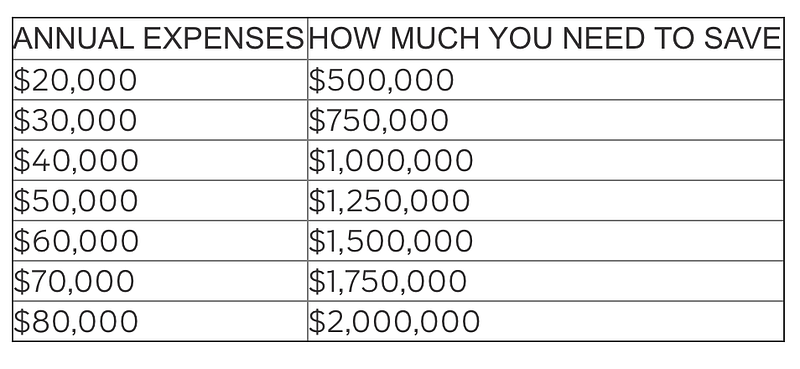
Rationally speaking, you want to cut your expenses to a minimum and lower your future lifestyle to a minimum as well — to have less money to save.
This leaves you trapped: you suffer now (wear used clothes and move to a bungalow), to suffer for the rest of your life. This also makes a bold assumption that your life is fixed, and won’t change until you die.
While yes, they say you can pick any lifestyle you want — if you spend just $20,000 per year (like the famous Mr. Hairy Face) you can retire earlier than someone who spends $80K/yr — your life is still capped.
What if I want to live on $100,000 per year?
What if you do need that BMW you’ve always dreamed of? Should you just abandon your dreams for the sake of illusionary stability?
What if you have other plans than to simply “survive”? What if you want to build businesses, invest in non-profits, charity, or even send kids to college?
None of that is calculated in the FIRE math.
And what’s worse — the “date” most FIRE seekers are looking forward to, might never happen. Just look at what’s happening today with the coronavirus pandemic crisis. You can’t prepare for something like that.
When you put away cash for many years, you’ve got a big enough timeframe for all sorts of “black swans” (bad unexpected events) to happen: you risk inflation, economic crises, and more importantly: personal emergencies.
3. It puts too much emphasis on money.
When I started saving money, I discovered that all I started thinking about was saving money. It turned into a game, where the size of my savings account became the way I kept score.
At first it was even fun.
But after six months, I got sick of living frugally for so long — and saying “no” to so many things I loved (like burgers at Five Guys every weekend) — only to see a few thousand dollars in my bank account.
While it’s a great thing to have those few grand, I doubt it was worth the stress, trouble, and anxiety from downgrading my lifestyle to breakfast burritos.
Life is more than just money.
It’s pursuing your dreams. Learning. Doing. It’s creativity, relationships, art, music, swimming in the ocean, loving, laughing, being with friends, and generally having a good time.
When you’re saving money for that “date” (that might never even come), you are depriving yourself of all of the great things life has to offer.
You simply don’t live.
4. It’s a cult.
And like any cult, it has leaders, followers and it looks down on people who aren’t in it.
In Playing With FIRE, Scott explicitly writes that he doesn’t judge people who don’t live by FIRE. But from reading blogs and being in that online community for a few months, I can tell you that there is a strong cultish feeling.
When you’re in it, you can’t help but congratulate other members on the size of their “savings rate” (sounds ridiculous, I know) and look down on people who bought a new blender from Amazon instead of a used one from eBay.
As if the more you suffer, the cooler you are.
5. It’s not made for today’s world.
But the biggest argument I have against FIRE is that it’s simply unnecessary.
What’s the point of such existence? Why would you want to save money for so many years, to just sit and do nothing? Well, only in one case: if you hate your job.
It might have been a great thing in the twentieth century — when you had no other choice than to work 9–5 at a dusty cubicle with fluorescent lights.
But today, you have so many opportunities to reclaim your freedom.
You be a Medium or a Substack writer and can create content for a living. You can join the “Gig Economy” and do freelance work on Fiverr and Upwork. You can teach online through Podia. You can even set up your business in minutes and literally, for free on places like Amazon.
You don’t need to choose between making money or following your passion anymore. This is why you don’t need to save money and go through all of this FIRE bullshit for many years before you can finally start living.
You can live now.
The Passion Economy we’re slowly transitioning in provides endless opportunities for linking passion and making money.
Because I am from Russia, I grew up with a phrase that school teachers attribute to Stalin. “If you criticize someone’s approach, propose an alternative.”
So here’s my alternative to FIRE.
Live Your Life *Now*
What I propose is how I live my life. (Or, at least, strive to.)
In short, I want to live my life now instead of chasing some arbitrary date in the future. I want to enjoy the money I make, but not put too much emphasis on it. And I want to live any lifestyle I want, anywhere I want.
Here’s what I tell myself:
- Instead of saving money, create positive cash flows. This can be either through a handful of freelance gigs, small businesses, content creation, or investments. You can run out of savings, but if you have recurring revenue coming in — you’ll be just fine.
- Don’t save money without purpose. Save only for something specific (e.g., buy a car). Savings money without purpose only makes you stressed out. And try to minimize the number of months you save to avoid “black swan” events. Money is useless unless it has a purpose.
- Be happy now. Steve Jobs looked in the mirror each morning and asked himself, “Do I want to do for the rest of my life what I am about to do today?” and when the answer was “no” for many days in a row, he knew he had to change something. Happy people are productive. If you want to sit and do nothing all day, you know you’ve got a problem.
- Don’t worry about money. You need to make money to live, but so do you need to breathe. And yet, you don’t calculate oxygen. Let go of the money worry not by “solving the money problem” but by changing your attitude towards it.
- If you want to worry about money, do this. First, pay off your debt. If you only pay your minimum payments, you’ll end up paying too much interest. Tackle the smallest debt first — to gain momentum — and gradually pay them all. And second, spend less than you make. It’s simple, and yet, can be extremely difficult. But having a 6–12-month runway of savings puts the mind at ease.
- Become free now. I know it’s a hard thing to grasp, especially after all those years of brainwashing in school, but you don’t have to wait anymore to become free. You can do whatever you want and make money on it. You can enter the Passion Economy and learn to monetize your skills, specific knowledge, or talents. All you need is a decision. And some courage. Not $1M in a bank account.
Back in 2018, I spent two months in California, at Draper University, studying entrepreneurship. Part of our training was to go for six days into the woods and live on $2 per day. I ended up eating peanut butter sandwiches with bananas for six days straight. On top of that, there was no hot water, we slept under the stars and hiked for 10 miles each day.
To say it was hard is a serious underestimation. I lost 5KG in a week.
But it was also great.
Once I came back, I found the best burger joint in town and had a juicy cheeseburger. With pickles. And grilled onions.
Just as going from a hot sauna into a cold bath feels great, so does living in different extremes. It improves confidence.
You know you can live frugally if you have to. One of the most famous Stoics of all time and the richest man in Nero’s Rome — Seneca the Younger — frequently lived as if he was poor as part of his stoic training.
But you don’t want to be stuck in one extreme or the other.
Just as you don’t want to be a mindless consumer — buying stuff you don’t need and getting into debilitating debt — you don’t want to spend your whole life eating burritos for breakfast.
It’s all about the right balance.
Get the Mini Post-Grad Survival Guide
A 5-day email course with amazing tips on budgeting, investing, and productivity for 20-somethings. Learn how to spend $40 per week on groceries, among other things, by signing up for free.


