
Why God Allows Evil: Can’t He Kill Satan?
Delete the devil and a human — maybe you? — becomes the “worst person in the world”
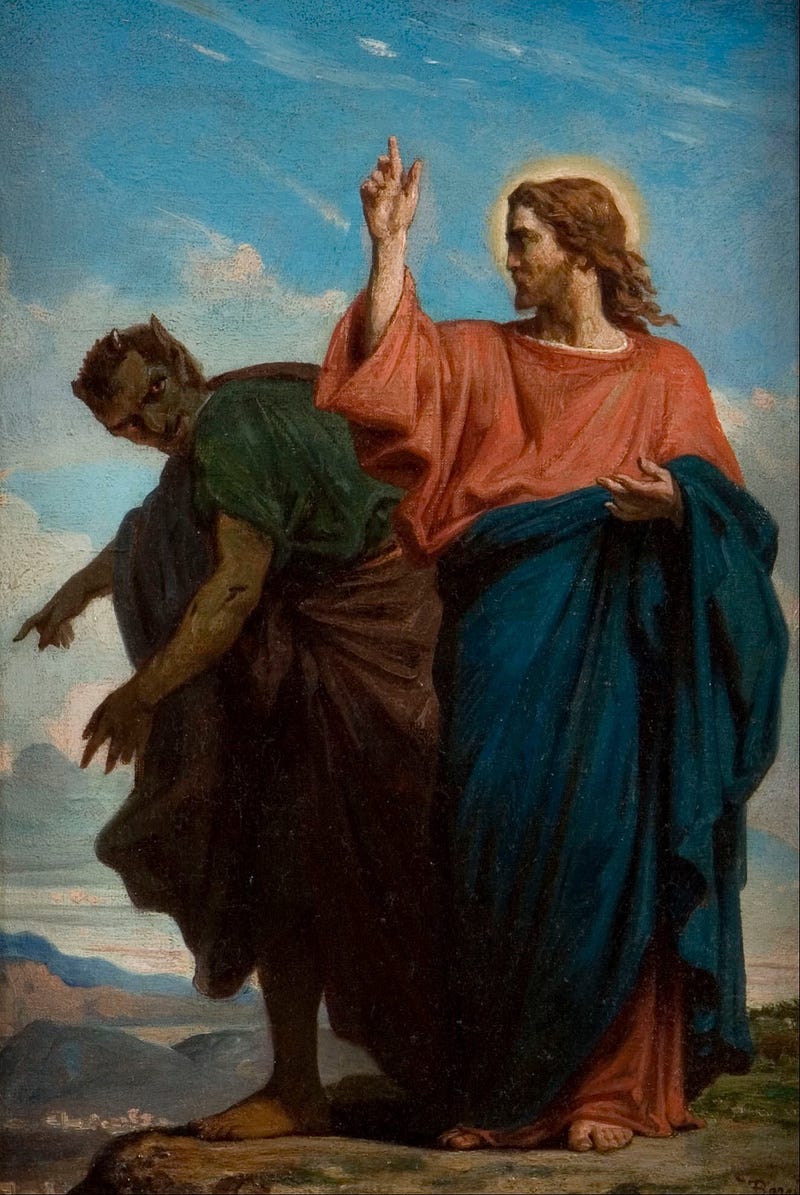

Why does God allow evil and suffering? Would a good God permit pain? These most asked questions are top reasons people leave religion.
In bad situations, we find a way to blame God but we take credit when life is great. The reverse is typically the reality.
Here are seven answers to the most frequently searched questions of spirituality and religion.
1. Choice: Everything God creates is good — so why allow evil?
God gave us the power to choose the right decision or its opposite. In his new book Immortal Combat, Father Dwight Longenecker explains:
“Love must be chosen,’’ and choice requires: “God’s great gamble. He must have love because He is love, but love must be chosen. And for it to be chosen, there must be an option not to love. Therefore, God gave His children the power to choose.’’
Before the Universe, God created angels, who were all created good. Lucifer is the fallen angel who became Satan, waiting as the serpent to tempt Eve and Adam. Satan and his demonic followers all chose to battle God and His Plans.
Satan can’t create anything, but his lies twist good into bad. Life without choices would be like bowling without the possibility of gutter balls (something we allow for kids but grown-ups bowl the old-fashioned way).
“A Nice Place to Visit,” the best episode of “The Twilight Zone,” imagined hell as a place where you get everything you want. The choice and possibility of success or failure is a central part of the glory of life.
2. We each get a guardian angel and a demon? Really?
The early church fathers taught that every human is assigned a guardian angel to watch over their souls. The devil, who is always challenging God’s vulnerable children (us), responds by assigning each person a demon.
So numerous films and TV shows from “Animal House’’ to “Pinnochio’’ to “The Simpsons’’ were theologically sound when they showed a demon and an angel on each shoulder, offering advice?
Conscience is key, yet seldom discussed in American education. Every decision is a choice between following The Way (God’s Will) and going our own way.
Christianity is often subtle and hidden. In “Pinocchio,’’ Jiminy Cricket (the same initials as Jesus Christ) is Pinocchio’s conscience. In the book version, Pinocchio murdered Jiminy with a hammer, but Jiminy’s spirit returned to challenge him.
The Way or your way. A lifelong test?
In The Dialogue, St. Catherine of Siena hears God say: “Time is as the point of a needle and no more; and, when the time has passed labor is ended, therefore you see that the labor is small. They endure with patience, and the thorns they pass through do not touch their heart, because their heart is drawn out of them and united to Me by the affection of love.”
3. Rerouting: Why doesn’t all-powerful God get rid of Satan?
Like our parents did before we were born, God starts with a plan for every one of us, knowing we will quickly “go our own way.’’ We (and the devil) are creatures created by God for specific purposes. Satan fell. We sin.
A dear family friend used to say he had a child go to Yale and one who went to jail. One saddened his heart more, but they were both his babies, so he loved them dearly. Trust comes and goes but love remains. Our Heavenly Father loves us too: He’s love and truth itself.
He takes everything — good, bad, and everything else — and works with it, Father Jean Baptiste Saint-Jure and St. Claude de la Colombiere explain in Trustful Surrender to Divine Providence.
“Even if we suppose that our disturbed state is the work of the devil, it must still be attributed to God. Does not the history of Job show that Satan has no power over us unless God gives it to him?… How many more have been led to the practice of the highest virtue by interior trials!’’
Think of your iPhone giving you the shortest, fastest route somewhere.
But you do other things, listen to other voices, get distracted (maybe even by a demon), and the phone flashes “rerouting, rerouting.”
Immediately the iPhone adapts to your moves and charts a new path based on where you are now.
God does the same with us. He offers us the surest, straightest way, but He adds love to our suffering to create something more significant, Divine Mercy.
4. God wills and allows: Think of the judge saying “I’ll allow it’’
God has a plan (His Will), but He also will allow things He didn’t plan. Picture a courtroom where you are making your case and seem to go off on a tangent. Your prosecutor (like your demon) shouts, “I object,’’ trying to make you lose.
But the judge, hearing both sides, says, “No, I’ll allow it. I’ll allow it.’’
Your advantage? God, the just judge, is also your forgiving Father and He loves you dearly.
Mary, the mother of God (most hated by Satan), and the Holy Spirit are both called “the advocate’’ because they will advocate your case. The odds are always in your favor as long as you recognize your inheritance: a child of God.
5. Obey means to “listen intently?’’
Americans bristle at the word “obey.’’ We cherish freedom, repelled at the mere thought of obeying anyone else. But the original meaning of obeying is to “listen intently.’’ To obey God means to “listen intently.’’
In the Garden, God asked Adam and Eve to do one thing, stay away from the fruit of one tree.
They didn’t listen intently to God, but they did listen intently to Satan, and that is how original sin began.
It’s also why Satan is called the tempter, the divider, and the liar. He got our first parents to distrust the Father, and we’ve distrusted father figures and authority ever since. It took a Son, Jesus, to bridge the divide.
6. The true meaning of sin and repenting
Sin is an archery term meaning to miss the target, the main goal our Creator hoped we could hit. That original sin was like cutting off the lines of communication between our Father and us.
The first cut of sin was like an arrow missing a target — cutting off our communications line, the vein connecting head and heart — or the direct line between child and Father. Jesus, the healer, restores the connection, healing the wound.
To repent means to turn from one way (the wrong way) to the right way “with understanding.” Literally to choose the right way over the wrong way. But we are distracted.
Satan simultaneously keeps telling us to cut that connection, continually repeating the single isolating message: “Trust No One. You know better.” Satan says:
- Don’t trust the Father, the Son, or those “church people.”
- Go your own way.
- If God suggests something, go “the other way,’’ farther away from God and The Way.
Yes, we are free. But generally, we follow a path influenced by others, becoming slaves to our habits, our ideology, and our ego and pride. St. Paul, in Romans 6, explains if we aren’t following God’s Way, we become “slaves to sin,’’ following the wrong way.
7. With no Satan, who would become “the world’s worst person?’’
Our friend, Professor Paul Kengor, in The Devil and Karl Marx, offers a massively detailed explanation of how the founders and guiding forces of communism knew they were fighting The Way of God and the Church.
Kengor documents how these anti-church movements repeatedly turned to the enemy of their enemy: Satan himself.
Father Gabriel Amorth similarly reported Soviet ruler Joseph Stalin was “perfectly possessed,” explaining demons are “very legalistic,” attracted to evil people who live in mortal sin.
Culture means the cult of what you worship. Many have tried to delete God from their culture since the French Revolution of 1789 and the 1917 Bolshevik Revolution. Two things are required:
Without God in your life, someone else moves to the top of your priority list, becoming the “new god’’ or idol you hold sacred above all others. For some, that’s you.
That includes the four false idols of money, honor, power, and pleasure.
Kengor details how all the founders of communism and similar atheistic movements studied and quoted Satan, the enemy of God their enemy.
Without a belief in a devil or demon, someone else becomes “the worst person in the world.’’ Many follow their political hero like a new messiah and speak of their political enemy as if that rival is Satan.
Both believers and non-believers place someone at the top of their priority list and an enemy at the very bottom of their list (someone they can’t stand). Christians are taught to pray for their enemies.
“The cleverest ruse of the devil is to persuade you he does not exist!’’ — Charles Baudelaire.
Just 55 percent of Christian evangelicals believe in the devil and the numbers are far lower for other faiths. An overwhelming 83 percent of American Catholics in research done for the Center for Applied Research in the Apostolate (CARA), said they thought Satan was merely a “symbol of evil,’’ with just 17 percent believing the devil is a living being.
In contrast, recent Gallup polls of the general public find:
- 89 percent believe in God.
- 72 percent believe in angels
- Just 61 percent believe in the devil, who is himself a fallen angel.
- 72 percent of Americans (85 percent of U.S. Catholics) believe in Heaven.
- Only 58 percent believe in hell.
That vast number who don’t believe in Satan regularly condemns “evil people’’ (their enemies) without feeling evil people may be redeemable good people. We are judging our brothers and sisters — children of God — equating them with devils when we cannot know what is truly in their hearts.
We can judge their actions but not their hearts
If you don’t believe in Satan, you make a human your worst enemy. If you do believe in and fight the devil, it’s easier to hate the sin and love the sinner.
Father John Riccardo explains it this way: he adored his late mother (believing her to be a saint) but hated the cancer cells infecting her body. We should love all sinners and hate the sin within them in the same way.
Author Jesse Romero warns of a rise in followers of the occult:“We feel this emptiness, we’re drawn to the mystical, we know there’s something else beyond this world, and so a lot of Catholics are attracted, especially in the Hispanic community, to these botanicas …especially power, if you do this you can get…’’
The need for answers can send us down crooked paths.
“We should not think of the devil as a myth…” Pope Francis warned in 2018’s Gaudete et Exsultate. “This mistake would lead us to let down our guard, to grow careless and end up more vulnerable. The devil does not need to possess us. He poisons us with the venom of hatred, desolation, envy and vice.”
A single stick can easily snap, Bishop Robert Barron notes, but when you bundle a pile of small sticks together, it’s much harder to break seven or eight sticks bound together. The same is true with us and our families: the devil can more easily influence one than a whole family.
“My love permits these temptations, for the devil is weak. He can do nothing by himself unless I allow him,’’ St. Catherine of Siena heard. “So I let him tempt you because I love you, not because I hate you. I want you to conquer, not to be conquered, and to come to a perfect knowledge of yourself and of Me.’’
Key Sources: Learn more from two new books and several classics:
- Immortal Combat: Confronting the Heart of Darkness by Dwight Longenecker.
- The Devil and Karl Marx: Communism’s Long March of Death, Deception and Infiltration by Paul Kengor.
- Trustful Surrender to Divine Providence: The Secret of Peace and Happiness by Rev. Fr. Jean Baptiste Saint-Jure, S.J. and St. Claude de la Colombiere, S.J.
- The Dialogue of St. Catherine of Siena: A Conversation with God on Living Your Spiritual Life to the Fullest by St. Catherine of Siena.
- “A Nice Place to Visit,’’ season 1, episode 28 of “The Twilight Zone.’’