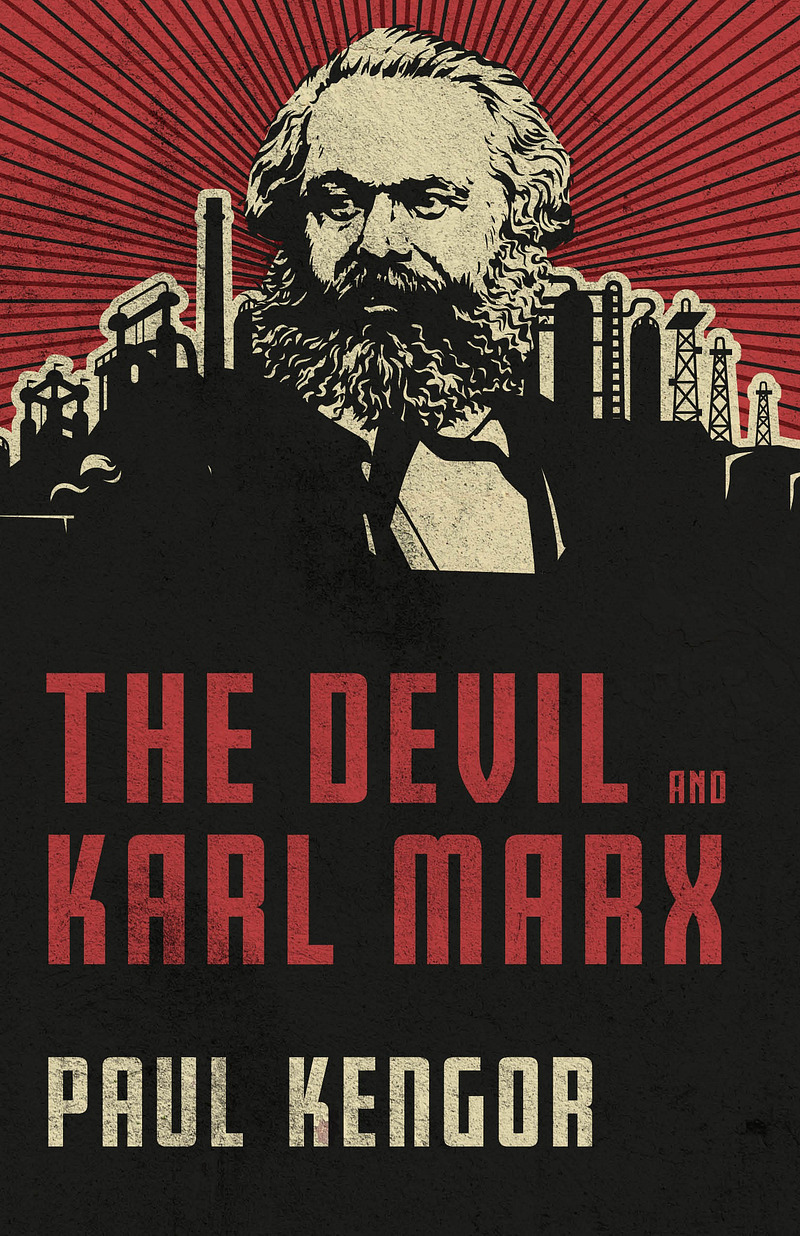
REVIEW: THE DEVIL AND KARL MARX — LIFE’S BIGGEST CHOICE?
The Way You Should Go
Paul Kengor connects the dots
“I will instruct you and teach you the way you should go,’’ Psalm 32:8.
For love to be complete, God gave us the biggest ongoing choice: Love and truth or the right to choose their exact opposite: Thy Way or “my way.”
St. John Paul the Great and Ronald Reagan chose God’s Way, The Divine Plan. Author Paul Kengor, a nationally respected historian/political science professor, dedicated his career to researching the Reagan/JPII crusade to topple communism. Kengor’s newest book explains how and why the roots of evil empires remain.
In The Devil and Karl Marx: Communism’s Long March of Death, Deception and Infiltration (TAN Books, 2020), Paul Kengor reveals atheistic communism’s fixation on the enemy: Satan and the occult.
Choosing to fight God and The Way inevitably leads to God’s greatest foe, the divider, the liar, and the prince of darkness.
“Thus Heaven I’ve forfeited, I know it full well,’’ Karl Marx wrote in 1837. “My soul, once true to God, Is chosen for Hell.”
Four years later, the founding father of communism declared: “See the sword — the Prince of Darkness sold it to me. For he beats the time and gives the signs.’’
Kengor shows Marx’s preoccupation with crushing religion, Marx’s embracing of the devil and the occult, and how the pattern repeats itself in generation after generation from the mid-1800s to the present.
Know thy enemy: Understand the alternative
The abolition of religion “for people to achieve real happiness,’’ was the bedrock belief of Marx and subsequent Marxists, Kengor shows.
Like Reagan and John Paul, Kengor believes in “knowing thy enemy,’’ studying their thinking to learn how to overcome them. Enduring the painful words of the craziest ways of the evil ones drew Kengor back home to The Way, to the loving messages of saints, strengthening his Catholicism.
Reagan, Kengor notes, “described a communist as one who reads Karl Marx and an anti-communist as one who understands Karl Marx.”
No one understands communism better than Kengor, Michael Knowles notes. Every guardian angel battles a dark demon. We choose which way to go.
“The problem with socialism isn’t the inefficiency; it’s the evil. Marx did not set out to tinker with markets and redistribute some wealth. He sought to radically transform society by changing human nature. He hated religion because he opposed God, the author of human nature. He sided with Satan.’’
Catholicism and Communism: Eternal adversaries
“From the very outset, well before Bolshevism seized Russia, no institution foresaw the scourge of atheistic communism like the institutional Roman Catholic Church,’’ Kengor writes. “Quite remarkably, the Church’s scathing condemnation of communism preceded even the publication of the Communist Manifesto.’’
Two years before Marx’s infamous Communist Manifesto, Blessed Pope Pius IX, in 1846, warned that communism is “absolutely contrary to the natural law itself ” and would “utterly destroy the rights, property, and possessions of all men, and even society itself.” Please re-read that last sentence.
The 1846 warning of Pius IX explains the current protests trying to topple church statues, discredit history, and Western Culture. The worst violence in Portland and Seattle is better understood when you learn the whole arc of the evolution of communism.
Pius called communism a “dark design” of “men in the clothing of sheep, while inwardly ravening wolves… After taking their captives gently, they mildly bind them, and then kill them in secret … They make men fly in terror from all practice of religion, and they cut down and dismember the sheep of the Lord.”
Seventy-one years before Russia became the communist Soviet Union, Pius IX warned communism would bring “widespread disgusting infection.” A year after Marx’s 1848 manifesto, Pius declared socialism and communism “wicked theories,” offering “perverted teachings.”
Human nature itself has to change?
Everything happens for a reason, Reagan and John Paul agreed. From Kengor’s first book, God and Ronald Reagan in 2004 and The Crusader in 2006 to A Pope and a President in 2017 and The Divine Plan in 2019, he ties together a bigger plan.
Marxism is all about fighting that belief in a Divine Plan, the faith that our lives have a higher meaning and purpose. Humanity itself had to be changed, Marx taught followers, calling for “a fundamental transformation of human nature.”
Marx’s partner Friedric Hengels said, “Communism abolishes eternal truths, it abolishes all religion and all morality.” Marx added, “Communism begins where atheism begins.”
They advocated the “abolition of the family,” in the Communist Manifesto. “The single-family ceases to be the economic unit of society,” Engels wrote.
Every pope would make similar warnings. In 1878, Pope Leo XIII predicted the future:
“We speak of that sect of men who, under various and almost barbarous names, are called socialists, communists, or nihilists… openly and boldly marching forth in the light of day, strive to bring what they have long been planning — the overthrow of all civil society.”
“They leave nothing untouched.” Not only do they attack the right of property, but they “debase the natural union of man and woman, held sacred even among barbarous peoples; and its bond, by which the family is chiefly held together. . . . Doctrines of socialism strive almost completely to dissolve this union.”
Marx shared the philosophy of Georg Wilhelm Friedrich Hegel: “history is a series of struggles between opposing forces, with each successive struggle unfolding on a progressively higher plane than the one that preceded it.’’
This latest Kengor book builds on nearly two decades of impressive history books and research connecting the dots to show how Marx and his followers impacted a movement that is both economic and increasingly more cultural. But the anti-church theme and interest in the occult have been constant:
- Saul Alinsky, the author of Rules for Radicals, called the devil “the first radical known to man who rebelled against the establishment and did it so effectively that he at least won his own kingdom.” In one of his last interviews, Alinsky declared, “Hell would be heaven for me… Once I get into hell, I’ll start organizing the have-nots over there.” He urged going after people rather than institutions since “people hurt faster.’’
- The Sexual Revolution, now known as a cultural movement, was originally a book by Freudian Marxist Wilhelm Reich. Kengor connects the dots between Marx, the dark side, and early leaders of multiple social movements challenging religion.
- Today’s “critical theory’’ has its roots in the Marxist scholars of the Frankfurt School, who focused on the remaking of society through the eradication of traditional norms and institutions. The movement tries to “confront the social, historical, and ideological forces and structures that produce and constrain it.”
- Bella Dodd, a communist organizer who recruited more than 1,000 communist to infiltrate Catholic seminaries, told the U.S. Senate: “There is no doubt in my mind that the Communists will use the schools and every other educational medium. . . from the nursery school to the universities.”
“Give me four years to teach the children,” Soviet tyrant Vladimir Lenin said, “and the seed I have sown shall never be uprooted.”
Marx’s “fundamental error,’’ Pope Benedict XVI concluded, was showing “precisely how to overthrow the existing order, but he did not say how matters should proceed thereafter. He simply presumed that with the expropriation of the ruling class, with the fall of political power and the socialization of means of production, the new Jerusalem would be realized.”
Once the old order collapsed, noted Benedict, Marx figured that “all contradictions would be resolved, man and the world would finally sort themselves out. Then everything would be able to proceed by itself along the right path.” But Marx’s path was always away from God and the Church.
Fundamentally Transform: Textbook definition of totalitarianism
The “textbook definition of totalitarianism,’’ Kengor teaches, “is to fundamentally transform — specifically, to seek to fundamentally transform human nature via some form of political-ideological-cultural upheaval.”
Marxists similarly seek “fundamental transformation, permanent revolution, and unrestrained criticism of everything… ‘the ruthless criticism of all that exists.’”
“There are two loves, the love of God and the love of the world,” St. Augustine explained. “If the love of the world takes possession of you, there is no way for the love of God to enter into you. Let the love of the world take the second place, and let the love of God dwell in you. Let the better love take over.”
Since the Berlin Wall and the Soviet Union collapsed three decades ago, “we thought that the very recent victory of the West in the Cold War had killed communism. Quite the contrary, the ideology has bounced back with a shocking appeal among a very high number of Millennials.”
Why does a system that killed more than 100 million and impoverished even more continue to hold appeal? Kengor harkens to Benedict’s writings about “anonymous power,” supporting prevailing fads and trends.
“Judas is neither a master of evil nor the figure of a demoniacal power of darkness but rather a sycophant who bows down before the anonymous power of changing moods and current fashion,” Benedict argued. “But it is precisely this anonymous power that crucified Jesus, for it was anonymous voices that cried, ‘Away with him! Crucify him!’”
When Christ Himself went into the desert, it is worth noting that the devil offered Jesus power over the rulers of the world, implying he already controlled or at least influenced them. Kengor explains:
“When he tried to tempt Christ with the material of the world, the Son of God corrected Satan, noting that man does not live on bread alone. Man is also a spiritual being. You cannot solve the problem of man by bread alone. Communists promised their flock the deception that man’s plight could be resolved by bread, by the strictly material and not the spiritual. ‘From each according to his abilities, to each according to his needs,’ said Marx, misquoting the Scripture just slyly enough, with yet another deception.”
Will Geer, best remembered for playing Grandpa Walton on the 1970s show “The Walton’s,” was himself a social and political radical in his youth, once saying his greatest fear was “people who believe you can’t change human nature.” Such a notion, Kengor concludes, is “totalitarian communism in a nutshell.”
“Who or what is whispering in our ears?” Kengor asks. “Who or what is silently prodding the culture? Is it the same murky force to which Karl Marx penned his sordid prose?’’