

Why Do We Gain Weight Each Year? Science Explains.
Understanding the science behind age-related weight gain may help you to strategise weight management.
What is the relative contribution of calories intake from food, and the contributions of calories expenditure from activities such as walking, working, exercising, etc., and how does metabolism rate affect our weight gain?
Science explains how easy it is to gain weight. By understanding this, you can strategise how best to maintain your body weight!
What is the average weight gain of an adult?
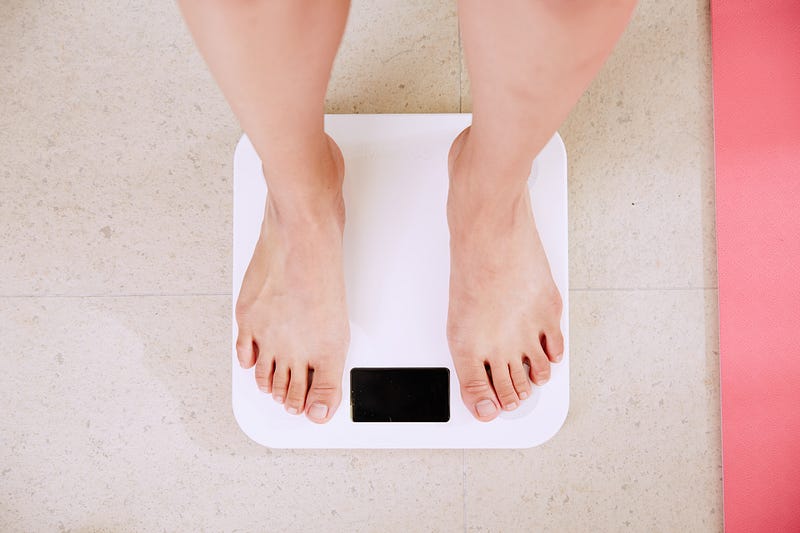
In the US, the body weight of an average adult is estimated to increase by 0.5kg per year [1]. This is just an average estimate. If you gain less amount than that, congratulations, you are maintaining your body weight pretty well. However, if your rate of weight gain is 0.5kg per year or higher, you are more at risk of becoming overweight in your late adulthood.
The increment of 0.5kg per year looks as if it is not a substantial amount. However, if this rate sustains for 20 years, you will be 10kg heavier 20 years later.
How much extra calories do you need to gain 0.5kg per year?
A statistical model showed that to sustain the abovementioned rate of weight gain, an average adult has to consume an excess of 2666 kcal in a year, equivalent to an excess of 7 kcal per day [1]. Such a tiny imbalance between calories-in and calories-out is sufficient to drive the weight gain of 0.5kg per year.
It is too easy to overeat to create this imbalance.
In reality, not every day is the same. There are days you eat more, and there are days you eat less. Similarly, there are days you are more active, and there are days you are less active. For most of us who maintains a relatively stable physical activity level (or not active at all), excess calories intake accumulated throughout a period of time is the main contributor to this calorie imbalance.
Our appetite is not finely tuned to adjust for calorie balance.
To detect an excess of 7 kcal per day, you need a finely tuned instrument. For example, if we want to measure body weight up to the sensitivity of 0.01kg, we need a very sensitive weighing instrument.
Our biology, unfortunately, is not the finely tuned instrument that can detect the excess 7 kcal per day.
For your information, a small apple provides about 78 kcal. It is unlikely that our biology can stop us from eating this little extra calorie.

Allow me to use attending a buffet meal as a hypothetical model. After you eat a massive amount of food at a buffet, your biology informs your brain that you are full through changes in blood and brain biochemistry. You might feel slightly guilty because you overeat. Then, you decide to eat less for the next few days.
However, how likely is it that the fewer calories that you eat for the next few days can make up for the calorie excess during the buffet meal?
Science’s verdict is ‘not likely’ [2].
It is easier to consume excess calories than to spend calories.
Money is hard to earn, easy to spend, while the ‘calorie currency’ turns out to be otherwise. Exercise has benefits beyond body weight control, but it is secondary to controlling calories intake when it comes to weight management. Hard work and time is required to shed calories. If you consume a 120 kcal of KFC drumstick, you probably need to perform 20 minutes of brisk walking to shed off the 120 kcal. The calorie spent is also dependent on your body weight. For example, a 70kg man who briskly walks for 20 minutes can burn 120 kcal, whereas a 55kg man might need to do 15% extra hard work to burn the same amount of calories. Therefore, if you weigh less, you need to perform more work, this is fair as a lighter individual spends fewer calories moving around.

You can find the estimated calories expenditure for some common physical activities, including sports, leisure activity, work, and other routine activities based on weight categories online [3]. Nevertheless, if you are able to match your calorie intake with a high physical activity level, there is no harm in eating more food. Of course, as a person who adopts an active lifestyle, I doubt you regularly indulge in KFC or any deep-fried high-calorie food.
Our biology is designed to resist weight loss, not weight gain.
If our appetite is not finely tuned to adjust for calorie balance, why do we end up unconsciously consuming more calorie but not less?
Prof Kevin Hall said,
It is easy to misinterpret that obesity is caused by gluttony and sloth, and can be treated by simply advising people to eat less and move more.
In Prof Hall’s publication [4], he hypothesized that our genetics determine a set point for our body weight. Then, our biology functions to defend our body weight from dropping to a level below the set point. Therefore, the major challenge when we eat fewer calories is the concomitant increase in appetite.
A simple ‘eat less and move more’ advice is meant to fail. The failure has little to do with the will power to lose weight, because we are defying our biology.
The change in metabolic rate and physical activity during ageing.
The decline in basal metabolic rate (BMR) as we age is part of the reasons for age-related weight gain [5]. There are a few BMR calculator online that you can experiment with by yourself [6]. The BMR declines by 4% to 5 % every 10 years. As a result of ageing, our body builds less muscle and stores more fat. Since muscle is metabolically active, the reduction in muscle, in addition to the deterioration of organ functions are causing the inevitable decline in BMR.
For women, estrogen (a female hormone) protects women against building up fat around the abdominal area [7]. As women age, estrogen level drops, predisposing them to increase in body weight if their calorie intake and physical activity remain unchanged. Women’s risk of weight gain is at its highest after menopause.
However, we cannot point our fingers towards the decline in BMR. In most people, when we advance in our career as we age, ironically, we become less active on our feet during work hours as we probably spend more time on our office chairs.
What is the best strategy for weight management?
The rule of thumb is to never gain weight in the first place. The average rate of weight gain is 0.5kg per year, so we should aim to prevent our body weight from that increase. However, if you find your body weight is changing day-to-day, it is likely due to the changes in body fluid. You can take a few measurements in the morning (before breakfast) across a few days to get your average body weight.
Monitor your physical health to prevent your weight from swaying off indefinitely.

If ‘eat less and move more’ is meant to fail, I believe you can strategise your weight management plan by trying the following stream of thoughts:
- Eat to maximise satiety. Have a balanced diet that consists of high-protein and high-fibre food. Being satisfied with your last meal is helpful for preventing us from snacking.
- Drink at least 2.5L of water in a day. Being hydrated is very important as it is sometimes useful to curb cravings.
- Maintain daily physical activities. These physical activities are referring to daily walking, housework, cooking, gardening, etc. Structured exercise has benefits beyond weight management. If you cannot increase physical activities to maintain calories expenditure, eating the same amount of food as you were young is the recipe to age-related weight gain.
- Limit the intake of highly processed food (sometimes so palatable that it fails to prevent us from stop eating) as it may cause overconsumption by overriding appetite cues.
- Limit the intake of calorie-dense food (these are high-fat food), sugary beverages and alcohol. Calorie-dense food is less satiating per unit of calorie, therefore you end up consuming more calories for the same satiety effect. On the other hand, a standard serving of sugary beverage generally provides 140 kcal whereas a standard glass of wine provides 120kcal. These are extra calories can accumulate quite easily.
If you have lost weight, how much weight regain should you expect? Does rapid weight loss hasten the weight regain? Find out here:



