
Re-evaluating The Rate Weight Loss and Weight Regain.
What you and I know are probably outdated by 40 years.
According to standard practice, doctors typically recommend weight loss for those who have a BMI >30, or >25 if you have health issues like diabetes. Do not consider intensive weight loss if your BMI is not at least 25. Many people fear to embark on a weight loss journey because of the inevitable weight regain due to various reasons. What is the point of losing weight if our weight can bounce back?
We might have frequently heard of gradual weight loss is preferable over rapid weight loss as a slower and consistent change in lifestyle is more sustainable in the longer term. So, this made me wonder what the “normal” or “healthy” rate of weight loss is? How many kilograms per week can a person expect from weight loss, and so how much weight regain should be expected?
Many health professionals still believe rapid weight loss without using real food is a “crash diet” that results in rapid weight loss with a low success rate in the long term.
Origin of rapid weight loss
First, let’s understand how the idea of rapid weight regain after a rapid weight loss came about. Based on my opinion, this idea might have originated from an ill-designed meal replacement diet that was formulated around the 1930s. It is sometimes known as the liquid-formula diet.
In the early days, the meal replacement diet was very low in calories, contributing to about 200–400 kcal in a day, massively reducing what an average American adult would eat (2400 kcal). The calorie slash is almost comparable to starvation. Moreover, this diet wasn’t great in its nutrition composition either. With a very-low-calorie intake, it is impossible to deliver sufficient protein to prevent muscle breakdown. Hence, they lost muscle while losing fat.
In an early paper discussing the safety of very-low-calorie (meal replacement) diet published in 1981, the author suggested 80% of people experienced an average weight loss of 2 kg/week, but the main problem for the future is to achieve permanent weight loss [1].
The evolution of meal replacement diet
Back in recent days, many health professionals still believe rapid weight loss without using real food is a “crash diet” that results in rapid weight loss with a low success rate in the long term. It is not difficult to go online and found that health professionals discuss the dangers of rapid weight loss in terms of weight regain.
However, the meal replacement diet industry has been rapidly evolving especially over the past 50 years. The meal replacement diet became more nutritionally complete, that means it includes an appropriate amount of protein with some carbohydrate and fat, as well as delivering 100% of recommended daily allowance for vitamins and minerals. Nowadays, meal replacement diets increase their calorie content to 800–1000 kcal per day, providing sufficient calories and protein to limit muscle breakdown. Sometimes, meal replacement is used in conjunction with real food to provide around 1200 kcal per day. Dieters who use meal replacements have a better vitamins and micronutrients profile than those who entirely rely on real food [2].
Since the formulation of meal replacement has improved, there is a need to re-evaluate whether rapid weight loss, irrespective of the use of meal replacements, is associated with weight regain.
Slow and steady does not win the race.
Rate of weight loss and weight regain
Generally, we observed 8–10 % of weight loss in 6 months using food-based dieting and attend regular nutritional counselling. You can also opt for slower weight loss just by trying to cutting sugary beverages and alcohol, or choosing minimally processed food over ultra-processed food, etc. Alternatively, you can do rapid weight loss by following the meal replacement diet or intensive food-based dieting, achieving 8–10% weight loss in 3 months. Since our body weight may fluctuate up and down in a day due to the changes in body fluid, we recommend you to weigh your body weight in the early morning, after voiding your urine and before having your breakfast. Generally, obesity management guidelines that we usually use in clinics recommends a person to lose about 1% body weight per week from the second week onwards until the end of 3 months. Do bear in mind that the rate of weight loss slowly drops as you progress.
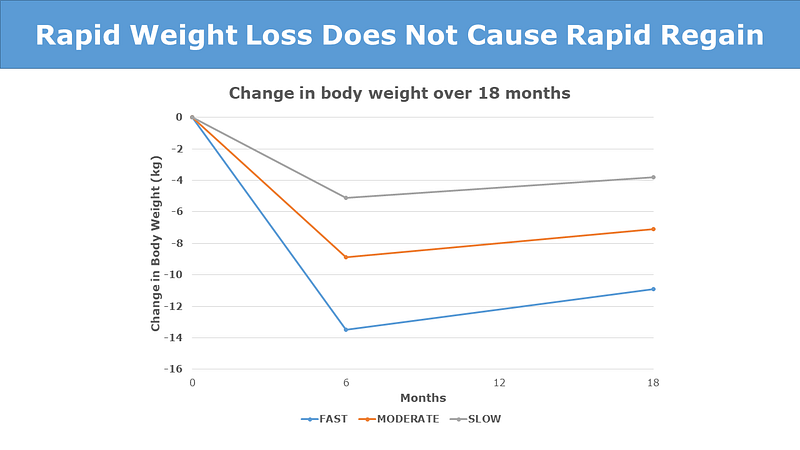
So, now the question is, should you be worried if you lose weight too quickly following any programs? Let’s have a good look at some clinical trials and what the experts have to say. A study prescribed 1200 kcal diet to a group of 298 women for 6 months, then help them to maintain their body weight for another 12 months. Using the same diet, some people lost weight quicker than the other. Those who lost weight rapidly did not regain more weight than those who lost weight gradually. Hence, unsurprisingly, they achieved a lower endpoint body weight. The authors concluded that slow and steady does not win the race [3].
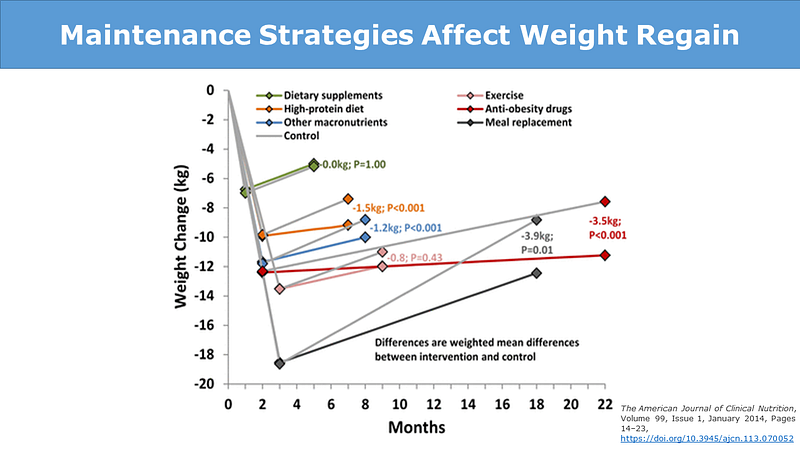
Okay, so this is just one single study. What about other studies? If the rate of weight loss is not affecting the rate of weight regain, then what is? A group of Swedish researchers attempted to dissect this issue [4]. They gathered 27 weight loss studies that introduced rapid weight loss and looked at a different rate of regain using different maintenance strategies. Unsurprisingly, if participants were not given maintenance supports, they regained more weight; if participants were given consistent and intensive maintenance supports, they regained less weight. The maintenance strategies were essential to keep your weight off. Seeing a dietitian is certainly a determinant for long-term success. Instead of worry about losing weight too quickly, we should worry about the long-term strategies for weight maintenance.
Weight regain is inevitable but is not invariable
We must also accept that weight regain is inevitable. But, that is not too bad. Our body stores 1 g of carbohydrate with 3 g of water. During the first week of dieting, we burn off the carbohydrate from our body, hence we lose the water accompanying it. This is why the quick weight loss in the first week can be deceiving. During weight maintenance, we increase our calories intake. If you have come out from a ketogenic diet, then your body will start to replenish your carbohydrate store, as well as the accompanying water [5]. So, parts of the weight regain are the weight of carbohydrate and water.
I say weight regain is invariable because you have the power to change your weight regain by using a good weight loss strategy that must be comprised of three components [6]:
- A strategy that curbs hunger and craving
- A strategy that improves physical fitness
- Have regular supports from dietitians.
Having a somebody to be accountable for, especially your dietitian, is often a neglected element of weight maintenance by laypeople.
If you have regained weight and perhaps fat, I also bring good news for you. Since weight maintenance is so hard, most people regained 75% of lost weight at the end of 5 years [7]. You are not alone. However, let’s think about what would have happened if you have not embarked on your weight loss journey. Considering the average natural progression of weight gain is about 0.5 kg per year, not embarking on a weight loss journey would have resulted in a net gain of 2.5 kg over 5 years. However, even if you regained 75% of lost weight over 5 years, you still have a net loss in body weight. This net loss is often sufficient to protect you from diabetes [8].
Take-home messages:
- Don’t worry about losing weight too quickly as long as you consume enough essential nutrients, especially protein, poly-unsaturated fat, vitamin and minerals. Remember slow and steady does not win the race.
- You must not take weight maintenance lightly because the rate of weight regain is determined by how you maintain it, not how you lost the weight. Weight maintenance strategies must be as intensive as weight loss strategies. A successful initial weight loss does not give you a free pass to eat anything you want during weight maintenance.
- Having a somebody to be accountable for, especially your dietitian, is often a neglected element of weight maintenance by laypeople.
- What you must absolutely avoid is not paying enough attention to weight maintenance and ending up with weight cycling.
- The modern meal replacement diet is a “crash diet” that works, not a fad diet. However, many doctors still hesitate to prescribe a meal replacement diet. Ironically, they are okay with weight loss surgery.
Can’t lose weight? Can you be overweight and healthy at the same time? Find out here in my next story:



