
Why do Humans Stare at Fire?
Scientific aspects of primal magic of fire
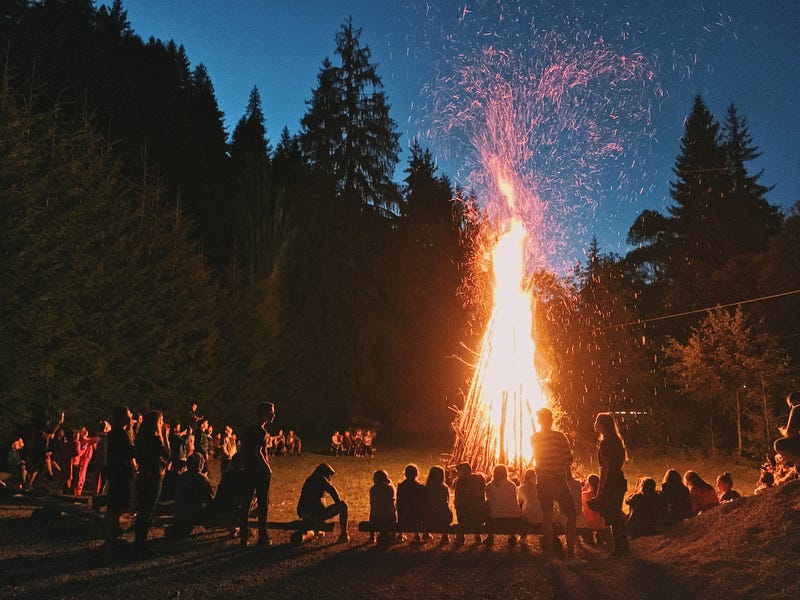
I like to say every fire tells a story. All people in the world are staring at it to know that story. But it’s not for us to know. Before you know it, several minutes have passed and you forgot what you were doing before staring into the fire. You can stare as long as you can, but it still will be a secret. Maybe one of the last secrets on Earth.
Archeologists & Anthropologists
Archeological evidence says that controlled use of fire started with Homo Erectus nearly two million years ago. According to John Gowlett, a University of Liverpool archeologist mastering the art of creating and controlling the fire opened the door for our brain to evolve.
After the sun goes down, our ancestors spend time asleep or inactive. The creation of artificial light enabled the hominid brain to adapt and evolve to the point where humans now remain alert and active for over 16 hours a day.
There is something about the fire. It’s impossible not looking at it when it is around. Always in the center of attention — starting from candles, bonfires, fireplaces ending at huge forest fires. People are gathering around it, talking about it, or sitting in silence.
During the stone age, humans likely socialized around campfires, a place where they felt safe and warm, a place where they could eat and meet their basic needs.
Especially in the colder climates, sitting around a fire to keep it going would have been a very important job. Collecting kindling, keeping the fire going, cooking — all these things required cooperation, at least when conditions were poor. Those groups more successful at keeping the fire going would have had an advantage over groups that didn’t. — Chrystopher Lynn, anthropologist
Fire gives light. Hope. Safety from intruders. We can make food using fire, craft tools, warm ourselves. Fire brings despair, fear, and panic. Fire is destructive, unpredictable, dangerous. There is nothing else like fire.
I found a scientist, who conducted research about fire fascination. Daniel M.T. Fessler, an evolutionary anthropologist at the University of California, Los Angeles in his work “A Burning Desire: Steps Toward an Evolutionary Psychology of Fire Learning”.
He’s claiming, humans have evolved psychological mechanisms specifically dedicated to controlling fire. But because most people no longer learn how to start, maintain, and use fire during childhood, we instead wind up with a curious attraction to it. In his opinion, the fascination with fire is an effect of a lack of knowledge on how to use it.
What’s more, Professor has found, that in societies where the fire is used as a daily tool, children are fascinated by the fire until they master how to start and control it. And after they learn how to use fire, their fascination fades and disappears.
Another study, by Irene Pinsonneault of the Massachusetts Coalition for Juvenile Firesetter Intervention Program, released the most frequently asked questions children ask about the fire.
Most of them were about how to build, control, and use fire.
‘What makes fire hot?’ ‘Why are some fires very smoky?’ ‘How does a small fire grow?’ ‘Can everything burn?’ ‘How can you keep a fire small?’ ‘How can you put fires out?’.
Ethnographic data says, that in societies where the fire is common tool children master it by the age of 7. According to Professor Fessler, most of us, raised in more advanced societies never gets to this point. So this may be one of the reasons of fire fascination.
Psychologists
The University of Alabama provided research that proved watching a fire lowers blood pressure. A group of 226 people was asked to watch a fire for some time. Scientists took their blood samples before and after the experiment, also they measured blood pressure. The longer volunteers were watching the fire, the more relaxed they were.
Frederick L. Coolidge, a psychologist at the University of Colorado declares fire improved quality of sleep.
During rapid eye movement (REM) sleep, the most vivid dreaming occurs and the brain consolidates long-term “procedural memories,” which allow us to retain skills and repeat previously learned tasks. The downside is that REM sleep is accompanied by a form of near paralysis known as muscle atonia — not the state you want to be in if you’re surrounded by animals that want to eat you. Using fire to keep predators away would have made it safe for early hominids to indulge in more REM (modern humans spend 25 percent of sleep in REM, compared with up to 15 percent for apes and monkeys), improving their ability to learn multistep tasks such as tool manufacturing. — Smithsonian
Another psychologist, Matt Rossano of Southeastern Louisiana University published his research in which I read that 100,000 years ago these small groups around the fire improved our ability to think about many things at once and relate them to one another. It means they learn to imagine, create, and even consult and execute complicated plans!
Rossano also writes about focusing on a specific object (fire) is a way to achieve a thoughtful state, the start of the meditation process. He claims evolution would have favored those who were good meditators, allowing them to pass their ability along to their progeny.
Meditation
Candle focus is one of the basic techniques in beginner meditation. It is a practical exercise to make your breath automatic and calm. For me, after breath exercises and body scanning, it was the third to know.
During the exercise, our brain shifts from focus and awareness of surroundings to creative thinking, relaxing and letting our thoughts flowing. And we don’t care what our thoughts are, because we got rid of them, they’re flowing somewhere, and we are watching a candle.
No television, computer, or phone screen will replace a candle. Meditating with it is relaxing and inspiring. When I write an article in the evening I often sit wrapped up in a blanket with lights off, surrounded by candles, sometimes with smoldering palo santo. Looking at the candles makes me feel safe, content, creative, and warm.
One of The Last Secret of Earth
Truth is, we still don’t know. And for me, it can stay this way. There are so few mysteries unsolved here on Earth. And I don’t know how about you, but I don’t want to know everything. Sometimes it’s better to belive in magic, use imagination to explain things that fascinate us, rather than reading tons of scientific data.