
Why Didn’t Shoguns In Feudal Japan Ever Declare Themselves Emperors?
Despite being considered a demi-god, the Japanese Emperor lost effective power — but was never formally deposed

Japan is known as the land of the rising sun. It is thus unsurprising that in such a country, the sun goddess, Amaterasu, would be the most sacred of deities.
The Emperor of Japan claimed descent from her, and was thus himself revered as a living god.
Despite this, for 700 years, the reigning Emperor was little more than a puppet. Real power stemmed from a set of hereditary generals known as Shoguns.
How did this come to be? And given that it did — why did none of the Shoguns with all their military might, simply declare themselves the new Emperor?
Let’s look at these in turn, below.
How The Emperor Lost His Groove (AKA Power)
Japan was once populated with many clans and tribes of people. Between the fourth and ninth centuries, however, most of these groups were unified under a single Emperor.
The Emperor’s rule however was reliant on key allies (such as the Soga Clan in the sixth century, and the Fujiwara during the next four).
In exchange for their support, the patriarchs of these clans ensured they held key positions in the court (such as the treasury or being in the council of state) and had their daughters married off to the Emperor — effectively ensuring that their grandchildren would sit on the throne in future.
This strategy allowed them not only control of key government policy, but as grandfather to the Emperor - the latter would often have to kowtow to the wishes of their familial elders in line with Confucian societal norms of the time.
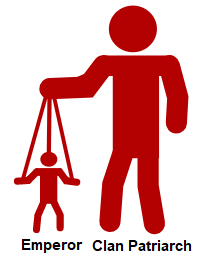
Eventually — Emperors were habitually compelled to abdicate while still in their 30s in favor of a new child emperor — who was nominated by the patriarchs of these powerful clans.
As a child obviously could not rule an entire kingdom, a regent would need to step in rule on their behalf.
Who better than the aforementioned patriarchs?
So it came to pass that a cycle emerged wherein an Emperor reigned — but did not rule; with true power sitting with a patriarch.
Whenever an Emperor attempted to reassert their independence, as they did from time to time; they either lost the struggle (in which case they’d be replaced by one more loyal to said patriarch) or — if victorious, would be indebted to a new patriarch who helped them secure power.
Eventually, one of the patriarchs in the mid-1100s had bestowed upon them, the long-dormant title of “Shogun”. This time, however, the title effectively became linked with whoever led the patriarch’s clan, and was in effect — now hereditary.
Why Didn’t Shoguns declare themselves emperor?
If the Shogun controlled the government, the military, and the lesser lords — why did they not simply dispense with formalities and crown themselves as Emperor of a new dynasty — as was done time and again everywhere else in the world?
There are five primary reasons for this:
#1 Being Emperor was a Blood Right
As noted above, the Emperor was descended from the sun-goddess, thus there was a strong symbolic element to their role.
One can depose the Emperor and wear the imperial robes, but it is difficult to re-invent the family tree and show a direct line back to Amaratsu.
Thus they could not create their own legitimacy. This leads to the second reason.
#2:The Emperor’s blessing legitimized their rule
The title of Shogun was conferred by the Emperor. If the Emperor is a demi-god, this then legitimized the Shogun’s legitimacy.
This is very similar to traditions in much of Europe where the Pope crowned or approved a new King’s coronation, thus conferring upon them the Divine Right to rule.
#3: They married into royalty anyway
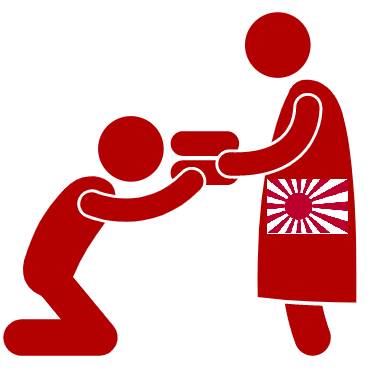
While the Shoguns may not have been able to directly take the Chrysanthemum throne themselves, they could ensure their progeny would.
Many Shoguns had their daughters (like Tokugawa Masako) marry emperors. This meant that children from these marriages would become future emperors (or empresses) — thereby intertwining their family trees.
Many Shoguns ended up being the grandfather or cousin of an emperor.
#4: They had to remain close to their base of power
The emperor and much of the clergy were historically based in the Kansai region in Western Japan — the cradle of their civilization.
In an effort to subdue the “uncivilized barbarians” at large, samurai were sent East, into the then frontier region of Kanto.
It so happened that Kanto was also the largest plateau in Japan — providing ample room to grow rice and raise horses.
With rice being a proxy for wealth in medieval Japan, and the obvious utility of horses (and the samurai lineage) for military means; the region became much stronger than the Imperial Kansai region.
It is no wonder then that the strongest Shogunates sprang from this region, and kept their capitals there (Kamakura for 141 years, and Edo for 264 more).
Becoming Emperor would likely have seen them need to move away from their power base to Kansai, and thus left them weaker.
#5: Being Emperor was a religious position
The Emperor was effectively the high priest of Shinto-ism. If you were a Shogun with a country and army to run — why bother also taking up religious ceremonies; when there is someone around to do that for you?
What are your thoughts? Have I missed any key reasons, or should the Shoguns have declared themselves emperor?
Let me know in the comments below!
You may also like: