
Why Did South Africans Decide To Make 3 Capitals?
While most countries settle for one, South Africa has 3 capital cities
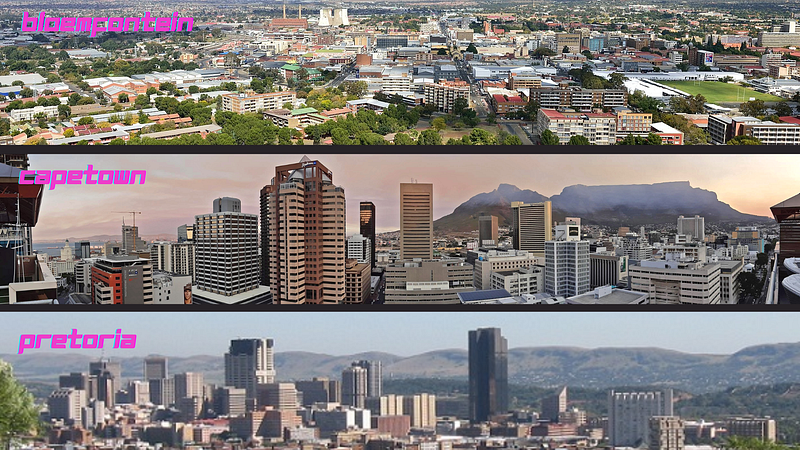
A capital city is a town holding primary status in a country, state, province, etc. usually as its seat of the government. Because of that, it has principal importance for the nation. While most countries have only one capital, South Africa has 3: Pretoria the executive, Cape Town the legislative, and Bloemfontein the judicial capital.
South Africa is a massive country, covering 1.2 Million sq km and the distribution of the government in such a way makes things a little complicated.
Distribution of Government
The three cities all have individual branches of the government that are all equally important and distinct.
The executive powers are based in Pretoria, so the cabinet and the president are based there. In Cape Town, the Parliament resides, and in Bloemfontein the High court.
This does create some confusion as the government officials have to travel between the three cities for business, but it has quite an interesting history to it.
The History behind the 3 cities
South Africa was founded in 1910 when three separate territories were unified as one state.
There was the British colony of a cape and two northern Dutch colonies. At the time of the merger, the three cities were quarreling over which regions capital quill gets to be the official capital of South Africa, but at this point, two wars had been fought already between the dutch and British settlers, to avoid further bloodshed, the three came to a unique decision, all three would be capitals. Interestingly, South Africa has managed to make this work.
None of these cities holds the title of South Africa’s largest city though, that award goes to Johannesburg which is also the financial center of the country.
Exploring Capitals
Having three capital and
Is the idea sustainable?
While the three capitals do make South Africa quirky, they do not provide any additional pros. The cons are many, with the most obvious one being the distance between the government centers of the country. It does create quite a hassle, and though most work is being digitalized in the modern era, there are still some discussions that require a one-on-one.
South Africa is in a time of change, Port Elizabeth has been officially renamed Gqeberha, and the idea of switching capitals isn’t all that wild.
In 1991, Nigeria moved its capital from Lagos to Abuja. The former was the wealthiest and largest city along with being a major shipping hub, but Abuja is the center of the country so it makes more sense for it to be the capital. Abuja used to be a sub-par city, but it was built specifically to be the capital.
Almost the exact same story is of Karachi, the old capital of Pakistan that was switched out for Islamabad, a much smaller, relatively insignificant town in 1967.
The 1960s was a good time to change capitals, Brazil moved the capital from the grand Rio de Janeiro to the accurately named Brasilia. The capital saw its first action in 1963 when a senator shot a rival in the senate building. It was a misfire, and he ended up killing a different senator entirely. If South Africa wants a competitor in its quirkiness, Brazil’s a good rival.
South Africa could always go down that path and build a new capital.
That’s also what Egypt is doing, since 2015 they have been constructing the New Administrative Capital, but currently, the capital is good old Cairo. Cairo, like most first capitals, is a lively city with 20 million people inhabiting it. There is an immense strain on infrastructure and this puts pressure on the government as well.
So like all the other countries, Egypt also thinks it’s better to have government bodies made in a city designed for them, in the middle of the desert of course. The goal is for 6 million people to live there.
Another country switching capitals is Indonesia, but for a different reason entirely. The current capital Jakarta is said to be sinking into the ocean at a rate of eight inches per annum.
They are not waiting for the capital to completely disappear before getting a backup, an Island 800 miles away from Jakarta is being considered for the new capital. This will cost about 30 billion dollars, and it would cost 40 billion to save Jakarta. So Indonesia needs a lot of bucks right now.
Another capital that’s sinking is Mexico, yes Mexico city is also going down. Originally built on top of a giant lake, presumably not the wisest decision, the city is now 32ft lower than it used to be. The buildings are obviously being impacted the most, with there being a constant fear of collapsing infrastructure. It’s sinking at a rate double that of Jakarta, falling 3 feet every year.
In closing
South Africa is not the only nation with multiple capitals though, both Malaysia and Bolivia have 2 capital cities, as does Eswatini a tiny nation that borders South Africa and is somewhat of a tinier copy of the nation. South Africa, though showing no indications yet of unifying its capitals to have a central capital, still has time and many examples to guide it through the age-old process.
Want to follow up more from me and other amazing writers on Medium?
Hop on the chance to join: