
Why Did Indian Sage Ramana Maharshi Die of Cancer at Age 70?
The search for an answer leads to a fascinating perspective about cancer
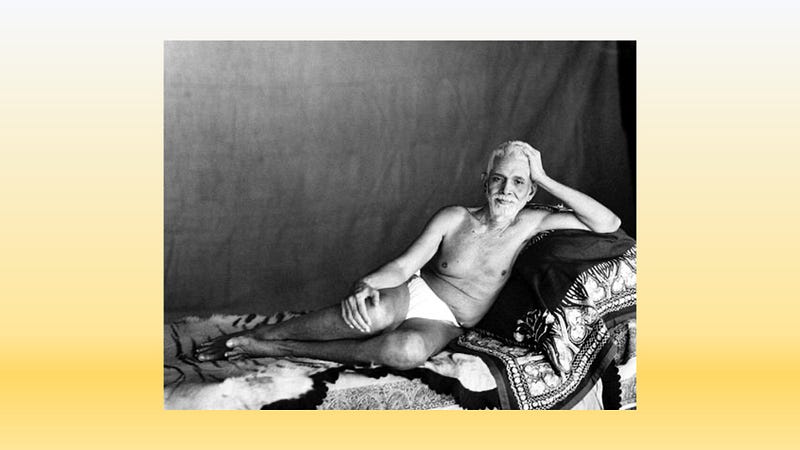
Many consider Ramana Maharshi to be one of the holiest men of the 20th century. Why did he develop cancer at such an early age, when he was not exposed to any of the factors we know promote this disease?
Follow me as I analyze Ramana’s life and death and find a perspective that sheds new light on cancer.
Ramana Maharshi
Ramana was born in 1879 in southern India. When he was 16 years old, he had an experience that he thought was death, but which turned out to be enlightenment. Soon after, Ramana left home and family to go to the sacred hill Arunachala, where he meditated for months. He was in such deep meditation that he did not notice the bites of pests and the development of festering ulcers. A local Hindu saint found him and took care of his body.
Ramana spent the rest of his life on Arunachala, where he was worshipped by admirers from around the world. In 1948, a cancerous lump was discovered on his arm. Four operations were unsuccessful. Doctors recommended amputation of the arm, but Ramana refused. He died on April 14, 1950, at the age of 70.
Why did he fall ill with cancer? He was enlightened, lived far from civilization, led a peaceful life with no stress, ate only healthy food, and was not exposed to environmental toxins. None of the factors we know to trigger cancer played a role in his life. Yet he died relatively young and painfully slowly from this disease.
As a scientist, I search for an answer by looking for a perspective from which I can see the solution. One approach is to look at a contrasting life story. I chose the Spanish painter Pablo Picasso, who was born only two years after Ramana.
Pablo Picasso
Pablo was born in 1881 in southern Spain. Very early he became passionate about drawing. His father, a painter and art teacher, trained him in the tradition of nineteenth-century painting. At 16, Pablo was sent to Spain’s leading art school in Madrid. But he didn’t like the formal education and skipped classes. He left Spain and moved to Paris, which was then a center of art.
Picasso is most known as the founder of Cubism, but he also left it behind. During his life, he created about 50,000 works of art in ever-changing art styles.
He led a very unhealthy life. He smoked like a chimney, drank like a fish, spent countless hours in restaurants and bars, and worked on his paintings at night. He died at 91 from pulmonary edema and a heart attack.
Two men live at the same time. One lives under biologically ideal conditions and dies prematurely and slowly of cancer at 70. The other lives under biologically challenging conditions until his sudden death at 91. A coincidence? No. Everything has a cause. To find it, we need to understand cancer. The essence of cancer is abnormal cell growth. But growth is also the essence of life.
Life
Everything in the universe decays as time passes. A leaf withers. A piece of meat rots. Stones decompose into fine sand. Even stars collapse when they reach a certain complexity. But there are also things that not only resist decay, but actually grow. They are called life forms.
Life begins with birth and ends with death. In between, there are three phases. Let’s take a tree as an example. In spring, the tree grows new leaves. In summer, it remains more or less stable. In fall, it loses its leaves, ie it decays. We humans go through the same three phases. As a child, our body grows and our physical and mental abilities grow. As adults, things are more or less stable. As we age, our bodies wither and our abilities, such as physical strength, decrease.
How can these three phases be understood in the face of ubiquitous decay? Decay is a constant force that destroys complexity. In spring, there must be an antagonist force that outpaces decay, so the result is growth. In summer, the antagonist just outbalances decay. In fall, the antagonist is weaker than decay, and the result is slow decay.
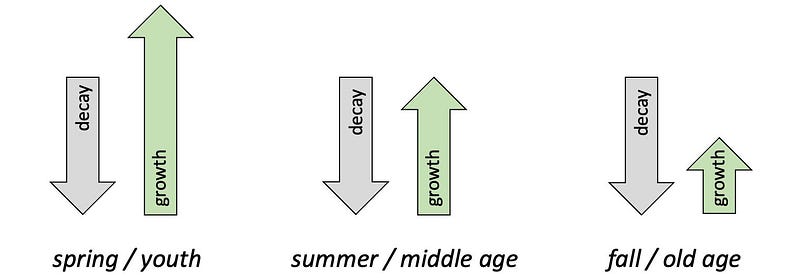
This antagonist force, which creates complexity and is called growth, is the essence of life. Life begins with a powerful expression of growth. Over time, this force becomes weaker. When it is exhausted, life ends. Even though growth is not always visible, it is present in everything that lives. A life form must grow in order to stay alive.
You can see in nature what an enormously powerful phenomenon life is. Every seed is proof. Life develops under the most extreme conditions, such as within a few days after a forest fire. Since we are a life form, this tremendous growth force must also be within us.
Since the essence of cancer is growth, it must express life. It is so strong that it can hardly be stopped or killed. Could it be that cancer expresses of our own growth force? After all, it is our own cells that start growing abnormally.
A New Perspective on Cancer
Imagine a water hose. The hose is bursting with water, so to speak. When you open the spray nozzle, the water shoots out. When you close the nozzle, the water stays in and is compressed. The pressurized water will take any opportunity to get out. If the hose has a tiny leak, the water will squirt out of it.
Just as a water hose bursts with water, life bursts with growth. A life form is a “growth hose,” so to speak. Could it be that cancer is a person’s pressurized growth force that finds a leak?

A human body comprises 35 trillion cells. Every physical behavior is produced by the interaction of these cells. For this purpose, the cells are grouped into organizational units, much like a company. First, each cell is a unit in itself — an employee. At this level, each cell performs the behavior it needs for its own survival. Second, cells are grouped into tissues and organs — departments. At this level, each cell performs the group behavior required for the survival of the tissue/organ to which it belongs. Third, tissues and organs are grouped into a body — the company. At this level, each cell performs the group behavior required for the survival of the body.
Thus, we have three levels of physical life within us:
- cell life,
- organ/tissue life (which can be considered plant life because organs and tissues are nothing more than specialized plants), and
- animal life (because biologically we are an animal).
Since we have a mind, we also have a mental life, which is our fourth level of life.
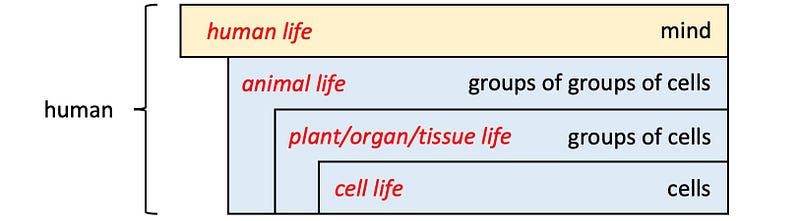
So, a human cell performs three sets of physical survival behavior, and it performs the owner’s mindset, which it takes as commands. (I explain why this is so in my article “Why and How Your Cells Read Your Mind — and What it Means for You.” For a detailed description of this model, developed with scientific rigor, see my book “Consciousness : Its Nature, Purpose, and How to Use It.”)
All life forms are driven by the tremendous power of growth. The purpose of a life form is to express this force at its characteristic level, which defines its top “nozzle.”
A cell’s nozzle is multiplication by division, because this is its most powerful survival technique. It divides endlessly.
A plant has two levels of life and, therefore, two nozzles. The cell nozzle is closed because unrestrained cell division would disrupt the integrity of the plant body. The plant nozzle is wide open throughout life, which means permanent tissue growth. However, there are physical limits to what is visibly produced, such as a height of 100 feet for an oak tree. Any further tissue growth merely compensates for losses because of natural decay.
An animal has three levels of life and, therefore, three nozzles. The cell nozzle and the plant nozzle are closed because unrestrained cell division or tissue growth would disrupt the integrity of the animal body. (The plant nozzle is open only when the animal body is young and growing to mechanically optimal size — or when healing from an injury.) The animal nozzle is wide open throughout life, which means permanent sensorimotor growth. However, there are physical limits to what is visibly achieved, such as a speed of 75 mph for a cheetah. Any further sensorimotor growth merely compensates for losses because of natural decay.
In nature, all life forms perform at world-class levels throughout life. Could you imagine reaching a world class level in a sport and then maintaining it for life? You don’t have to, because we are not made for that. Animals are, and wild specimen do, otherwise they couldn’t survive. We are built to keep our human nozzle wide open throughout life, which means permanent mental growth. (I go into more detail on this in my article “This is What I Found Out About Our Purpose in Life.”)
If we are not growing mentally (ie our human nozzle is closed), our growth force is under pressure and will take every opportunity to get out. It has three options because we have three other levels of life:
- It can spurt out on the animal level, showing up as excessive sensorimotor activities, such as excessive sports, excessive sexuality, or any other activity with excessive use of the motor system or senses.
- It can spread at the plant/tissue/organ level, showing up as excessive tissue growth, such as obesity.
- It can spread at the cell level in the form of excessive cell growth, showing up as cancer.
A person’s lifestyle determines which path the growth force can and will take. If it takes the cell level, it will spread at weak points, ie tissues or organs that have been weakened by an unhealthy lifestyle or other factors.
This fits perfectly with Ramana Maharshi and Pablo Picasso.
Picasso’s human nozzle was wide open throughout his life. He savored life and never stopped growing mentally. His motto was:
„I always do that which I cannot do, in order that I may learn how to do it.” (Pablo Picasso)
Ramana’s human nozzle was closed. He was no longer growing — and he didn’t care about life. Shortly before his death, he answered devotees who begged him to heal himself: “Why are you so attached to this body? Let it go!”
One could argue that Ramana did not care about physical life, but about spiritual life. But there is no spiritual life without physical life. Life is a physical phenomenon. Without a body, the spirit/mind has no way to express itself, have experiences, and grow from them. Mental/spiritual growth is based on a body. Not caring about the body means not caring about further growth.
Because of Ramana’s mindset and ascetic lifestyle, his growth force had no channel other than the cell level, so he developed cancer.
This is not to discredit Ramana Maharshi or his achievements. He made a choice based on the spiritual tradition he grew up with, which focuses on the spirit and neglects the body. (Remember that even the young Ramana neglected his body when he meditated for months.) I think this is just as one-sided as focusing on the body and neglecting the spirit, which is typical of modern Western cultures. But the beauty of being human is that we can choose. And others can learn from us; either directly or through our legacy. Ramana’s life story inspired me to see what I expressed in this article. I have learned from his experiences.
Is this perspective the truth? One cannot say. Perspectives are neither right nor wrong; they are just more or less useful.
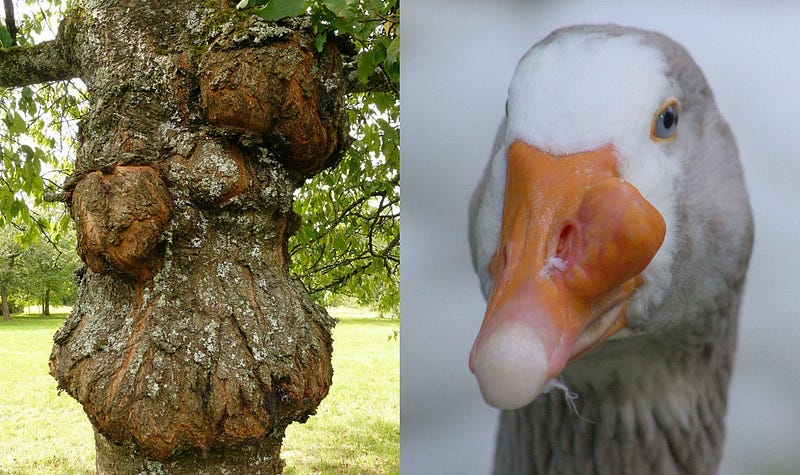
If this perspective has value, then it applies to non-human life forms as well. And cancer can indeed be observed in plants and animals. It develops in plants that grow in places that limit the plant’s ability to grow to full size, such as when there are not enough nutrients or light or when the soil is otherwise poor. And it shows up in animals that cannot fully develop their sensorimotor abilities, such as animals in zoos or pets.
Application
I have looked at the lifestyles of people who have cancer. And I have talked to doctors. So far, I have found this perspective confirmed. Of course, I continue to observe.
Make your own observations. Look for examples — or counter-examples.
Exercise 1: Look at the lifestyles of people you know who are suffering/have suffered from cancer. Compare their physical and mental lifestyles. How much growth is/was in these people’s lives and on which of the four levels did it occur?
Exercise 2: Consider people you know who are growing mentally. How does their health compare to their physical lifestyle?
Exercise 3: Find trees with cancer. Examine the places where they grow.
Further (supplementary) readings:
Article “Why and How Your Cells Read Your Mind — and What This Means for You”
Article “This is What I Found Out About Our Purpose in Life”
Book “Consciousness : Its Nature, Purpose, and How to Use It”
If you are not yet a member of medium, I invite you to consider membership. Membership gives you access not only to all my articles but also to the articles of thousands of other writers. If you use THIS LINK to become a member, you are supporting my writing.


