
This is What I Found Out About Our Purpose in Life
How to experience true fulfilment.

Why are we here? What is our purpose? These are fundamental questions of life. To find an answer, I followed the advice of Albert Einstein, who said:
“Look deep into nature, and then you will understand everything better.”
Follow along as I share what I found out.
The purpose of a bird is to fly — and become the best flyer it can be. The purpose of a fish is to swim — and become the best swimmer it can be. The purpose of a cheetah is to run — and become the best runner it can be. In nature, there are no lousy flyers, swimmers, or runners. Nature forces every life form to be its best version, that is, to serve its purpose as part of the whole, as otherwise it could not survive. The result is a healthy symbiosis of all life forms. Isn’t it a great and uplifting feeling to be in nature, surrounded by living beings that serve their purpose?
Flying is the essence of birds. Swimming is the essence of fish. Running is the essence of cheetahs. To find our purpose, we must know our essence. Since we are a life form, the essence of a human is a special case of the essence of life as such. So, we find that out first.
The Essence of Life
Everything in the universe decays as time passes. A leaf withers. A piece of meat rots. It may take a long time, but eventually stones decompose into fine sand. Even stars collapse when they reach a certain complexity.
Decay destroys complexity. But there are also things that resist decay. Think of a leaf on a tree compared to a leaf that has fallen from the tree. The fallen leaf withers within a few days, while the leaf on the tree remains what it is. We call this phenomenon life. This word has the Proto-Indoeuropean root *leip- (= to stick, adhere).
How is this possible when decay is omnipresent? There must be a force at work that is the antagonist of decay. Since decay destroys complexity, this antagonist must create complexity. The appropriate word for this force is growth, because the Latin word creare means just that. When growth meets decay, there are three scenarios:
1) When growth is stronger than decay, the result is an increase in complexity.
2) When growth and decay are equal, the result is stability.
3) When growth is weaker than decay, the result is a decrease in complexity.
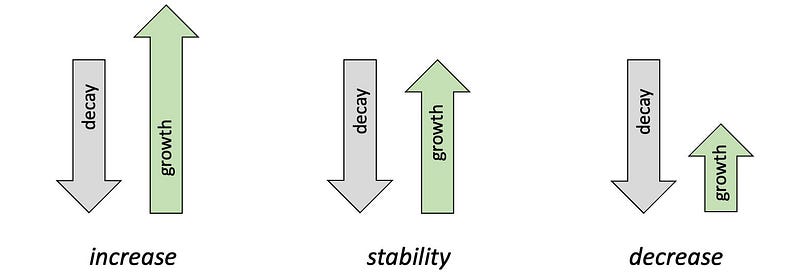
This is exactly what we observe in all life forms. Let’s take a tree as an example. In spring, growth outpaces decay, and the tree develops new leaves. In summer, growth and decay balance each other out. In fall, growth is weaker than decay, and the tree loses its leaves. We humans go through the same three phases. As a child, we thrive; our bodies grow and our physical and mental abilities grow. This corresponds to spring. As we age, our bodies wither and our abilities, such as physical strength, decrease. This corresponds to fall.
The essence of life is growth. A life form must grow to stay alive. Even though growth is not always visible, it is present in everything that lives.
For a deeper understanding, let’s take a closer look at life forms. There are four types that build on each other:
- The first type is cells. A cell is the basic unit of life.
- The second type is plants, which are collectives of specialized cells.
- The third type is animals, which can be considered collectives of specialized plants. (Organs and tissues are just that.)
- The fourth type is the human, which can be considered a specialized animal. Humans have a tool that no other life form on this planet has: the mind.
Plants have two levels of life: cell life and plant life (the cooperation of cells to be the plant). Animals have three levels of life: cell life, plant life (the cooperation of cells to be organs and tissues), and animal life (the cooperation of organs and tissues to be the animal). Humans have four levels of life: cell life, plant life, animal life, and human life (the activities of the mind).
(For a meticulous derivation of this typology and a detailed description of the mind, see my book “Consciousness : Its Nature, Purpose, and How to Use It.” I also explain the mind and the difference between humans and animals in my article “This is Exactly the Difference Between Humans and Animals.”)
Every non-human life form on this planet remains in its “behavioral box,” which is defined by its behavioral programs. An oak can only behave like an oak, ie grow into an oak and produce acorns. It cannot grow into a birch or produce apples. A cheetah can only behave like a cheetah, ie grow into a cheetah, run, and feed on other animals. It cannot grow into a cow, fly, or feed on fruits and nuts. Consequently, all specimens of a non-human species follow pretty much the same behavioral patterns unless they are programmed, as when a lion is trained to jump through a hoop of fire. A human can leave its behavioral box at will. The mind is the tool for this.
Since growth is the essence of life, all life forms grow throughout life. In fact, every type of life form introduces a new form of growth:
- Cells grow in number (through division).
- Plants grow in size — and also in number.
- Animals grow in their sensorimotor skills — and also in size (until they reach their optimal size or need to heal something) and number.
- Humans grow in mental skills — and also in sensorimotor skills, size, and number.
The essence of a life form — as a special case of the essence of life as such — is nothing other than its highest form of growth:
- The essence of a cell is survival, which is the most elementary manifestation of growth. Survival is a complex process that includes growth to resist decay at the molecular level and growth through division.
- The essence of a plant is physical growth.
- The essence of an animal is sensorimotor growth.
- The essence of a human is mental growth.
The purpose of a life form is to express its essence in the best possible way.
- The purpose of a cell is to survive — with as many copies as possible.
- The purpose of a plant is to grow in size — and to grow as large as possible.
- The purpose of an animal is to grow its sensorimotor skills — and become as good as possible, such as the best possible flyer, swimmer, or runner.
To serve their purpose, non-human life forms never stop growing — even if the growth is not always visible. In adult animals, sensorimotor growth means compensating for the natural decline of their sensorimotor abilities and thereby staying as fit as possible. Lions and gazelles, for example, “motivate” each other to stay fit: The least fit gazelle has the greatest chance of having no chance when hunted by lions. Conversely, the least fit lion has the greatest chance of having no chance of catching a gazelle.
It follows that
- the purpose of a human is to grow mentally — and to become as mentally competent as possible.
Our Purpose
Our purpose is permanent mental growth, outgrowing ourselves day by day.
We have a memory of having done just that. It is the memory of our childhood. (This memory creates the longing we feel throughout life that causes us to search — although most people don’t know what to search for ...) As a child, we curiously explored the world by asking ‘Why?’ and ‘Why Not?’ in countless ways with all our senses, and we grew from that at a tremendous pace. But as we grew older, we were drawn into the limitations of adult life, which includes trying to satisfy our curiosity, which is nothing more than mental hunger, with substitute methods such as food, possessions, sports, and later, sex, information, travel, and drugs. But that doesn’t work. Our only true fulfillment comes from the experience of growth.
Some people try to grow physically or sensorimotor instead of growing mentally. But in both cases, there are physical limits that eventually put an end to it.
Physical growth is an increase in height or weight. Height growth usually ends before the age of twenty. Weight gain is possible throughout life, but apart from unhealthy forms of weight gain that lead to obesity, you could do bodybuilding. However, this has physical limits. Once you reach them, all further training serves to maintain what you have already achieved. If you can only maintain what you have already achieved, your mind may tell you that is great, but you no longer experience growth and, therefore, fulfillment. Consequently, physical growth will not fulfill you throughout your life.
The same is true for sensorimotor growth. You can train to be as good as you can in a sport. But there is a point at which you cannot grow further. When you reach that point, all further training serves only to maintain your level, and you no longer experience growth and, therefore, fulfillment. Consequently, sensorimotor growth will also not fulfill you throughout your life.
Mental growth is an increase in knowledge and know-how, such as understanding, insight, and foreign languages. It is achieved by curiously exploring the world and creating within it. There are no limits to this. There are no limits to how many languages you can speak or how much you can remember, understand, know, or create. Therefore, mental growth will always fulfill you.
But this needs a word of caution: information is not the same as knowledge. When you read a book on nutrition, you are gathering information. When you do your own nutrition experiments, possibly based on what you have read, you are gathering knowledge. Knowledge creates fulfillment. Information provides only short-term, superficial satisfaction. We can observe this in children: Children strive for knowledge, not information. That’s why they ask most questions silently in their play. When they ask aloud and receive answers in the form of information, they continue to ask, because information does not satisfy them.
Pablo Picasso is one of the best role models for lifelong growth. He created about 50,000 works of art in constantly changing art styles. He never stopped growing until he died at 91:
“I am always doing that which I cannot do, in order that I may learn how to do it.” (Pablo Picasso)
At first, it seems to be a challenge to live your purpose, because there are endless possibilities to grow mentally. Should you learn foreign languages, study physics, explore nature, write poems, paint pictures? Perhaps you feel drawn to one or more areas. But is that the truth? It could just as easily be one of the many programs that control you.
If you have the courage to free yourself from your programs, what remains is what you really are: a genius in a field that will reveal itself. Once that happens, nothing can stop you— and you will be rewarded with the highest form of fulfillment.
If you want to know how to free yourself from your programs, read my article “The 7-Step Method to Become What You Truly Are” or my book “Being Free : Get Out of the Box — The Method With 99 Exercises” to find out what I do.
Exercises
Reflect on the three types of growth (physical, sensorimotor, mental) in yourself.
A famous exclamation by the Greek philosopher and mathematician Archimedes expresses mental growth:
“Eureka!” (Archimedes)
This word means: “I found it!” It is said that Archimedes, while taking a bath, discovered what today is known as Archimedes’ Principle. (“The static buoyancy of a body in a medium is as great as the weight force of the medium displaced by the body.” In practical terms, this means that a body heavier than water sinks in water, while one lighter than water floats in water.) With sheer joy, he got out of the bathtub, and ran through the city shouting “Eureka!”. He was so euphoric that he didn’t realize he was naked.
This story beautifully illustrates the tremendous fulfillment we can experience when we grow. It is in our nature to invite Eureka! moments into our lives.
What Eureka! moments have you experienced in your life? In childhood? In adolescence? In the last two years? How can you invite Eureka! moments into your life again?
Further (supplementary) readings:
Article “The is Exactly the Difference Between Humans and Animals”
Article “The 7-Step Method to Become What You Truly Are”
Book “Consciousness : Its Nature, Purpose, and How to Use It”
Book “Being Free : Get Out of the Box — The Method With 99 Exercises”
If you are not yet a member of medium, I invite you to consider membership. Membership gives you access not only to all my articles but also to the articles of thousands of other writers. If you use THIS LINK to become a member, you are supporting my writing.


