
Why and How Your Cells Read Your Mind — and What it Means for You
This explains intuition, the placebo/nocebo effect, telepathy, and even quantum entanglement
Many phenomena cannot be explained with the usual scientific model of the universe. In the course of my exploration of the question ‘What am I?’, I needed explanations for some of these phenomena. Since I am a scientist, these had to meet the best scientific standards. So I developed a new model of the universe. The insights gained from this proved to be very useful in my voyage of personal growth.
Follow me as I share one of my most fundamental insights. This will give you a new perspective on many things, including yourself, and it can help you on your path. At the end of the article, I suggest some exercises.
How Behavior is Created
My approach to becoming what I really am is to reverse-engineer myself: I observe myself and consider how my behavior, including my thinking, might be generated. In this way, I learn to understand why I behave and think the way I do, and this is the basis of mastering my programs and thus myself. It starts with a simple question, such as ‘How do I raise my left arm?’
Do it. Raise your left arm. How did you do it? You might answer that you commanded your muscles. But you didn’t. Unless you are an expert in anatomy, you don’t even know which muscles were involved in this movement — so how could you have commanded them? The truth is: you knew lifting your right arm — and it went up. Knowing was your only contribution. Everything else was done by your body.
You may argue that your brain commanded your muscles. But is that the truth? Your body comprises 35 trillion cells. Every physical behavior results from the perfectly coordinated interaction of these 35 trillion cells. To put this in perspective, we need to understand how big this number is. We are eight billion people on this planet. On 4,500 planets like Earth, there would be 35 trillion people. How could one coordinate that many people working together as perfectly and quickly as your cells do? After all, your arm went up as soon as you grasped the thought. So there is no reaction time between a possible command from the brain and its execution.
If you think about it, the very idea that the brain commands your 35 trillion cells by sending out signals is absurd — apart from the fact that we have no answer to the question: who chose to raise the right arm, and therefore knew raising it? After all, you are not your brain.
My simple — and in the eyes of some probably as heretical as it is challenging — explanation is that your cells know what you know, and they perform your knowing by acting like a school of fish or a flock of birds, which often behave like a single organism. Your body is nothing but a flock of 35 trillion cells. They are united by the knowledge of how to survive as a flock and, besides performing this survival behavior, they perform what you know — such as raising the left arm.
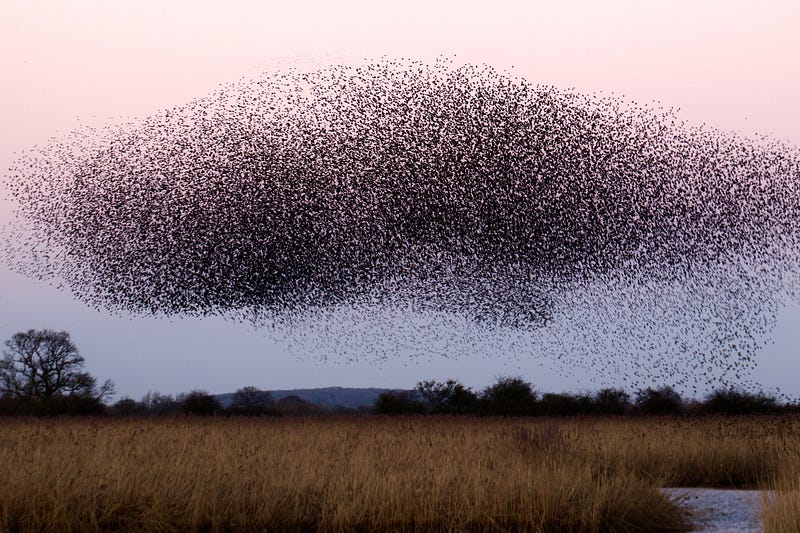
You are thoughts piloting a flock of 35 trillion cells — and not a body that thinks, which is the usual perspective.
(If you are interested in a detailed derivation of this new perspective, see my article “Thoughts are Not Products of the Brain.” For a full description of the underlying model, developed according to best scientific practice, see my book “Consciousness : Its Nature, Purpose, and How to Use It.”)
The communication between you, the pilot, and your cells is simply that your cells know what you know. They read your mind. This begs the question, ‘Why and how does a cell know?’
Why and How Cells Know
In my exploration, I have found the fabric that not only makes up thoughts, but also the entire universe. This fabric is pure information, ie information that has no form — in contrast to information that has a form, such as text, sounds, or images. I call this fabric EL as an abbreviation for ‘entanglement at large,’ which is one of its characteristic properties.
To illustrate EL, consider your mind, which is a “small version” of EL. The flow in your mind, which includes thoughts, feelings, and intuitions, is pure information. It is unlike anything in the physical universe. There are no distances between thoughts, no paths to travel to get from one thought to another or to move one thought from here to there. You just have to focus in this “sea” of pure information. Since physics breaks down when all distances are zero, your mind has no physics and therefore is not bound by the laws of physics. It is not part of the physical universe. The same is true for EL.
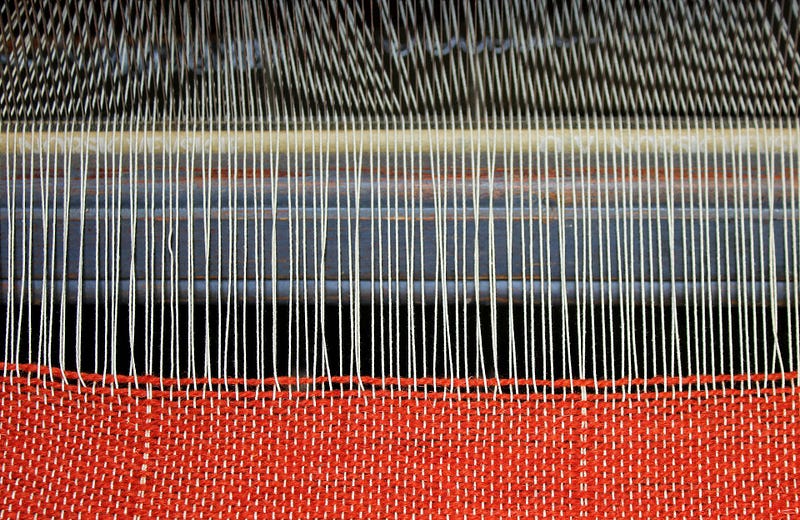
To illustrate that EL is the fabric of all, imagine a loom on which a cloth is woven from a single thread. It is a vertical loom and you are looking at it from above so that you see only the last weft.
- The thread is EL.
- The last weft is the universe.
- The cloth, except for the last weft, is the history of the universe (which includes your own history).
All information about everything present and past is available everywhere in the universe simultaneously. In “Doors of Perception,” Aldous Huxley has pointed this out:
“Each person is at each moment capable of remembering all that has ever happened to him and of perceiving everything that is happening everywhere in the universe. The function of the brain and nervous system is to protect us from being overwhelmed and confused by this mass of largely useless and irrelevant knowledge, by shutting out most of what we should otherwise perceive or remember at any moment, and leaving only that very small and special selection which is likely to be practically useful.“ (Aldous Huxley in “Doors of Perception”)
(If you are interested in the full train of thoughts leading to the discovery of EL and its properties, check out my book on consciousness. For a short version of the reasoning why EL is also the fabric of the physical universe, see my article “Is the Universe Really Just an Illusion?”)
A model/theory/perspective is neither right nor wrong. It is only more or less useful, such as for explaining phenomena. This is true for the traditional model of the universe as well as for this new model. So the question is: Does this new model offer better explanations than the traditional model? Let’s look at the evidence.
Who Knows What?
To be the thread means to be pure information and therefore to know — potentially everything. Since everything in the universe is woven from the thread, everything in the universe is the thread. Everything is pure information and therefore knows: atoms, molecules, rocks, planets, water, cells, plants, animals, humans, etc.
The behavior of non-living things is described by the laws of physics, which include that information cannot travel faster than the speed of light. Quantum physicists, however, have observed an instantaneous exchange of information. This phenomenon is called quantum entanglement and has been experimentally demonstrated with photons, neutrinos, electrons, molecules, and even small diamonds (source: Wikipedia).
Physics knows only information with form like texts, sounds, or images. In the new model, there is information with form and information without form (pure information). Information with form must travel physically. Pure information is everywhere at the same time. It is not accessible to objective observation, it can only be known (which is subjective). Therefore, physics cannot deal with it. Quantum physicists observe only the effect that occurs when, for example, two electrons know about each other — and are “amazed” because it doesn’t fit the laws of physics. Therefore, they accept it as a(n amazing) fact, with no explanation.
The new model offers a simple explanation: Everything potentially knows everything. Practically, it knows what it needs to know to fulfill its properties and its purpose as part of the whole. In inanimate things, there is not much to observe in this regard because their range of behavior is limited.
Animate things have a much wider range of behavior, they respond to their environment in more diverse ways. The behavior of non-human living beings is described by the laws of physics and their behavioral programs. There are countless phenomena that result from their knowing beyond physical senses, ie through EL, such as when animals intuit danger. (I discuss this in my article “Why the 2004 Tsunami Killed 230,000 Humans But Virtually No Animals.”) An approaching tsunami wave is part of the universe (the last weft). It is pure information and, as such, can immediately be known everywhere. Intuition is nothing else than accessing this pure information.
What does it mean that “an animal knows”? An animal is also nothing more than a flock of cells and its behavior is generated by the interaction of its cells. When we say that an animal knows that it must escape to higher ground (in response to intuiting an approaching tsunami wave), it actually means that its cells know they must work together to escape to higher ground together.
Biologically, a human is an animal. But it is a special animal. It is the only life form on this planet that is piloted by thought. We call this pilot mind. (I explain and justify our uniqueness in my article “This is Exactly the Difference Between Humans and Animals.”) The mind is nothing but pure information that has learned to identify itself with a flock of 35 trillion cells. Practically, this creates an additional level of cell behavior, so that each human cell performs the pilot’s thoughts/mindset besides performing the animal survival knowhow.
A human has the freedom to choose a behavior that is not a reaction to its environment — such as raising the left arm. This freedom comes at a price. Here’s an example: healing is part of survival behavior. When an animal is injured, the wound heals according to the laws of physics and biology. The animal can intuit which plants to eat that support healing. When a human body is injured, the wound could heal in the same way as an animal’s. But for most people, their intuitive connection to nature (their EL connection) is so weak that they don’t intuit which plants can support them or what else they should or should not do. Even more influential to the healing process, however, is that the cells perform the pilot’s thoughts/mindset. These “commands” can be neutral, supportive, or obstructive. Optimistic thoughts, such as the belief in the benefits of therapy, accelerate healing to the point of miracle cures. Pessimistic thoughts, such as doubt, slow it down to the point of preventing it. This phenomenon is known as the placebo and nocebo effect.
You are mind that has learned to identify with “your” body. Through your thinking, feeling, etc, you are constantly feeding EL (the thread) with pure information about you that becomes instantly available throughout the universe. Potentially, the entire universe is listening to you. Another person could — intentionally or unintentionally — intuit this information. This is nothing more than telepathy. It also explains social and other phenomena, such as feeling comfortable or uncomfortable in the presence of certain people, or how certain plants and animals react to us.
Exercises
Exercise 1: Apply this new perspective to yourself. Imagine your body as a corporation with 35 trillion employees that you pilot with what you know. Meditate on what that means in concrete life situations.
Exercise 2: Analyze examples of the placebo and nocebo effects that you have experienced in yourself or observed in others. What can you learn from these examples?
Exercise 3: Analyze examples of social interactions where you or the other person knew more than was physically communicated.
Exercise 4: Observe yourself when you are with someone. What do you “intuit” about the other person?
Further (supplementary) readings:
Article “Thoughts are Not Products of the Brain”
Article “Is the Universe Really Just an Illusion?”
Article “Why the 2004 Tsunami Killed 230,000 Humans But Virtually No Animals”
Article “This is Exactly the Difference Between Humans and Animals”
Book “Consciousness : Its Nature, Purpose, and How to Use It”
If you are not yet a member of medium, I invite you to consider membership. Membership gives you access not only to all my articles but also to the articles of thousands of other writers. If you use THIS LINK to become a member, you are supporting my writing.


