
Do You Unconsciously Prevent Your Child From Learning How To Read Feelings?
Don’t let parenting with the brain put a lock on your heart!
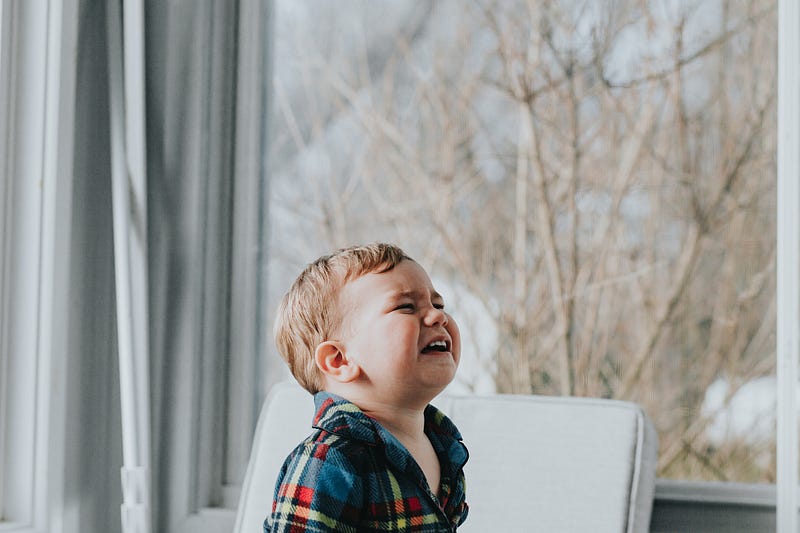
Most of the good parenting books out there encourage parents to understand the child’s brain and set their expectations accordingly.
Breathe. Watch your tone. Relax. It’s nothing personal, don’t feel offended. Wait for the storm to pass, and then help the child rationalize what happened.
All this is excellent advice. Still, I can’t help but notice how we tend to rationalize things to a point where we leave little room for showing our feelings. It’s as if parenting using the brain makes us shut down our hearts. We do our best to be present and think of what is going on with our children. Meanwhile, we pull the curtain on our emotions, and we fear revealing what we feel in the process.
I don’t know… Traditional parenting was too emotional, as in impulse-driven. Wouldn’t you say that conscious parenting often tends to be too cerebral? We rationalize everything, and we don’t allow our feelings to surface.
Parenting shouldn’t numb our natural reflex of showing emotions
The more of a conscious parent I try to be, the more I notice I fear being myself.
Honey — I’m not sad, not mad; I’m actually really, really pissed off that you’re regurgitating on the wall for the tenth time and that you’re using your hands and feet to spread that semi-digested meal into a cave painting that our ape ancestors would envy.
But is it OK that I tell you this? And if it’s OK, is this really the best way to put it? Will it scare you? Could it make you feel like you’re less worthy of my love?
Wtf, you’re just a kid; maybe I’m overreacting. I should put a smile on my face, hand you a paper towel, and help you clean it up without making too much fuss.
Parenting books insist on guiding the young spirits with rational explanations and justifications. And so, we tend to educate and correct our little ones merely using our brains. We forget about our hearts. We numb our emotions, particularly the reactive ones, fearing that showing our children a raw image of our selves will damage them.
But children need to see our raw side. See us as humans. Grasp the complexity of our human nature and social interactions. We shouldn’t be losing our natural reflex of showing our emotions in front of anyone, let alone our children. If we do that, they will grow up with a false image of their parents.
Showing our emotions can be a learning tool or a weapon
I know why I’m overthinking it. I fear that by not hiding and blocking my natural emotions, I could subject my child to some sort of emotional abuse. And I know I’m not the only one with this wrong image in mind.
I guess that, at some level, I’m afraid that showing my child how I feel about his behavior would put extra, unnecessary strain on him. I don’t want my feelings to be a weapon that forces him to do what I want. I’ve noticed how sensitive he gets when we play, and I pretend I’m hurt. That sad little face, the “Mommy, don’t cry”, and him freezing in the middle of our game makes me aware of the power I have on this tiny human. Aware and overwhelmed.
But there’s a huge difference between using feelings for emotional blackmail and being authentic human beings. This is something I try to remind myself as often as I can.
Authentic humans can also be disappointed, at times more vocal than usual, or even upset. It’s OK and perfectly natural to be like that.
If you use these feelings to control, dominate, threaten, or make the child feel that you’re taking your love away from him, you’re turning your emotions into a weapon.
If you use the same feelings and their expression to help your child self-regulate his impulses and model his behavior, you’re turning your emotions into a fantastic learning instrument.
Who’s going to teach children to read the social maps?
Growing up with parents who use their brains 99.99% of the time and block their feelings to the best they can doesn’t just make children have a false image of their parents. It also robs them of the essential ability to read social maps and recognize what the people they interact with really feel. It leads to a lack of empathy that socially handicaps adolescents and young adults.
We want to model the child’s behavior and help him self-regulate. We can’t just tell him what to do or how to do it. Instead, we need to let him mirror it all through our eyes.
As parents, we must show our children our sadness and joy.
We should feel free to wonder or frown in front of them. And we must definitely show our surprise, disappointment, enchantment, pride, and any other reactive emotion we experience.
This is how we teach children to see and read our natural discomfort, to learn about it through empathy. In time, this will allow them to grow to a stage where they can quickly and naturally identify and recognize all these feelings in the reactions and intentions of the people they interact with.
I want an emphatic child. I want my son to be able to read the maps of various social interactions he attends to. I want him to be able to see the intentions, emotions, and feelings of those around him, including the children he plays with. And I can’t do that if I’m afraid to show my real feelings in front of him.
The secret seems to be in stepping out of the parent role
Every now and then, take off your parent coat and use your genuine personality as a woman/man, someone more than a mother/father, someone who has feelings and isn’t afraid to let them be.
I do not want to show my child that I lose control of my feelings.
He is young, and my inner stability means the world to him. He needs to feel me as confident and in control as possible. He needs it for a long time from now on.
But I do want to show my child that I, too, get upset at times.
Showing children our raw emotions, in a non-aggressive way, of course, is mandatory, no matter how uncomfortable those emotions are.
I’ll leave you here for now.
I have to go check the lock on my heart and open the door to my inner world in front of my child. I should do it more often. I need to be brave and show my son what I feel, just as much as he needs to gaze through my heart. It should help him cope with the less comfortable feelings. Feelings that he needs to be aware of and that will help him grow.
I hope you’ll have the courage to do the same — use that lock on your heart more often and with more confidence.
Wait a sec! Take a peek at my other parenting articles:
Thank you for reading! You can always find me here: Adelina Vasile.


