
Who Owns Your Food? Big Tobacco Execs, That’s Who
Now they push sugar

This is a public service announcement in advance of Valentine’s Day.
And Easter. And every other holiday that pushes sweets.
We are sugar addicts almost from birth. Eating sugar regularly is normalized in our society, and has been since the sweet drug first found its way to Europe in the form of cane and beet sugar.
But it’s one thing to eat it as an adult, and another to watch kids get addicted.
Ah, children, the pickiest of eaters. They like bland foods, get particular about textures, adore colorful packaging, are easily fooled by Ronald McDonald…and can get loud about their, er, preferences.
Of course, most kids love sweets.
And Big Food loves our kids, so it’s a match made in heaven.
Long before they rolled up their sleeves to invent fruit roll-ups, food execs were in another business: they sold cigarettes to your children.
Today’s Big Food executives marketed cigarettes to to kids, and got away with it for years. When states began suing these filthy rich creeps, the lying bastards left the business — only to reemerge in newly demonic form.
They bought up food manufacturing companies.
In the shadow of the execs are the “food scientists” — a small group of overpaid, bureaucratic eggheads who routinely decided whether cigarettes were safe to smoke. This same cadre now tells us if food additives are safe to eat.
You can’t make this sh*t up.
Young and Stupid and Smoking
Ninety percent of smokers started when they were under 18. Why is that? There isn’t a complicated scientific reason. The answer is:
When we’re young, we’re dumb.
Remember cigarette machines? Now banned, they made buying a pack of cigs like grabbing a cold Coke, a pack of gum, or a bag of chips.

Cancer sticks were pretty cheap back in the day — under a buck a pack. In my high school, they let us puff in the smoking lounge where the “freaks” (guilty) convened. The teacher’s lounge was smoggier than downtown L.A.
We smoked on busses, we smoked on planes, we lit up at parties, and on trains! Doctor Suess was, no doubt, alarmed.
You get the picture: smoking was cool and it was everywhere. I picked up the habit because both my parents smoked, and so did many of my teenaged friends.
The take home message is none of it was accidental. Big Tobacco wanted me and my friends to smoke like chimneys.
Positive Peer Pressure
At my first grownup job, my supervisor was an MD trying to figure out how to teach ordinary people — rather than doctors — how to help smokers quit.
It turns out, most doctors are not good at having heart-to-heart talks with their patients. They don’t have the time, the training, the bedside manner, or the inclination for giving advice. They are trained to diagnose and treat with drugs.
My job was to find scholarly articles about tobacco. The articles inevitably began with these words:
“Tobacco is responsible for 340,000 preventable deaths each year in the U.S.”
I was also moonlighting a waitress in a greasy diner, where everyone smoked — sometimes while they were dishing up a peach cobbler. I quit.
No one at my university day job was smoking. I was given a priceless gift: positive peer pressure.
I also quit because it finally sunk in that tobacco kills, and I could be next.
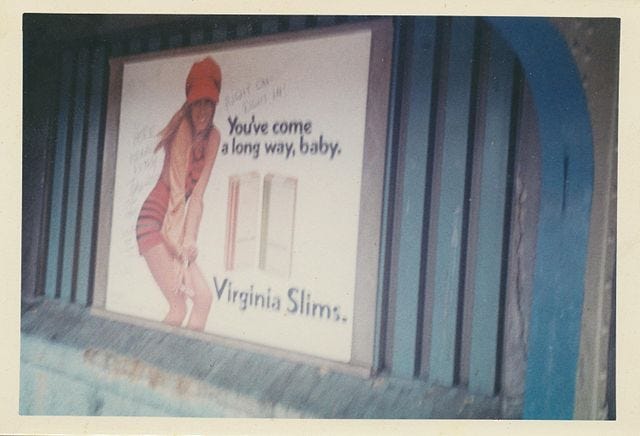
You’ve Come a Long Way, Baby
Big Tobacco worked their collective butts off to make a product that could deliver nicotine efficiently. They churned out fast-burning cigarettes that would stay lit. They made sure you weren’t eating tobacco with the magic of filters. They stuffed nicotine doses inside easy-to-use delivery systems in packs of 20.
Somehow, they made it possible for you to take frequent work breaks so you could light up.
Cigarettes are primarily addictive because they contain nicotine, just like Pop-Tarts are addictive because they contain sugar and processed flour.
Big Tobacco also targeted users more vulnerable to addiction, including teenagers, LGBTQ populations, and those who suffered from mental illness. They roped women into smoking with their famous and condescending ads:
“You’ve Come a Long Way, Baby!”
To say their scheme to addict Americans to a deadly product was successful is the understatement of the century. Along the way, they began to understand how the human brain works to fully exploit our innate weaknesses.
Public health and medical workers finally got fed up. They were tired and angry after watching their patients die from emphysema and lung cancer.
In 1994, the Attorney General Mike Moore of Mississippi sued the 13 major tobacco companies. By 1998, state governments garnered payouts totaling $246 billion as compensation for the damage done by tobacco.
In short, we the people sued Big Tobacco and won.
The lying tobacco execs, like deadly bacteria, adapted. They bought food manufacturing companies and doubled down. They had already mastered selling soft drinks and other sugar-laden foods. Soft drink manufacturers used the tobacco playbook to recruit youth.
And they began buying food companies as early as 1963, at the height of smoking in the U.S.
The began working on ways to get your kids hooked on their products, as detailed in an excellent piece from The New York Times.
Pop-Tarts, fruit roll-ups, sugary peanut butter, and instant oatmeal with “real maple sugar” aren’t accidents. They aren’t foods, either. It is not happenstance they many of those items can be purchased in machines.
According to research by Lauren Schmidt at the University of San Francisco Philip R. Lee Institute for Health Policy Studies:
“Executives in the two largest U.S.-based tobacco companies had developed colors and flavors as additives for cigarettes and used them to build major children’s beverage product lines, including Hawaiian Punch, Kool-Aid, Tang, and Capri Sun.”
Unlike cigarettes, sugary “foods” are often widely available in schools, hospitals, and prisons. As of 2022, the law is still on the side of food manufacturers. Most U.S. states, for example, have yet to pass a single law taxing soft drinks.
Final Big Thoughts
It’s white, it’s powdery, it’s fun at parties. Sugar is more addictive than cocaine.
As a former tobacco control researcher, I will proudly raise my right hand and declare: Big Food/Big Tobacco executives are like The Terminator. They will not stop.
They are gunning for your pocketbook, via your child’s basic hunger drive.
The best thing you can do this New Year is say goodbye to sugar. Once safe, you can begin the difficult and heroic process of getting your kids off sugar.
Start by taking steps as simple as ordering fast food that doesn’t include a soda, a milk shake, or a dessert.
Read labels, too. Peanut butter spread has a lot of high fructose corn syrup, even brands that look innocuous and healthy. Go online, and buy all-natural, no-sugar peanut butter.
You might find yourself steering toward a keto diet one day, once you realize how much better you feel when you’ve banished the sweet stuff from your life.
Don’t put another dime in the pockets of these diabolical drug pushers.
Jean Campbell is a 4x top Medium writer in food, fitness, psychology, and humor. Help support her by subscribing!
Incredible books about the science of sugar and health:
The Diabetes Code: Prevent and Reverse Type 2 Diabetes Naturally, by Jason Fung
Ravenous: Otto Warburg, the Nazis, and the Search for the Diet-Cancer Connection, by Sam Apple
The Case for Keto, by Gary Taubes
The Big Fat Surprise: Why Butter, Meat, and Cheese Belong in a Healthy Diet, by Nina Teicholz


