
Who owns God? Rupert Murdoch, of course
Let’s look at the economics of Christianity
If you go to buy a Bible, the seller is likely to be, not God, but a certain Australian billionaire. Rupert Murdoch pretty much owns the Christian sacred text.
The economics of ‘God’ is a subject full of surprises. Murdoch owns 10 out of 20 of the top-selling Bibles, including #1 and #2. Another surprise? Christianity is a ‘secular’ business—and keeps quiet about it.
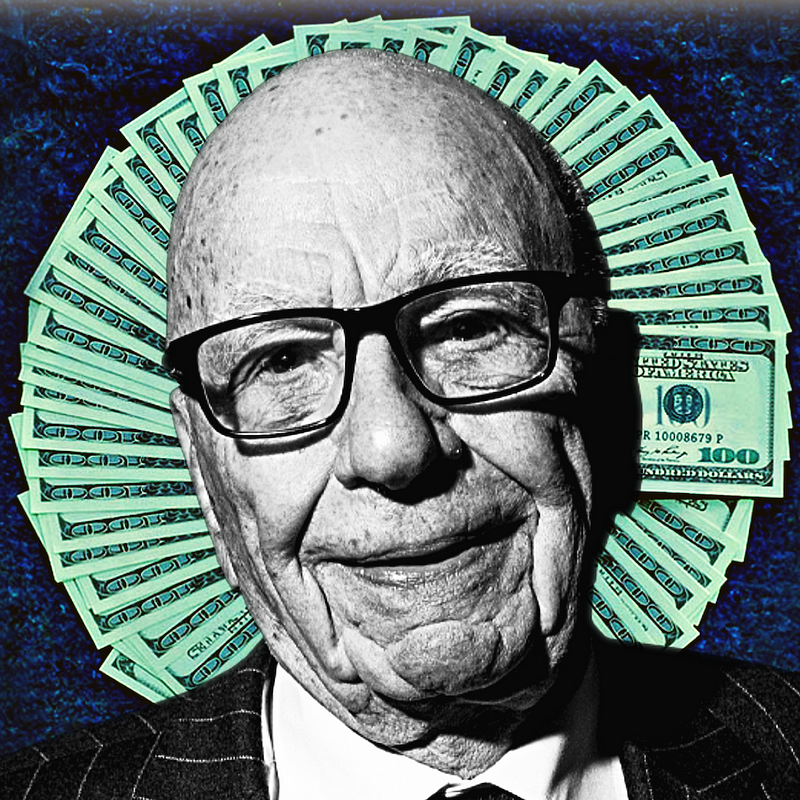
From the late 1980s on, Rupert Murdoch went on a shopping spree.
Flush with money from British tabloid newspapers, he bought HarperCollins, which owned Zondervan, the venerable Christian publisher. With that, he owned the NIV, the #1 English translation of the Bible.
In 2007, he bought Integrity Publishing, and with it authors like Beth Moore and Sarah Young.
In 2011, Murdoch bought Thomas Nelson, the Christian publisher which owned the NKJV and CEV—and also Christian authors like Billy Graham, Max Lucado, etc. At that point he’d purchased American Christianity.
The religion just let itself be acquired by a man famous for tabloid titties and gutter politics.
Murdoch’s sleazy British tabloids had just been exposed for a phone-hacking scandal. Was Murdoch even a Christian?
In a 1992 interview, he said he attended a Catholic church with his second wife. He’s currently divorcing his fourth.
By any typical standard he would not be considered ‘Christian’, and certainly not Evangelical. And yet, he owned them.
The loudest protest was by an atheist.
Frank Schaeffer, son of the well-known Christian writer Francis Schaeffer, tried to shame the faith for getting in bed with the devil:
“What serious, let alone decent religiously conscious person — left or right, conservative or liberal — would knowingly work to enrich this dreadful man who will go down in history as the epitome of everything that all religion says it’s against: lies, greed, criminality and sheer disgusting exploitation of the defenseless that would shame a sewer rat?”
I would make the opposite point. Christianity had found its true leader.
Murdoch kept growing his conservative media empire.
He founded the FoxNews news network and bought the Wall Street Journal. The reality is that to be a ‘conservative Christian’ in America is to just be taking in what Rupert Murdoch is selling.
Under his leadership, ‘Christian’ and ‘Republican’ are two faces of a lifestyle brand. You’d get your news from him, and your Bibles too.
It’s might even seem a package deal, the “media ecosystem” you choose to live in, or not.
Murdoch is a religious figure comparable to the Pope, the Dalai Lama, or a major Imam.
Via his management team, he shapes the Christian experience globally. Everyone just keeps quiet about this curious business arrangement.
A note: You don’t even need to buy a Bible to be dumping money in Rupert Murdoch’s coffers. ‘Bible Gateway’ is a popular hub for Bible translations. It’s owned by Zondervan, which is owned by HarperCollins, which is owned by News Corp, which is owned by…Rupert Murdoch.
Other Bibles are available.
The KJV remains very popular. It’s the Anglican Bible, still under copyright in England, so the Royal Family gets just a bit richer with every sale.
Other Bible translations can be popular, as marketed by non-profit companies still identified as ‘Christian’, like Crossway or Tyndale House. They have nothing like the reach of the NIV, NKJV and CEV.
The NASB is popular. It’s published by the Lockman Foundation, a conservative Christian organization, which also publishes pamphlets on subjects like “How to have a Happy Home” and “Principles of Stewardship.”
The reality is that all major Bible translations are marketed explicitly to change behavior and to influence the religion. And a man outside the religion did it smartest and best.
You can buy Bibles that don’t have a social agenda.
The problem is that they’re not so “Christian.” I’m still trying to get through Sarah Ruden’s The Gospels, in which the famed translator of ancient Greek texts turns to the New Testament. But she says familiar religious translations bear little resemblance to the Greek text.
Or as she puts it, the Bible “has fallen under the muffling, alien weight of later Christian institutions and had the life nearly smothered out of it.”
Her version is like a book I have never read before.
This thing called ‘Christianity’ is a show.
Churches are theaters. And Rupert Murdoch bought the script.
The dirty little truth on view here is that Christianity was being poorly managed. Despite the massive amounts of money it brought in, it was running itself into the ground.
And so it got bought out. Most of the ‘Christian businesses’ that market ‘Christian products’ are just other faces of secular corporations. A Christian gets music from Word Records, a division of Warner Records.
Phil Vischer developed the Christian-themed Veggie Tales children’s cartoon series. In 2004, the company was circling the drain of bankruptcy, and was bought by NBCUniversal, i.e. Comcast.
Vischer stayed on as an employee.
“The motivation does change,” he says. “They always say, ‘We want you to keep doing what you’re doing, just keep doing what you’re doing, except…’”
That is to say: corporations put out the same basic product without the layer of Christian moralizing and conflicts. And Christians like it that way. If it was a “Christian business” putting out the products, it would all have to be monitored, constantly and anxiously, for religious correctness.
But a “secular” corporation isn’t monitored. The religion knows it’s there to sell products and that’s pretty much it.
Under Murdoch, the religion becomes less moralizing and less weird.
His companies keeps the flow of products coming and everyone was happy.
He’d never ‘rock the boat’, but Christians don’t like that. The religion likes the idea of being unchanging—which means changes are made that aren’t noticed. Or are ignored.
And so “Christianity” appears at a store near you. You don’t have to think about who owns it. All you have to do is buy it. 🔶


