avatarSean Youra

Free AI web copilot to create summaries, insights and extended knowledge, download it at here

6419

Abstract

ment-study-shows">autism</a>, <a href="https://www.cambridge.org/core/journals/the-british-journal-of-psychiatry/article/association-between-air-pollution-exposure-and-mental-health-service-use-among-individuals-with-first-presentations-of-psychotic-and-mood-disorders-retrospective-cohort-study/010F283B9107A5F04C51F90B5D5F96D6">schizophrenia</a>, and other mental health disorders.</p><blockquote id="fc04"><p>“Every aspect of human performance that you could possibly measure is damaged by air pollution.” — <a href="https://www.youtube.com/watch?v=JaPr6xW2Oks">David Wallace-Wells</a></p></blockquote><p id="fc98">With pollution clearly such a threat to public health, have we really not made any progress on addressing it?</p><p id="9f99">Well, yes and no.</p><p id="fe8d">Although there have been improvements in indoor air quality, drinking water quality, and sanitation that have led to a decrease in traditional pollution-related deaths since 2000, this has been offset by the <a href="https://www.thelancet.com/action/showPdf?pii=S2542-5196%2822%2900090-0">66% increase</a> in deaths from modern forms of pollution (e.g., ambient air pollution, chemical pollution). And this increase happened just over the past 20 years.</p><figure id="c21b"><img src="https://cdn-images-1.readmedium.com/v2/resize:fit:800/1*5NEV9EduFYk4SWwuWERNug.png"><figcaption>The negative economic impacts from traditional pollution sources are on the decline while negative economic impacts from modern pollution are on the rise in LMICs. Source: <a href="https://www.thelancet.com/action/showPdf?pii=S2542-5196%2822%2900090-0">Lancet Commission study</a></figcaption></figure><p id="09cc">If these trends continue, then modern forms of pollution will increasingly represent a larger share of total pollution-related deaths. This is especially true of rapidly <a href="https://www.thelancet.com/action/showPdf?pii=S2542-5196%2822%2900090-0">developing countries in Africa</a> and elsewhere where the incidence of air pollution-related deaths is much higher resulting from industrialization and infrastructure buildout.</p><h1 id="4071">The interconnectedness of pollution and climate change</h1><p id="d5b7">It is unequivocal at this point that the combustion of fossil fuels are at the heart of our pollution and climate change issues.</p><p id="812f">The combustion of these fuels results in fine particulate matter (<a href="https://www.cleanairresources.com/resources/what-is-pm-2-point-5-and-why-does-it-matter">PM 2.5</a>), long-lived greenhouse gases (GHGs), and short-lived climate pollutants (SLCPs). SLCPs such as methane and <a href="https://www.epa.gov/sites/default/files/2013-12/documents/black-carbon-fact-sheet_0.pdf">black carbon</a> have much greater global warming potentials (<a href="https://www.epa.gov/ghgemissions/understanding-global-warming-potentials">GWPs</a>) than carbon dioxide, and also contribute significantly to air pollution. For example, methane is a precursor to <a href="https://www.epa.gov/ground-level-ozone-pollution/ground-level-ozone-basics">ground-level ozone</a>, a “major source of premature death”, according to the <i>Lancet</i> Commission <a href="https://www.thelancet.com/action/showPdf?pii=S2542-5196%2822%2900090-0">study</a>.</p><p id="a615">Therefore, fossil fuels are a much greater threat than most people realize. But this also means climate actions such as switching to renewables for electricity are much more powerful in terms of their potential impact on society.</p><p id="28d8">By getting off of fossil fuels, we have the ability to mitigate climate change and keep our planet more habitable while saving millions of lives and trillions of dollars in the process.</p><blockquote id="2bdc"><p>“Now more than ever we can see the healthier, more just and sustainable world that climate actions can deliver.” — <a href="https://www.hsph.harvard.edu/c-change/news/fossil-fuel-air-pollution-responsible-for-1-in-5-deaths-worldwide/">Dr. Aaron Bernstein, Director of the Center for Climate, Health, and the Global Environment at Harvard Chan School</a></p></blockquote><p id="da96">Because of the interconnectedness of air pollution and climate change — and the clear benefits from mitigating them — we must pursue solutions that address both. This is why certain so-called solutions such as carbon capture and storage (CCS) aren’t sufficient.</p><p id="3449">Not only is CCS <a href="https://news.stanford.edu/2019/10/25/study-casts-doubt-carbon-capture/">not great at capturing carbon</a> (when upstream emissions are factored in), it may actually <i>increase </i>air pollution. Professor Mark Z. Jacobson’s <a href="https://pubs.rsc.org/en/content/articlelanding/2019/ee/c9ee02709b/unauth#!divAbstract">research</a> has shown that CCS is worse from a social cost perspective than not capturing the carbon at all. And it is always better in terms of reducing social cost to utilize renewables to replace fossil fuel capacity rather than utilize renewables to power CCS equipment.</p><p id="c2c7" type="7">By getting off of fossil fuels, we have the ability to mitigate climate change and keep our planet more habitable while saving millions of lives and trillions of dollars in the process.</p><p id="17ab">Pollution has often been viewed as more of a local or regional issue. But just as with climate change, pollution is a planetary threat that demands a global response. The <i>Lancet</i> Commission <a href="https://www.thelancet.com/action/showPdf?pii=S2542-5196%2822%2900090-0">study</a> explains why:</p><blockquote id="c784"><p>“Pollution has typically been viewed as a local issue to be addressed through subnational and national regulation or, occasionally, using regional policy in higher-income countries. Now, however, it is increasingly clear that pollution is a planetary threat, and that its drivers, its dispersion, and its effects on health transcend local boundaries and demand a global response. Global action on all major modern pollutants is needed.”</p></blockquote><p id="a68f">Air pollution, in particular, can <a href="https://www.thelancet.com/action/showPdf?pii=S2542-5196%2822%2900090-0">travel vast distances</a> far from the source via global wind currents. As discussed in the study, air pollutants originating in China from industrial activity can travel as far as California. So as wealthier countries continue to outsource more industrial ac

Options

tivity overseas, that doesn’t mean they completely outsource the associated pollution as well. All that pollution will come back to harm us, regardless of where we live.</p><h1 id="7b66">What should a global response to pollution look like?</h1><p id="b920">As discussed earlier, we haven’t made much progress in addressing pollution overall as modern forms of pollution are causing an increasing number of premature deaths along with a host of negative impacts on people’s mental and physical health.</p><p id="0f48">Since the previous <i>Lancet</i> Commission study published in 2017, there has been <a href="https://www.thelancet.com/action/showPdf?pii=S2542-5196%2822%2900090-0">little action</a> from most countries in the way of policies or prioritization of pollution control measures. Instead, more attention is paid to other risk factors like obesity or tobacco use.</p><p id="8017">The latest <i>Lancet</i> Commission <a href="https://www.thelancet.com/action/showPdf?pii=S2542-5196%2822%2900090-0">study</a> made a number of recommendations of what a global response to pollution should look like, which include things like prioritizing pollution prevention both nationally and internationally, and increasing funding for pollution prevention. Adequate pollution monitoring systems are important as well, especially in LMICs where there is still a lack of air quality monitoring stations that can provide reliable real-time feedback.</p><p id="5216">Pollution needs to be considered in each country’s development strategy. And each country should identify their most critical pollution problems and develop a plan of action to address them. There also needs to be more international coordination on policy efforts to combat pollution just as there has been to combat climate change. I would actually take it a step farther and advocate for an Intergovernmental Panel on Pollution similar to the Intergovernmental Panel on Climate Change (IPCC), or at least making this a major focus within the IPCC’s work since there is such an obvious interconnectedness of these issues**.</p><p id="91b7">Lastly, the study recommends stepping up research efforts on pollution and pollution control with particular focus on LMICs, as well as creating more concrete targets for pollution control in the UN’s Sustainable Development Goals (<a href="https://www.undp.org/sustainable-development-goals">SDGs</a>).</p><p id="2e8d">Pollution control deserves far more attention than it gets. It is <a href="https://www.thelancet.com/action/showPdf?pii=S2542-5196%2822%2900090-0">cost-effective</a>, has the opportunity to save millions of lives and greatly improve public health, and can provide several co-benefits by also mitigating climate change and biodiversity loss.</p><p id="6968">I’ll leave you with perhaps the most important key message from the <i>Lancet</i> Commission <a href="https://www.thelancet.com/action/showPdf?pii=S2542-5196%2822%2900090-0">study</a>:</p><blockquote id="e65d"><p>“We cannot continue to ignore pollution. We are going backwards.”</p></blockquote><p id="7f54">*If you happen to be wondering why one study estimated 8.7 million deaths from air pollution alone while the other estimated 9 million deaths from pollution from all sources, it’s because the first study used a more robust methodology that was able to <a href="https://www.hsph.harvard.edu/c-change/news/fossil-fuel-air-pollution-responsible-for-1-in-5-deaths-worldwide/">directly attribute premature deaths from fine particulate pollution to fossil fuel combustion</a>. In other words, air pollution is an even greater threat than we previously realized, but which also means getting off of fossil fuels will have an even greater positive effect on public health than we previously realized.</p><p id="a4e4">**The latest IPCC Sixth Assessment Reports hardly mentioned air pollution and did not focus on its significant health, environmental, and economic impacts that would also benefit from climate mitigation efforts to get off of fossil fuels.</p><p id="0014">If you enjoyed this story, then you might also like:</p><div id="10e1" class="link-block"> <a href="https://readmedium.com/walls-wont-work-in-a-warming-world-f4f383deffcb"> <div> <div> <h2>Walls Won’t Work in a Warming World</h2> <div><h3>A physical border can’t keep out millions of climate refugees. But what’s the alternative?</h3></div> <div><p>medium.com</p></div> </div> <div> <div style="background-image: url(https://miro.readmedium.com/v2/resize:fit:320/0*PqvQK-g_SHSOo8yi)"></div> </div> </div> </a> </div><div id="84de" class="link-block"> <a href="https://readmedium.com/radical-caring-can-save-the-world-7552d7da66fe"> <div> <div> <h2>Radical Caring Can Save the World</h2> <div><h3>But a major shift in our mindset is required</h3></div> <div><p>medium.com</p></div> </div> <div> <div style="background-image: url(https://miro.readmedium.com/v2/resize:fit:320/0*SjAK_YOZ1QmjBEkZ)"></div> </div> </div> </a> </div><div id="bf97" class="link-block"> <a href="https://readmedium.com/galvanizing-climate-action-in-the-face-of-environmental-catastrophes-ea4e6caaad35"> <div> <div> <h2>Galvanizing Climate Action in the Face of Environmental Catastrophes</h2> <div><h3>People should be protesting in the streets every time there is an environmental catastrophe like the oil spill in…</h3></div> <div><p>medium.com</p></div> </div> <div> <div style="background-image: url(https://miro.readmedium.com/v2/resize:fit:320/0*KkHuYa2eKfd2jWZZ.jpg)"></div> </div> </div> </a> </div><p id="e6b1">To address the crises we face, we all need to work together and contribute our knowledge, ideas, and skills. If you share my vision of building a <b>better future together</b>, then please consider subscribing <a href="https://sean-youra.medium.com/subscribe"><b>here</b></a> to stay connected and be notified when I publish a new story.</p></article></body>

Where’s the Emergency Response to Our Global Public Health Crisis of Pollution?

Pollution isn’t just a local problem; it’s a planetary threat
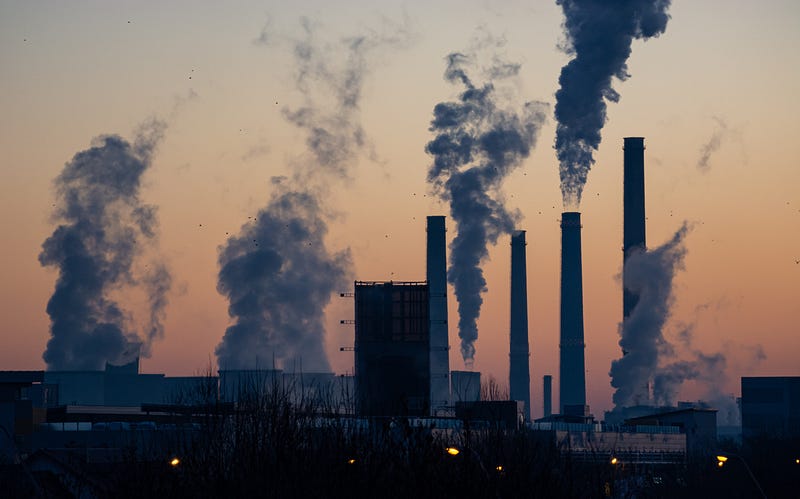
Photo by Ella Ivanescu on Unsplash

The global killer that almost no one is talking about

Back in May of last year, when I wrote the story below about why I left my engineering job in the medical device industry to take on the climate crisis, I said, “the combination of air pollution and climate change-related health effects and mortality is a health crisis that will only become more severe over time, and will threaten to undo the significant medical progress we have made over the past several decades.”

When I wrote that, I referenced a study that estimated that 8.7 million people die prematurely every year due to air pollution from the burning of fossil fuels.

The Guardian came out with an article last month that provided an updated estimate on the global premature deaths due to all forms of pollution — 9 million*. This number is based on the recently published Lancet Commission study that utilized the latest 2019 data from the Global Burden of Disease (GBD) study.

Guess what the estimated global premature deaths from pollution were in 2015?

9 million.

That’s right. In the span of five years from 2015 to 2019, we lost about 45 million people due to pollution. Primarily air pollution.

To put that into perspective, the high-end estimate of the number of deaths during World War I is about 40 million, which occurred within similar timespans.

As reported by The Guardian, “The death toll from pollution dwarfs that from road traffic deaths, HIV/AIDS, malaria and TB combined, or from drug and alcohol misuse. The researchers calculated the economic impact of pollution deaths at $4.6tn (£3.7tn), about $9m a minute.”
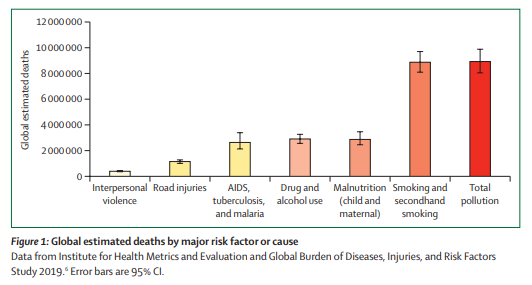
Deaths from pollution are on par with deaths from smoking, and exceed most other major risk factors or causes. Source: Lancet Commission study

9 million deaths a year and $9 million a minute in economic impacts. Those are the real costs of pollution.

But where’s the news coverage? Where’s the public outrage? Where’s the emergency response?

The COVID-19 pandemic has dominated news headlines for the past two years and has killed approximately 6.3 million people globally at the time of this writing. In comparison, how many headlines have you read about pollution-caused deaths this year?

The reason why there’s been such a lack of coverage becomes obvious when you read this statistic in the latest Lancet Commission study: 92% of pollution-related deaths — and the greatest associated economic losses — occur in low-income and middle-income countries (LMICs).

Just as with climate change, pollution hits those who are most disadvantaged in our society the hardest. You can bet that if pollution was killing off billionaires and elites left and right, there would be non-stop coverage and an immediate response.

That said, pollution is still a major issue for higher income countries like the U.S. As the American journalist and author, David Wallace-Wells, recently discussed on a podcast, air pollution causes an estimated 350,000 premature deaths in the U.S. every year (as many people that died of COVID-19 in 2020). And as he also talked about, even if air pollution doesn’t eventually result in premature deaths, it can still have severe negative impacts on cognitive performance, respiratory health, and childhood development. Furthermore, it can contribute to higher rates of ADHD, autism, schizophrenia, and other mental health disorders.

“Every aspect of human performance that you could possibly measure is damaged by air pollution.” — David Wallace-Wells

With pollution clearly such a threat to public health, have we really not made any progress on addressing it?

Well, yes and no.

Although there have been improvements in indoor air quality, drinking water quality, and sanitation that have led to a decrease in traditional pollution-related deaths since 2000, this has been offset by the 66% increase in deaths from modern forms of pollution (e.g., ambient air pollution, chemical pollution). And this increase happened just over the past 20 years.
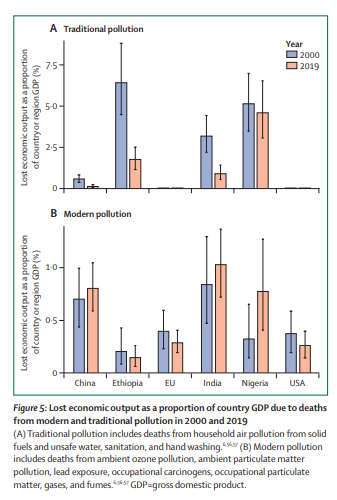
The negative economic impacts from traditional pollution sources are on the decline while negative economic impacts from modern pollution are on the rise in LMICs. Source: Lancet Commission study

If these trends continue, then modern forms of pollution will increasingly represent a larger share of total pollution-related deaths. This is especially true of rapidly developing countries in Africa and elsewhere where the incidence of air pollution-related deaths is much higher resulting from industrialization and infrastructure buildout.

The interconnectedness of pollution and climate change

It is unequivocal at this point that the combustion of fossil fuels are at the heart of our pollution and climate change issues.

The combustion of these fuels results in fine particulate matter (PM 2.5), long-lived greenhouse gases (GHGs), and short-lived climate pollutants (SLCPs). SLCPs such as methane and black carbon have much greater global warming potentials (GWPs) than carbon dioxide, and also contribute significantly to air pollution. For example, methane is a precursor to ground-level ozone, a “major source of premature death”, according to the Lancet Commission study.

Therefore, fossil fuels are a much greater threat than most people realize. But this also means climate actions such as switching to renewables for electricity are much more powerful in terms of their potential impact on society.

By getting off of fossil fuels, we have the ability to mitigate climate change and keep our planet more habitable while saving millions of lives and trillions of dollars in the process.

“Now more than ever we can see the healthier, more just and sustainable world that climate actions can deliver.” — Dr. Aaron Bernstein, Director of the Center for Climate, Health, and the Global Environment at Harvard Chan School

Because of the interconnectedness of air pollution and climate change — and the clear benefits from mitigating them — we must pursue solutions that address both. This is why certain so-called solutions such as carbon capture and storage (CCS) aren’t sufficient.

Not only is CCS not great at capturing carbon (when upstream emissions are factored in), it may actually increase air pollution. Professor Mark Z. Jacobson’s research has shown that CCS is worse from a social cost perspective than not capturing the carbon at all. And it is always better in terms of reducing social cost to utilize renewables to replace fossil fuel capacity rather than utilize renewables to power CCS equipment.

By getting off of fossil fuels, we have the ability to mitigate climate change and keep our planet more habitable while saving millions of lives and trillions of dollars in the process.

Pollution has often been viewed as more of a local or regional issue. But just as with climate change, pollution is a planetary threat that demands a global response. The Lancet Commission study explains why:

“Pollution has typically been viewed as a local issue to be addressed through subnational and national regulation or, occasionally, using regional policy in higher-income countries. Now, however, it is increasingly clear that pollution is a planetary threat, and that its drivers, its dispersion, and its effects on health transcend local boundaries and demand a global response. Global action on all major modern pollutants is needed.”

Air pollution, in particular, can travel vast distances far from the source via global wind currents. As discussed in the study, air pollutants originating in China from industrial activity can travel as far as California. So as wealthier countries continue to outsource more industrial activity overseas, that doesn’t mean they completely outsource the associated pollution as well. All that pollution will come back to harm us, regardless of where we live.

What should a global response to pollution look like?

As discussed earlier, we haven’t made much progress in addressing pollution overall as modern forms of pollution are causing an increasing number of premature deaths along with a host of negative impacts on people’s mental and physical health.

Since the previous Lancet Commission study published in 2017, there has been little action from most countries in the way of policies or prioritization of pollution control measures. Instead, more attention is paid to other risk factors like obesity or tobacco use.

The latest Lancet Commission study made a number of recommendations of what a global response to pollution should look like, which include things like prioritizing pollution prevention both nationally and internationally, and increasing funding for pollution prevention. Adequate pollution monitoring systems are important as well, especially in LMICs where there is still a lack of air quality monitoring stations that can provide reliable real-time feedback.

Pollution needs to be considered in each country’s development strategy. And each country should identify their most critical pollution problems and develop a plan of action to address them. There also needs to be more international coordination on policy efforts to combat pollution just as there has been to combat climate change. I would actually take it a step farther and advocate for an Intergovernmental Panel on Pollution similar to the Intergovernmental Panel on Climate Change (IPCC), or at least making this a major focus within the IPCC’s work since there is such an obvious interconnectedness of these issues**.

Lastly, the study recommends stepping up research efforts on pollution and pollution control with particular focus on LMICs, as well as creating more concrete targets for pollution control in the UN’s Sustainable Development Goals (SDGs).

Pollution control deserves far more attention than it gets. It is cost-effective, has the opportunity to save millions of lives and greatly improve public health, and can provide several co-benefits by also mitigating climate change and biodiversity loss.

I’ll leave you with perhaps the most important key message from the Lancet Commission study:

“We cannot continue to ignore pollution. We are going backwards.”

*If you happen to be wondering why one study estimated 8.7 million deaths from air pollution alone while the other estimated 9 million deaths from pollution from all sources, it’s because the first study used a more robust methodology that was able to directly attribute premature deaths from fine particulate pollution to fossil fuel combustion. In other words, air pollution is an even greater threat than we previously realized, but which also means getting off of fossil fuels will have an even greater positive effect on public health than we previously realized.

**The latest IPCC Sixth Assessment Reports hardly mentioned air pollution and did not focus on its significant health, environmental, and economic impacts that would also benefit from climate mitigation efforts to get off of fossil fuels.

If you enjoyed this story, then you might also like:

To address the crises we face, we all need to work together and contribute our knowledge, ideas, and skills. If you share my vision of building a better future together, then please consider subscribing here to stay connected and be notified when I publish a new story.

Pollution
Public Health
Environment
Climate Change
Policy
Recommended from ReadMedium