avatarSean Youra

Free AI web copilot to create summaries, insights and extended knowledge, download it at here

5848

Abstract

ivelihoods much more difficult, if not deadly, in these countries.</p><p id="ef77">What does this ultimately mean for some of these countries?</p><p id="1f69">Well, in a “business-as-usual scenario” in terms of increasing global emissions, parts of the <a href="https://gizmodo.com/extreme-heat-will-make-parts-of-the-middle-east-and-afr-1774311994">Middle East and Africa could become uninhabitable by 2050</a> due to a combination of increasingly severe droughts, heatwaves, and windblown desert dust. Add to this the coastal cities in places like Bangladesh that will be submerged from future sea level rise, and you begin to realize the scale of the crisis.</p><p id="5f0d">Which leads to the next question posed by Andrew Light.</p><blockquote id="fdfa"><p>“Where do all these people go? Well, you’re going to have to see some shifts in political borders, we’re going to have to see some give and take, we’re going to have to see feats of diplomacy we can’t quite even imagine” — <a href="https://www.pbs.org/video/journey-planet-earth-extreme/">Andrew Light</a>, Director, Center for Global Ethics at George Mason University</p></blockquote><h1 id="7b4a">Current immigration deterrents will not deter climate refugees</h1><p id="bed1">Before we discuss potential solutions to the climate refugee crisis, let’s first discuss what most definitely won’t work.</p><p id="c663">Physical barriers may deter a few hundred or even thousand immigrants, but not millions. It won’t matter how large the country’s border patrol is, how large their wall is, or how many guns they have; desperate people will find a way through guaranteed. <a href="https://www.dailymail.co.uk/news/article-4129784/Underground-tunnels-dug-Mexican-cartels-remain-open.html">If drug cartels can find a way in</a>, so too will climate refugees.</p><p id="fd54">Even Donald Trump’s “super-duper wall” won’t stand a chance against this wave of potential climate refugees. I’ll let John Oliver give you the status of Trump’s border wall with Mexico in the video below, but the short of it is that it’s an abysmal failure thus far and American taxpayers are on the hook for it — <a href="https://time.com/5499391/donald-trump-border-wall-mexico-pay/">not Mexico</a>.</p> <figure id="570b"> <div> <div> <img class="ratio" src="http://placehold.it/16x9"> <iframe class="" src="https://cdn.embedly.com/widgets/media.html?src=https%3A%2F%2Fwww.youtube.com%2Fembed%2F3ZRE6uVMDAo%3Fstart%3D3%26feature%3Doembed%26start%3D3&amp;display_name=YouTube&amp;url=https%3A%2F%2Fwww.youtube.com%2Fwatch%3Fv%3D3ZRE6uVMDAo&amp;image=https%3A%2F%2Fi.ytimg.com%2Fvi%2F3ZRE6uVMDAo%2Fhqdefault.jpg&amp;key=a19fcc184b9711e1b4764040d3dc5c07&amp;type=text%2Fhtml&amp;schema=youtube" allowfullscreen="" frameborder="0" height="480" width="854"> </div> </div> </figure></iframe></div></div></figure><p id="7763">Our existing detention centers for both illegal immigrants and asylum seekers will also be stressed to the brink. As covered in the Netflix docuseries, <a href="https://www.netflix.com/Title/80994107">Immigration Nation</a>, U.S. detention centers are already at, or near, full capacity in many cases, especially as ICE raids and arrests have increased drastically under the Trump administration and <a href="https://theconversation.com/how-ice-enforcement-has-changed-under-the-trump-administration-120322">targeted illegal immigrants with no prior criminal history</a>. They will not be able to house and process millions of climate refugees if it comes to that.</p><blockquote id="e1ae"><p>“We don’t have bed space that can handle, you know, 20,000 families. And that’s a piece where this becomes a really bad idea, because it’s one thing to say ‘This is what we’re gonna do,’ but then if there’s no plan at the national level, it makes it so much more challenging […] we don’t have the resources to manage this long-term.” — <a href="https://www.netflix.com/Title/80994107">“Joe”, Detention Center Officer in El Paso, Texas</a></p></blockquote><p id="528a">For those refugees who are deported back to their home countries that are increasingly becoming uninhabitable, they will face extreme destitution that will lead to many lives lost. Are we willing to live with that morally unconscionable decision?</p><h1 id="9531">What’s the alternative?</h1><p id="0fa1">We in the developed world need to accept a sobering fact: places that are becoming more uninhabitable by the day are largely our fault along with the <a href="https://www.theguardian.com/sustainable-business/2017/jul/10/100-fossil-fuel-companies-investors-responsible-71-global-emissions-cdp-study-climate-change">small handful of companies that produce a majority of global emissions</a>. Therefore, we have a moral obligation to help these people out in any way that we can.</p><p id="c74a">But what <i>can</i> we do to help?</p><p id="2c74">For starters, complex issues like climate change require critical thinking, not simple-minded thinking like building walls around us to protect us from other humans just trying to survive.</p><p id="772b">Perhaps, it’s finally time for the human race to end our bad habits of trying to divide and conquer the world. Instead, what if we exercised a little empathy and <a href="https://readmedium.com/radical-caring-can-save-the-world-7552d7da66fe">radical caring</a> to help those in desperate need?</p><p id="a1a1">One way to help is for developed countries to provide financial aid to developing countries so they can better adapt to climate change and reduce their own emissions, which is one of the stated objectives of the Paris Agreement. Yet, the aid offered so far by developed countries is well under the original goal of providing $100 billion per year to developing countrie

Options

s; in fact, it’s <a href="https://www.theguardian.com/environment/2018/may/03/climate-change-aid-poor-nations-paris-cop21-oxfam">less than a quarter of that goal</a> in terms of direct climate finance. We can, and must, do better than that.</p><p id="5c8c">Providing financial and other forms of aid to developing countries is not only the moral thing to do; it also could provide important co-benefits. As just one example, what if instead of <a href="https://www.macrotrends.net/countries/USA/united-states/military-spending-defense-budget">appropriating hundreds of billions of dollars a year</a> to the U.S. defense budget to fight endless wars against terrorism in the Middle East and elsewhere, we invested that money directly into communities suffering from the effects of climate change so that those people would not have to turn to the Taliban and other militant extremist groups for support?</p><p id="e54a">In fact, some evidence suggests that foreign aid, primarily governance and civil society aid, can serve as <a href="https://www.polisci.pitt.edu/sites/default/files/Foreign%20Aid%20as%20Counterterrorism.pdf">“an effective counterterrorism tool”</a>. And if people feel more secure and stable within their own countries, they probably won’t feel the need to seek refuge elsewhere.</p><p id="588c">However, throwing money at the problem is not the only solution. The transfer of technology, such as solar panels and wind turbines, from developed countries to developing countries will also need to take place. People in developing countries need access to this technology including training on how to manufacture, install, and utilize it so that their local economies can benefit as well.</p><p id="c8ee">That said, foreign aid and technology do have their limitations and may not be enough to subdue the tide of climate refugees from certain regions. In these cases, developed countries need to be willing and able to accept these refugees into their countries.</p><p id="5dab">If we actually want people to come to the U.S. legally by seeking asylum, then asylum laws will need to change. Under our <a href="https://uscode.house.gov/view.xhtml?req=granuleid%3AUSC-prelim-title8-section1101&amp;num=0&amp;edition=prelim">current asylum law</a>, a refugee is defined as someone who cannot or will not return to their native country “because of persecution or a well-founded fear of persecution on account of race, religion, nationality, membership in a particular social group, or political opinion.” Notice how that definition does not include people who face imminent danger due to environmental threats compounded with poverty, terrorism, and political corruption.</p><p id="0def">We also need to make the process for asylum seekers much <a href="https://www.sandiegouniontribune.com/news/immigration/story/2020-08-23/who-gets-asylum-even-before-trump-system-was-riddled-with-bias-and-disparities">easier, fairer, and quicker</a> than it currently is to further encourage this lawful way of immigration so that desperate refugees don’t feel the need to take the risk of crossing the border illegally and end up deported back to their home countries.</p><p id="95b8">In order to tackle the climate crisis effectively on a global scale, we’ll need to consider the solutions mentioned above, but even more importantly, we will need to develop a <a href="https://readmedium.com/the-secret-weapons-in-tackling-the-climate-crisis-vision-and-storytelling-cf79a9ad152a">collective vision</a> for our future that includes national borders and immigration within that vision. What do those look like in a more sustainable and just world?</p><p id="afc3">I encourage you to think about this and to not constrain your imagination to what seems politically feasible. The climate crisis requires us to think systemically, boldly, and profoundly.</p><p id="0a4c">John Lennon understood the power of our imagination when he wrote the song “<a href="https://www.youtube.com/watch?v=YkgkThdzX-8">Imagine</a>.” In it, he asks us to imagine a world without countries; a world “as one.”</p><p id="618a">Can you? It isn’t hard to do.</p><p id="ab95">If you enjoyed this story, then you might also like:</p><div id="2aac" class="link-block"> <a href="https://readmedium.com/radical-caring-can-save-the-world-7552d7da66fe"> <div> <div> <h2>Radical Caring Can Save the World</h2> <div><h3>But a major shift in our mindset is required</h3></div> <div><p>medium.com</p></div> </div> <div> <div style="background-image: url(https://miro.readmedium.com/v2/resize:fit:320/0*SjAK_YOZ1QmjBEkZ)"></div> </div> </div> </a> </div><div id="10e6" class="link-block"> <a href="https://readmedium.com/wheres-the-emergency-response-to-our-global-public-health-crisis-of-pollution-2d29d61b3740"> <div> <div> <h2>Where’s the Emergency Response to Our Global Public Health Crisis of Pollution?</h2> <div><h3>Pollution isn’t just a local problem; it’s a planetary threat</h3></div> <div><p>medium.com</p></div> </div> <div> <div style="background-image: url(https://miro.readmedium.com/v2/resize:fit:320/0*20ChJZs7CCEZeUGq)"></div> </div> </div> </a> </div><p id="2944">To address the crises we face, we all need to work together and contribute our knowledge, ideas, and skills. If you share my vision of building a <b>better future together</b>, then please consider subscribing <a href="https://sean-youra.medium.com/subscribe"><b>here</b></a> to stay connected and be notified when I publish a new story.</p></article></body>

Walls Won’t Work in a Warming World

A physical border can’t keep out millions of climate refugees. But what’s the alternative?
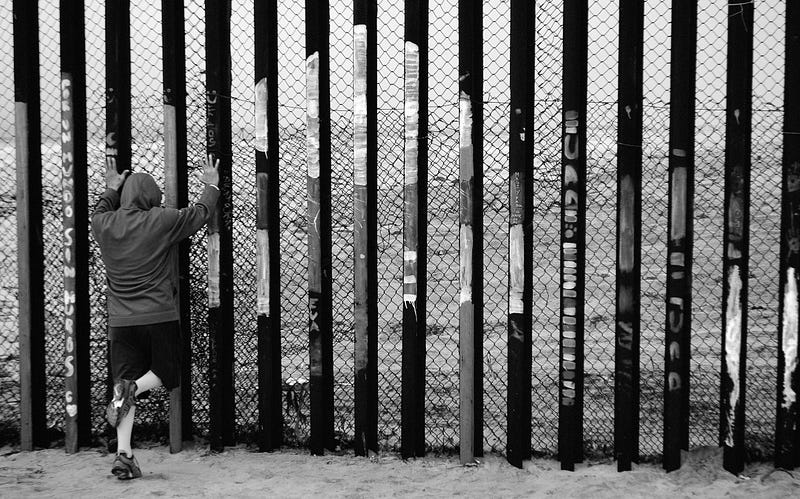
Photo by Max Böhme on Unsplash

“For the poor, boundaries don’t really matter. When they have to survive, they will scale any boundaries. They’ll go over them, through them, or under them, because poverty does not recognize boundaries.” — Venkateswar Ramaswamy, Indian community activist supporting climate refugees from Bangladesh

Climate change — a threat multiplier

Immigration has always been a hot-button issue in America, and will only become hotter in a warming world.

The impacts of climate change are falling disproportionately on those in the Global South (i.e., Africa, Latin America, and regions of the Middle East and Asia) that fall under the umbrella of developing countries. Since they lack the resources and wealth of developed countries, they’re also ill-prepared for these impacts and generally are more vulnerable than those of us in developed countries that can better adapt to a changing climate.

Let’s take a look at a few examples of these impacts and their consequences in developing countries.

In 2001, a severe and prolonged drought in Afghanistan that resulted in no rain for over a year affected over one million people as farmers struggled to grow any crops, especially wheat, a primary crop for them. The Taliban came to the rescue and offered protection to farmers and their families in exchange for poppies (a drought-resistant plant commonly used to make opium; a lucrative business for the Taliban). The Taliban also recruited farmers’ sons to join their forces and thus grew the Taliban’s presence in Afghanistan.

Kenya experienced an even longer prolonged drought of over seven years starting in 2003. A country already suffering from a lack of resources was stripped of its most important resource — fresh water. Neighboring villages desperate for other resources to survive and make a living engaged in cattle raids that killed many herders. The herders that did survive suffered from their own livestock dying from lack of water, so they had to resort to other less lucrative and more risky jobs like cutting down Acacia trees to make charcoal for a dollar a bag, which is illegal in the region.

Bangladesh, a country home to 165 million people, relies on the cultivation of rice to feed its people and contributes to half their agricultural GDP and a sixth of their national income. However, this way of life is in peril due to sea level rise. Climate projections forecast that one meter of sea level rise could submerge 17 percent of the country, and up to 60 percent of the country could be underwater under higher sea level rise projections. Meanwhile, India is building a barbed wire fence along its border with Bangladesh to keep refugees out.

Over in Pakistan, a monsoon season in 2010 exacerbated by climate change led to one-fifth of the country being flooded with towns and crops decimated, leaving 20 million people homeless. The Taliban again took advantage of the situation by providing food and aid to Pakistanis that were affected in the hopes of winning their favor and recruiting them into their forces.

What do all these countries have in common besides being particularly devastated by climate change impacts?

They suffer from political corruption, ineffective government action, population densities that exceed their available resources, extreme poverty, and terrorist activity. Climate change acts as a “threat multiplier” for each of these issues, making livelihoods much more difficult, if not deadly, in these countries.

What does this ultimately mean for some of these countries?

Well, in a “business-as-usual scenario” in terms of increasing global emissions, parts of the Middle East and Africa could become uninhabitable by 2050 due to a combination of increasingly severe droughts, heatwaves, and windblown desert dust. Add to this the coastal cities in places like Bangladesh that will be submerged from future sea level rise, and you begin to realize the scale of the crisis.

Which leads to the next question posed by Andrew Light.

“Where do all these people go? Well, you’re going to have to see some shifts in political borders, we’re going to have to see some give and take, we’re going to have to see feats of diplomacy we can’t quite even imagine” — Andrew Light, Director, Center for Global Ethics at George Mason University

Current immigration deterrents will not deter climate refugees

Before we discuss potential solutions to the climate refugee crisis, let’s first discuss what most definitely won’t work.

Physical barriers may deter a few hundred or even thousand immigrants, but not millions. It won’t matter how large the country’s border patrol is, how large their wall is, or how many guns they have; desperate people will find a way through guaranteed. If drug cartels can find a way in, so too will climate refugees.

Even Donald Trump’s “super-duper wall” won’t stand a chance against this wave of potential climate refugees. I’ll let John Oliver give you the status of Trump’s border wall with Mexico in the video below, but the short of it is that it’s an abysmal failure thus far and American taxpayers are on the hook for it — not Mexico.

Our existing detention centers for both illegal immigrants and asylum seekers will also be stressed to the brink. As covered in the Netflix docuseries, Immigration Nation, U.S. detention centers are already at, or near, full capacity in many cases, especially as ICE raids and arrests have increased drastically under the Trump administration and targeted illegal immigrants with no prior criminal history. They will not be able to house and process millions of climate refugees if it comes to that.

“We don’t have bed space that can handle, you know, 20,000 families. And that’s a piece where this becomes a really bad idea, because it’s one thing to say ‘This is what we’re gonna do,’ but then if there’s no plan at the national level, it makes it so much more challenging […] we don’t have the resources to manage this long-term.” — “Joe”, Detention Center Officer in El Paso, Texas

For those refugees who are deported back to their home countries that are increasingly becoming uninhabitable, they will face extreme destitution that will lead to many lives lost. Are we willing to live with that morally unconscionable decision?

What’s the alternative?

We in the developed world need to accept a sobering fact: places that are becoming more uninhabitable by the day are largely our fault along with the small handful of companies that produce a majority of global emissions. Therefore, we have a moral obligation to help these people out in any way that we can.

But what can we do to help?

For starters, complex issues like climate change require critical thinking, not simple-minded thinking like building walls around us to protect us from other humans just trying to survive.

Perhaps, it’s finally time for the human race to end our bad habits of trying to divide and conquer the world. Instead, what if we exercised a little empathy and radical caring to help those in desperate need?

One way to help is for developed countries to provide financial aid to developing countries so they can better adapt to climate change and reduce their own emissions, which is one of the stated objectives of the Paris Agreement. Yet, the aid offered so far by developed countries is well under the original goal of providing $100 billion per year to developing countries; in fact, it’s less than a quarter of that goal in terms of direct climate finance. We can, and must, do better than that.

Providing financial and other forms of aid to developing countries is not only the moral thing to do; it also could provide important co-benefits. As just one example, what if instead of appropriating hundreds of billions of dollars a year to the U.S. defense budget to fight endless wars against terrorism in the Middle East and elsewhere, we invested that money directly into communities suffering from the effects of climate change so that those people would not have to turn to the Taliban and other militant extremist groups for support?

In fact, some evidence suggests that foreign aid, primarily governance and civil society aid, can serve as “an effective counterterrorism tool”. And if people feel more secure and stable within their own countries, they probably won’t feel the need to seek refuge elsewhere.

However, throwing money at the problem is not the only solution. The transfer of technology, such as solar panels and wind turbines, from developed countries to developing countries will also need to take place. People in developing countries need access to this technology including training on how to manufacture, install, and utilize it so that their local economies can benefit as well.

That said, foreign aid and technology do have their limitations and may not be enough to subdue the tide of climate refugees from certain regions. In these cases, developed countries need to be willing and able to accept these refugees into their countries.

If we actually want people to come to the U.S. legally by seeking asylum, then asylum laws will need to change. Under our current asylum law, a refugee is defined as someone who cannot or will not return to their native country “because of persecution or a well-founded fear of persecution on account of race, religion, nationality, membership in a particular social group, or political opinion.” Notice how that definition does not include people who face imminent danger due to environmental threats compounded with poverty, terrorism, and political corruption.

We also need to make the process for asylum seekers much easier, fairer, and quicker than it currently is to further encourage this lawful way of immigration so that desperate refugees don’t feel the need to take the risk of crossing the border illegally and end up deported back to their home countries.

In order to tackle the climate crisis effectively on a global scale, we’ll need to consider the solutions mentioned above, but even more importantly, we will need to develop a collective vision for our future that includes national borders and immigration within that vision. What do those look like in a more sustainable and just world?

I encourage you to think about this and to not constrain your imagination to what seems politically feasible. The climate crisis requires us to think systemically, boldly, and profoundly.

John Lennon understood the power of our imagination when he wrote the song “Imagine.” In it, he asks us to imagine a world without countries; a world “as one.”

Can you? It isn’t hard to do.

If you enjoyed this story, then you might also like:

To address the crises we face, we all need to work together and contribute our knowledge, ideas, and skills. If you share my vision of building a better future together, then please consider subscribing here to stay connected and be notified when I publish a new story.

Climate Change
Politics
Climate Refugees
Vision
Border Wall
Recommended from ReadMedium