
The Secret Weapons in Tackling the Climate Crisis: Vision and Storytelling
A vision of a sustainable future told through a compelling story is far more powerful than scientific facts and figures
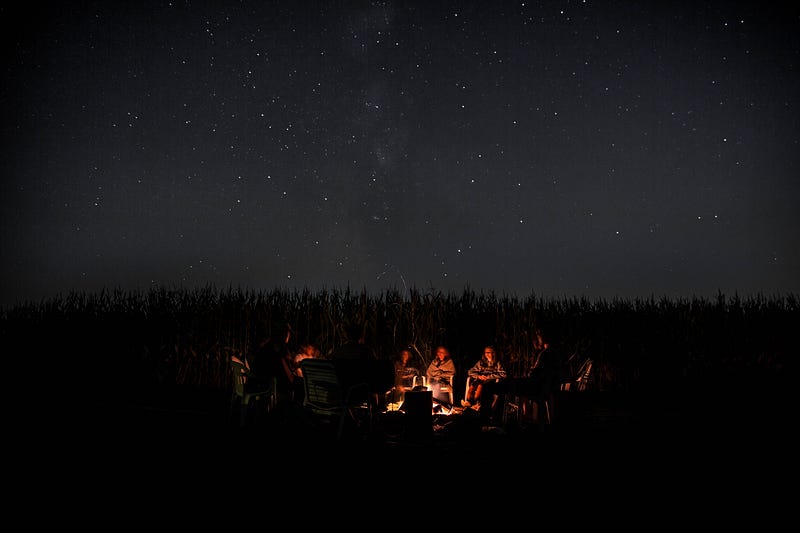
Crafting a vision for the future
Imagine it’s the year 2050 and we’ve successfully been able to hold global warming below the 2°C threshold (and ideally 1.5°C) the Intergovernmental Panel on Climate Change (IPCC) scientists have been warning us about.
What does that future world look like and feel like when you imagine it?
Are we more connected to nature or more connected to technology, or both?
How do we communicate and treat one another?
Do our political and economic systems function the same as they do now, or are they drastically different?
Is there more inequality than exists now or less?
Is it an extractive society that places growth and development above all else, or one that promotes the use of natural resources with care and consideration?
What are the most important values and beliefs that people hold in this future society?
Too often, we discuss the many problems that face us like climate change, as well as the potential solutions, without thinking about what our vision for the future should look like when we’ve successfully addressed the problem, which arguably should be the first step in tackling any problem.
Donella Meadows, the environmental scientist and author of The Limits to Growth, makes the argument for setting out a vision early on in the policy process: “If we have not specified where we want to go, it is hard to set our compass, to muster enthusiasm, or to measure progress.”¹
Laying out a vision for a more sustainable and just world is no easy feat. I made an attempt to do so in the story below that provides a vision for how we can systemically transform our society for the better.
Creating a vision is difficult because it requires challenging our existing mental models and using our imagination to explore beyond the current boundaries of our society. Sci-fi writers are already experts at this and know how to craft that vision into a riveting story, but for the average person it’s a skill that must be learned like any other — and requires continual practice as well. Reading fantasy and sci-fi novels or watching those types of movies with a keen eye for details is actually a great way to foster the ability to create your own unique visions and tell them to others in an eloquent way.
According to Meadows, vision requires both supra-rational and rational thinking¹; thus it requires both sides of our brain to be active (i.e., the left side associated with logic, facts, and reasoning, and the right side associated with imagination, intuition, and creativity).
In order to be effective, a vision for the future should be clear in its values and flexible in its implementation in light of new information¹.
Creating a shared, or collective vision, can be even more powerful, which is one of the primary goals of the Climate Conscious publication. This is critical for influencing change on a large scale, as Jeff Leinaweaver explains below.
“In order to adapt and influence change and direction, we must be able to weave together a collective vision and story of the future that incorporates our own personal storylines of sustainability, as well as the organizational and collective story of what we see sustainability as being and becoming.” —Jeff Leinaweaver, Storytelling for Sustainability: Deepening the Case for Change²
The good news is that an increasing number of experts in their respective fields are realizing the importance of crafting a vision in order to address issues like climate change rather than solely relying on scientific studies or policy research to change human behavior and outcomes.
For example, Kate Raworth, economist and author of Doughnut Economics: Seven Ways to Think Like a 21st Century Economist, offers us a vision in her book of how the field of economics can be transformed to ameliorate social inequities and keep human development within the confines of our ecological boundaries³.
Storytelling with a purpose
Once you have that vision clearly imagined in your mind, the next step is to tell others about it. This is where being a good storyteller comes in handy, but even if you’re not, this too can be learned and perfected.
Think about during political debates when one candidate is spouting off some facts and statistics to prove their point while the other tells a personal story. Which resonates more with us and which are we more likely to remember?
We’re quick to forget facts, but we remember stories, especially emotional ones.
Storytelling is as old as spoken language. We pass down knowledge and ideas through our stories, which have been critical for the development of human civilization. Its power is immense — organized religion would most likely not exist without our ability to tell stories.
But storytelling can serve an even greater purpose when used effectively.
Neurobehavioral research conducted by Paul Zak at UC Berkeley showed that when we watch powerful stories with dramatic arcs like we see in the movies, our brains produce oxytocin which tends to make us more “trustworthy, generous, charitable, and compassionate.” Study participants were shown a fictional film about a boy named Ben who doesn’t have long to live because of his brain tumor, but his father does everything he can to make Ben happy in his final days. Almost all of the study participants donated some of their earnings from the experiment to a charity after watching the film.
Importantly, these stories have to be able to hold our attention and transport us into the fictional world of the story. As also discussed in the study, participants that were shown a different film with a flat structure lacking tension, emotion, and purpose, did not offer much, if any, of their earnings to charities.
Effective stories can not only change our behavior to be more compassionate and caring towards one another, but they can also change our mindsets and persuade us to take alternative actions.
As Leinaweaver says, “People ask for data, but believe stories.”²
When the public is shown graphs of increasing carbon dioxide emissions and then told the only way to avoid catastrophic consequences is to drastically change our lives and society, they may begin to associate climate action and environmentalism with restriction and sacrifice. Misinformation aside, is it any wonder why so much of the population is still resistant to these ideas?
Framing matters. Instead of showing them scary graphs and telling them foreboding facts about the state of our environment, perhaps we should instead be telling them our visions for a more beautiful, sustainable world where we no longer have to worry about emissions and environmental destruction.
However, this shouldn’t downplay the importance of scientific inquiry and reports; the information that climate scientists provide is extremely important for us to understand fully the scale of the crisis and what the ramifications might be of inaction.
That said, climate scientists are excellent technical writers, but not necessarily great storytellers. We need writers, public speakers, artists, and creatively-minded people to fill in that gap.
The power of vision and storytelling may be the secret weapons that help us tackle the climate crisis and other crises we face. Our imaginative storytelling capabilities are a defining characteristic of our species; a characteristic that has evolved over time allowing us to cooperate with one another and achieve feats that would be impossible on our own.
I hope you join me in building a collective vision for the future and sharing that vision with the world.
References:
[1] Meadows, D. (1996). Getting Down to Earth: Practical Applications of Ecological Economics (R. Costanza, O. Segura, & J. Martinez-Alier, Eds.). Island Press.
[2] Leinaweaver, J. (2017). Storytelling for Sustainability: Deepening the Case for Change. Routledge.
[3] Raworth, K. (2017). Doughnut Economics: Seven Ways to Think Like a 21st Century Economist. Chelsea Green Publishing.
If you enjoyed this story, then you might also like:
To address the crises we face, we all need to work together and contribute our knowledge, ideas, and skills. If you share my vision of building a better future together, then please consider subscribing here to stay connected and be notified when I publish a new story.


