
Howl
Where Is Our Nourishing Sex Life?
And why is it so hard to find?


Recently, I sent out an informal survey that I hoped would help me illustrate some of the topics I write about. The core set of questions in the survey asked respondents about their level of satisfaction in their sex lives and romantic partnerships. We all want to be sexually and intimately nourished and we know that physical intimacy is a deep need of the human experience.
And yet, since I’ve been writing on Medium, I’ve been contacted by countless people who are frustrated, angry, sad, lonely, and sometimes just plain starving. So many people are struggling in their relationships.
In some ways, that’s heartening — we are not alone in this! But it also makes me sad for all of us.
Why do so many of us feel stuck in situations that leave us feeling dissatisfied? Why are we failing to find what we want?
These are the questions that I can’t stop asking.
The Survey
Here are a couple important notes about my survey: these are anonymous responses (I have no idea who said what) and the only thing I tracked was gender. Of the four options listed, 60% of respondents identified as male, 40% as female. I asked for gender identification out of my own curiosity — I was interested to see if any themes would emerge based on this data. Interestingly, the responses from both men and women were eerily similar.
In matters of love and sex, what is your greatest challenge right now?
The multiple choice options for this question were: Getting over heartbreak, sexual frustration, sexual dysfunction (you or your partner), lack of intimacy, being single when you don’t want to be, and overcoming sexual trauma.
As you can see, my answer options aren’t exactly the product of someone who knows how to facilitate a genuine research study. Some of these options bleed into others, I admit. But they are all issues I’ve wanted to explore and seemed like a good place to start.
I assumed the most common answers would be “being single when I don’t want to be,” and “sexual frustration.” But no, I was wrong. Tied for the top two answers were “sexual dysfunction” and “lack of intimacy.” Many people also wrote in answers that included: aging, being on meds that destroy your libido, difficulty finding a partner, and difficulty in finding time for sex.
What do you need most that you aren’t getting?
The answer options for this question were: Love, loving touch, sexual fulfillment/release, emotional intimacy, trust, acceptance, attention.
Again, I know, a lot of these bleed into one another, but these are all themes I’ve heard from readers who have reached out to me and I wanted to include them all.
Ultimately, I expected emotional intimacy or love to be the most common answers, based on what I’d heard from readers. And again, I was wrong. See for yourself:
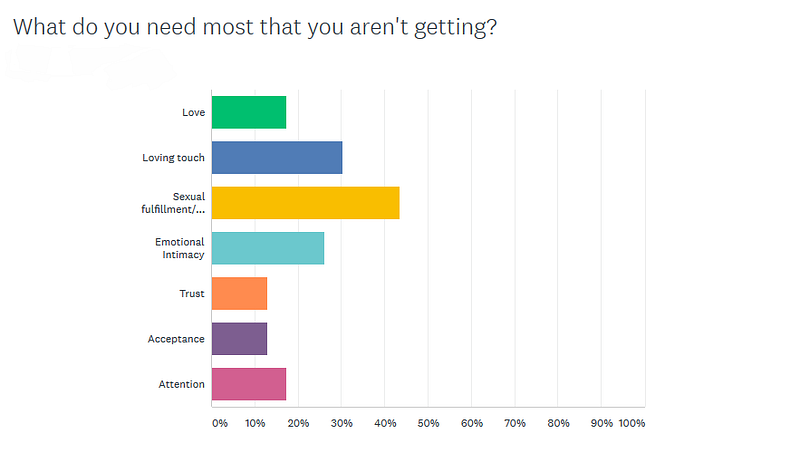
Yes, sexual fulfillment/release was the most common answer. By far. Then loving touch, then emotional intimacy. Love, surprisingly, ended up in a tie with attention.
Again, I looked to the comments to help me contextualize these surprising findings. One respondent said they wanted more slow sex and foreplay. Someone else referenced the importance of a spiritual connection in the bedroom. Stress and lack of time were named as obstacles to intimacy.
How does this (not getting what you need) make you feel?
The answers to this question hit me right in the heart. They are all too familiar to me — and to all of us, it seems. Here’s a sampling of write-in answers:
- Ugly
- Like a failure
- Unwanted
- Frustrated, sometimes hopeless or sad
- Anxious
- Angry
- A little out here, alone
- Sad and alone
- Depressed. Anxious. Like a crazy person.
- Small, invisible
- Empty
- Like a wasted resource
These answers repeated themselves again and again and again. Alone. Sad. Frustrated. Alone. Alone. Alone.
Are your attitudes and/or behaviors about this issue making the problem worse?
I’m always curious to know what’s going on inside us when we hit these walls. I know, for example, that I brought crushing romantic expectations into my last relationship that no partner should ever have to try to meet. That definitely didn’t help with a commitment-phobic partner.
Interestingly, almost everyone said no — their attitudes and behaviors were not contributing to the problem in the relationship. A few people said they weren’t sure. One brave respondent said:
Absolutely. I shut myself down, all while knowing my partner (and previous partners) don’t judge me anywhere as harshly as I judge myself.
What have you done to improve your relationship and overcome this challenge and do you think it’s working?
This is an important part of the process for me. It drives me insane how many people I know who complain endlessly about their relationship but in the end, they admit they will never do anything about it. There’s no time or money for therapy, they say, or their partner is never going to change, or divorce is too much of a hassle, or it’s easier to just get what you need on the side…
I have seen so many people go through the motions for years — decades. Why do we do that? I’m still shocked that I stayed for so long in a relationship that often made me so unhappy.
So what are we doing to get what we claim we want?
- Therapy…, reading, meditation... It isn’t working...
- Nothing
- Found an alternate partner for release
- Offered her another man, has worked yes
- Showing myself some compassion and forgiveness
- Leaving. Not really. [Isn’t working.]
- Talked about it and tried to plan for longer time together. Helped but still not there yet.
- I think there’s an element missing and I’m not sure it can be ‘brought out’
- Romancing — not working
- Going to therapy, it is helping
- Therapy, self-work... Not quite working yet.
- Communication with my partner. Who then complains I’m just complaining.
- …bought a few clothing items that are form fitting. Communicated the desire to have “tiny intimacies” but she thinks I am in charge of that.
- Talk. Cry. Hug.
This was another emotional one for me. So many people are trying so hard. And I even have such compassion for those who have given up trying. Either way, relationships can be so challenging.
I do believe that when we change, the relationships we’re in change — or break. But so many times, we want a particular kind of change and that, we cannot make happen. We can’t make our partner into something they aren’t. And that can feel so hopeless.
If things don’t improve, whose fault is it, in your perspective?
I can’t help but be intrigued by this idea. I have seen so many people blame their partners for what’s not working in the relationship. “He doesn’t even try,” she says. “She doesn’t love me or understand me,” he says. I hear that so often from my hetero friends.
Yet once again, I was surprised by the answers that came in. Almost everyone took on the responsibility for where their relationship was at.
- I do need to say more, despite self-consciousness
- Both — communication is the issue
- I don’t think it’s anyone’s fault. Sometimes we’re just not compatible in all areas and you either accept and stay or realize you can’t live without and move on.
- Fault is a word I’m trying not to use too often. I do believe I’m on the right course. If things appear not to be improving, then I probably haven’t gone far enough yet…
- I take full responsibility.
I loved these responses and it made me feel hopeful for us all. Yes, a few people blamed their partners. Or (jokingly, I assume) the universe or society. (Actually, that last one is fair.) But to see so many people taking responsibility for themselves and placing accountability on both themselves and their partners was very refreshing.
Where is our nourishing, fulfilling sex?
I’m sorry to say that even after reading through the responses to this survey, I’m still not entirely sure why we are struggling to find sexual fulfillment.
I suspect, honestly, that some of it is purely our mindset. I think even the most woke of us are deeply affected by our culture’s messages around sexuality — not just the shame we tend to associate with it but the romanticization of it. I think often we expect uninhibited, ecstatic union to be not just easily achievable but also regularly available. And when we’re talking about two or more humans trying to create something so intimate together…well, it’s never that easy, that available, or that simple.
Oddly, what I find most comforting is how common this longing is. We might not be quite getting what we want…but so many of us want it. With that goal in common, I have great hope for us all.
This article was written for Howl by Yael Wolfe, a weekly column. © Yael Wolfe 2019

More nourishment from Howl by Yael Wolfe:


