
When You’re More Assertive, Everyone Is Better Off
It’s key to better relationships and self-esteem.

When I was about eight years old, I got into a dispute with my teacher. I don’t remember what it was about, but I remember coming home to my grandma’s place for lunch, and handing her the yellow, trouble-indicating letter I got.
Eight-year-old me was extremely nervous and expected some life-changing consequences, like being grounded for a whole week.
Instead, my grandma slit the envelope, read through the paper inside, sat me down, and asked for my side of the story. Then, she told me something I’ll never forget.
“Never be afraid to state your opinion — as long as it’s well-thought-out and you do so in a polite and considerate way.”
I stuck with the advice.
It’s this assertiveness that has served me well. It’s why I get what I want from life. Yes, I turned some people off in the process, but they weren’t conducive to my life anyway.
Assertiveness is the ability to communicate in neither a passive nor aggressive, but self-assured way. To put it simple: The ability to stand up for yourself and your own interests without being a jerk.
It’s crucial for getting what you want and creating your dream life. Think about where you could be in a month or even a year from now if you just had the guts to ask and go for what you want instead of worrying about pleasing others.
Look at it this way: Would you rather have your interests clash with someone else’s, or disappoint and betray yourself?
It can be hard, I know. Standing up for yourself feels like the right thing to do until you face resistance. People get “offended” or cry about how you “hurt their feelings” as if this was a valid, factual argument. They complain you let them down and find all sorts of reasons why they’re right and you’re wrong.
When that happens, you start to question yourself. You’re afraid you might come across as a jerk. And when the pressure gets too big, you give in and act according to their interests, against your own better judgment.
The result? You feel like you betrayed yourself and have to deal with all the shitty consequences of not being assertive. You end up in places you don’t want to be, doing things you don’t want to do.
Common wisdom says you have to soft-pedal and cut your demands so you don’t act like an entitled jerk and upset people around you.
Well, what if I told you assertiveness and standing up for yourself is the only way to make life better for you and everyone around you?
Being Assertive Is a Win-Win Situation
Most people aren’t assertive because they want to please others. They’re afraid they might ruin a relationship or friendship if they speak up for themselves.
Let me tell you something. If your relationship with someone can’t stand open and honest communication and authenticity, it’s doomed. Period.
“Once you have a major success with assertiveness, you learn that it’s a much healthier path than being a doormat to the insensitive folks. You gain respect for yourself, have more time for your priorities, and develop authentic and healthier relationships.”
― Doreen Virtue
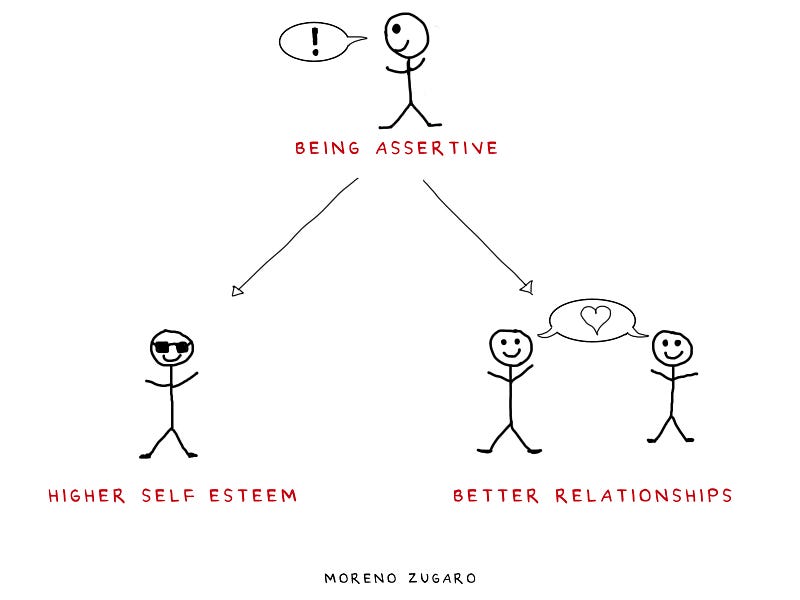
When you’re assertive, you and everyone else around you is better off for two reasons.
- Being assertive is key to better relationships Any relationship has to be well-balanced. If your needs and wants aren’t met, the relationship is one-sided, and therefore doomed. If an employee says yes to everything and never addresses issues, he’ll soon be stressed out, unproductive, and feel unvalued. This inevitably leads to lower performance and job satisfaction. If you’re afraid to communicate boundaries like time for yourself to your spouse or she’s afraid to tell you that you never do the dishes, you’ll build resentment towards each other. Instead of talking things out, you’ll both swallow your anger until you either grow bitter over time or can’t hold it anymore and explode like a volcano. If you always let your friend convince you to do things you actually don’t want to, your friendship deteriorates. It becomes one-sided and you two grow apart. In all these cases, both parties are worse off because one is not being assertive. You not being assertive = no bueno for both.
- Being assertive is key to healthy self-esteem Most people think healthy self-esteem is a requirement for assertiveness. It is, but it’s a two-way street. Yes, healthy self-esteem makes it easier to be assertive, but at the same time, being assertive begets confidence. Just like smiling can make you more happy, standing up for yourself makes you more confident. Feeling a certain way causes you to act, and acting a certain way causes you to feel. Being assertive results in higher self-esteem. And it’s this self-esteem that enables you to lift other people up, build something, and contribute and give back to the world. Again, everyone is better off because you’re assertive.
Being assertive serves you as well as the ones around you.
What Assertiveness Is — and What It’s Not
Let me be very clear here. Assertiveness isn’t blaming others, forcing your own will upon them, or thinking your interests are worth more than somebody else’s. That’s being bossy, arrogant, or egotistic.
Instead, being assertive is
- Asking for what you want in a polite and respectful, but clear way.
- Respecting other people’s yes or no as much as you respect your own right to ask.
- Expressing your opinions, emotions, needs, and wants.
- Knowing what you don’t want, where your boundaries are, and enforcing them.
- A willingness to say no and disappoint people.
Being assertive is being authentic and honest with yourself and the people around you. To do that, you first have to understand a few things. Write them on your bathroom mirror or something, because this stuff is important.
To be more assertive, you first have to know what you want. You have to become clear about your values, who you are, your boundaries, and your opinions.
You have to understand your needs are as important as anyone else’s — and the other way around. You’re both human beings. Equal rights and all that stuff.
Yes, you will clash with others — which is exactly why you have to do it. Nobody is going to stand up for you, so you have to do it yourself.
Assertiveness isn’t only an attitude or character trait. It’s a way of living that enables you to become the best version of your true self and create the life you want to live.
Stand up for Yourself
“If you do not respect your own wishes, no one else will. You will simply attract people who disrespect you as much as you do.” ― Vironika Tugaleva
There is nothing wrong with being assertive. People are thrown off by it because they are used to walking all over you. They act offended so you cut back on your needs and give way to theirs.
Always remember you have every right to ask for what you want, enforce your boundaries, and say no. You and your needs aren’t worth less.
Being assertive isn’t a guarantee for getting what you want. But if you don’t stand up for yourself, nobody will.
My guess is you often hold back your assertiveness because you’re afraid you might sound like a jerk. Here’s an easy and proven 3-step formula to be assertive, but polite.
Get The Authentic Man 5–3–1 Newsletter
5 minutes to read. 3 ideas, quotes, and questions to help you become a more Authentic Man. 1 biweekly challenge to get you closer to your dream life. Become the best version of your true self in under 5 minutes!


